What is the accounting and finance module in JAI CRM?
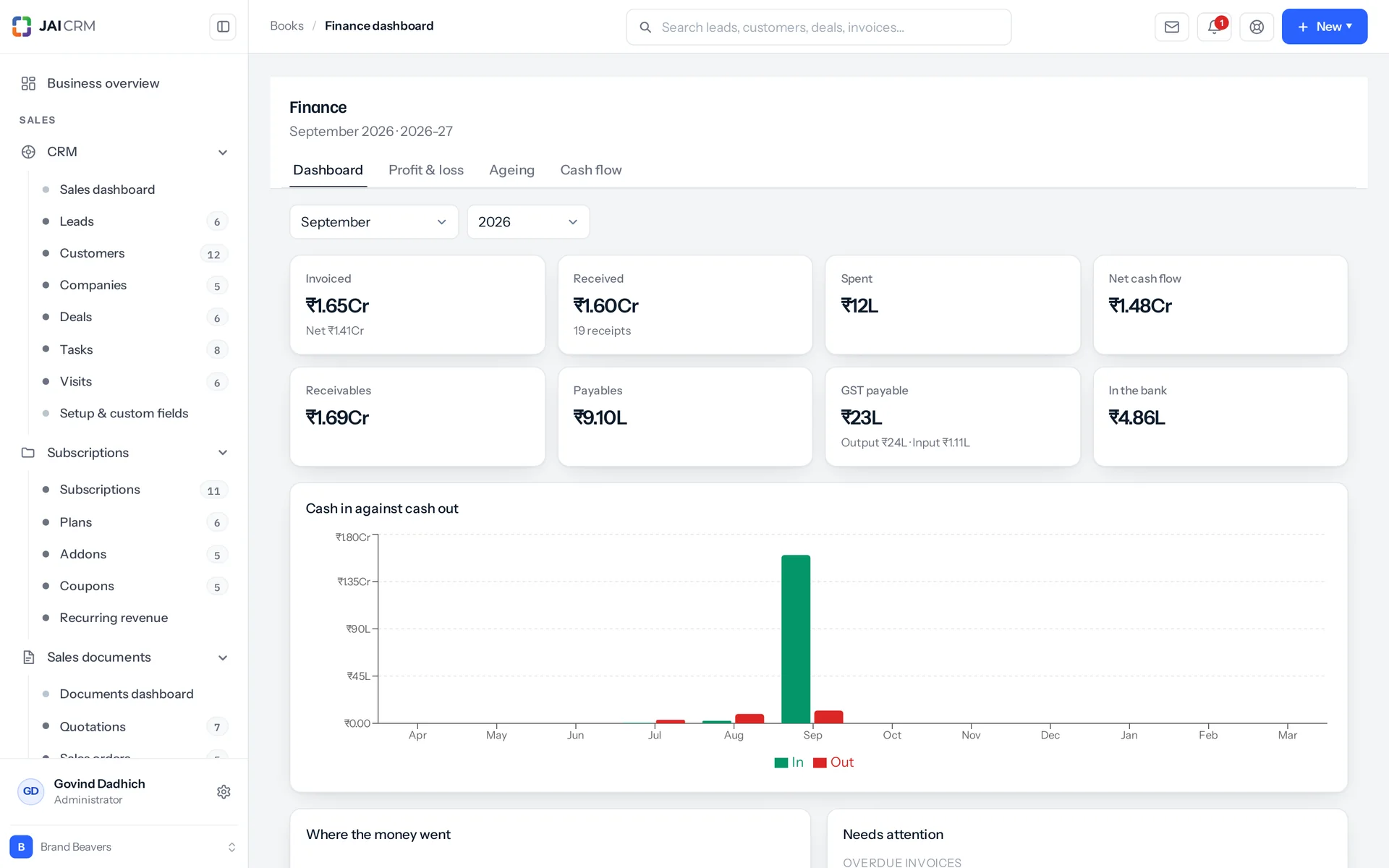
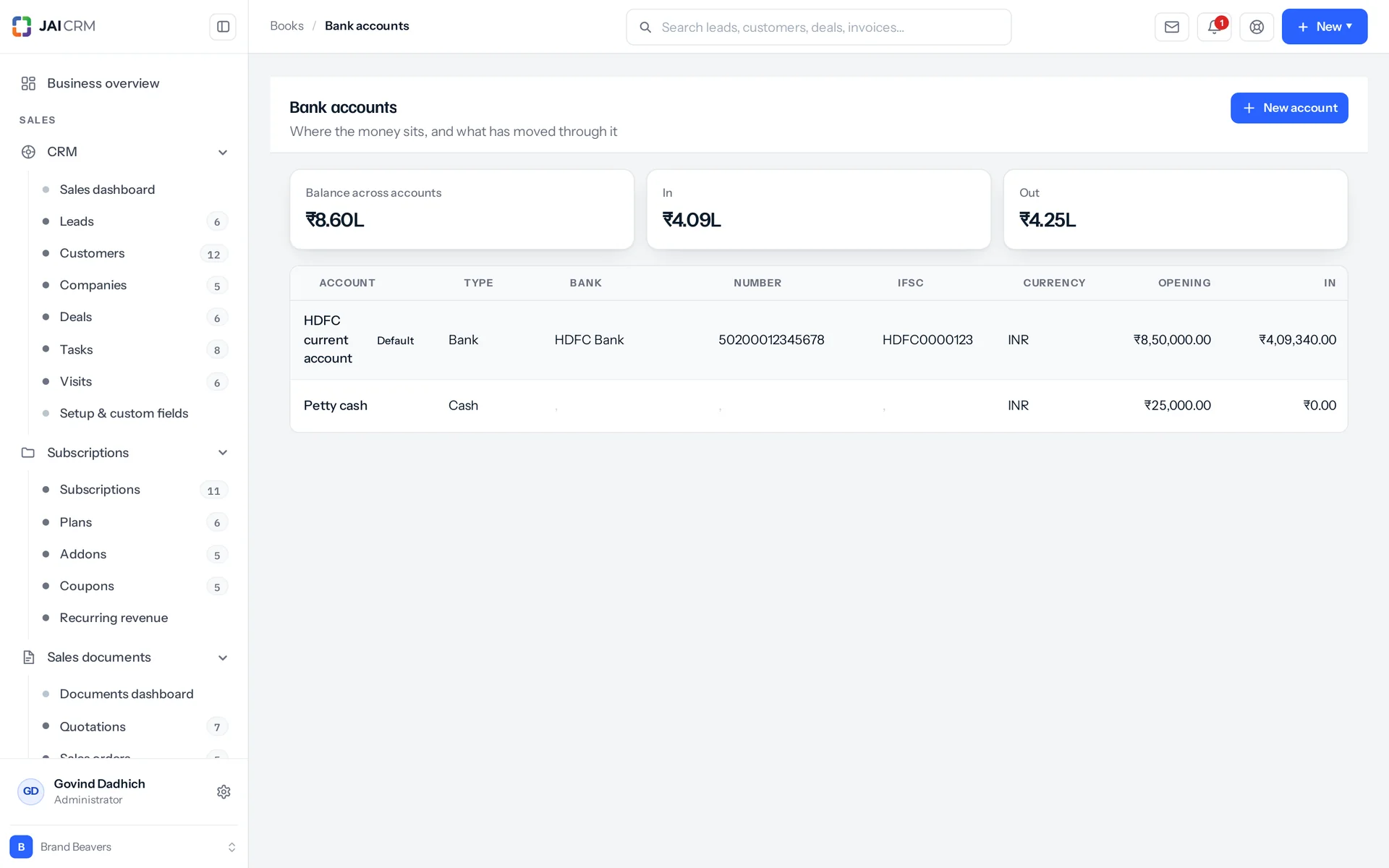
It is the accounting software inside JAI CRM. It handles expenses, supplier bills, banking, GST, TDS and payroll for Indian businesses of five to two hundred people. It builds GSTR-1 and GSTR-3B from the invoices you already raised. It keeps a TDS register that follows your bills, and runs payroll with PF and ESIC. Reports such as profit and loss and ageing are worked out from your documents when you open them.
How much does JAI CRM accounting software cost?
₹149 per user per month, billed annually, or ₹199 per user month to month. The full suite of seventeen modules is ₹499 per user per month on annual billing, or ₹599 month to month. The invoices, bills, vendors and projects behind your numbers are in the same product, so there is no sync to pay for. A module you do not use does not appear in your menu at all.
Who is this accounting software for?
Indian businesses of five to two hundred people. Often one person there raises the invoices, enters the bills, chases what is owed and puts the GST return together. It also suits the owner who checks GST before the 20th, a CA who needs access without seeing salaries, a services firm whose clients deduct TDS from its invoices, and a trading business with sixty supplier bills a month.
Does JAI CRM accounting software replace my CA?
No, and it is not trying to. It replaces the shoebox of papers you hand your CA, which is usually where their fee goes. What changes is what they get: a GSTR-1 already split into its seven sections, a 3B already laid out as the portal's tables, a TDS register that matches the bills it came from, and a chart of accounts and journals they can work in. You can also give them a login that reaches GST, TDS and the books without reaching payroll or anyone's salary.
Does it file my GST return on the GST portal?
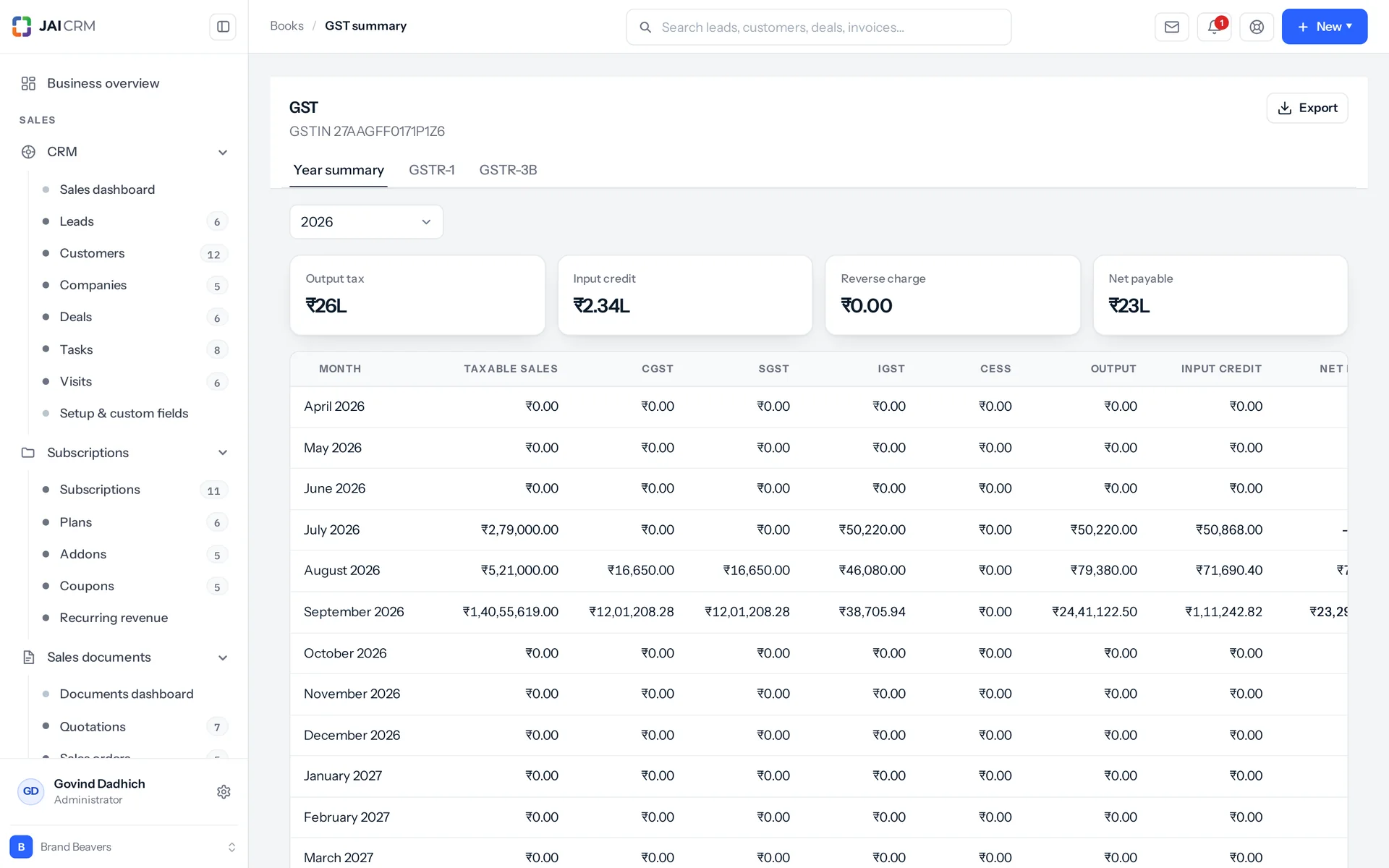
No. We would rather say that plainly than suggest an integration we do not have. It builds GSTR-1 section by section and GSTR-3B as the portal's own tables. It works out output tax against input credit and what is net payable, and exports a twelve-month position as CSV. You or your CA file it. Then you record what happened: the return type, the period, the status (draft, filed or acknowledged) and the ARN the portal gave back. This is kept with the computed return as it stood at the time.
Can I enter some purchases as quick expenses and others as supplier bills?
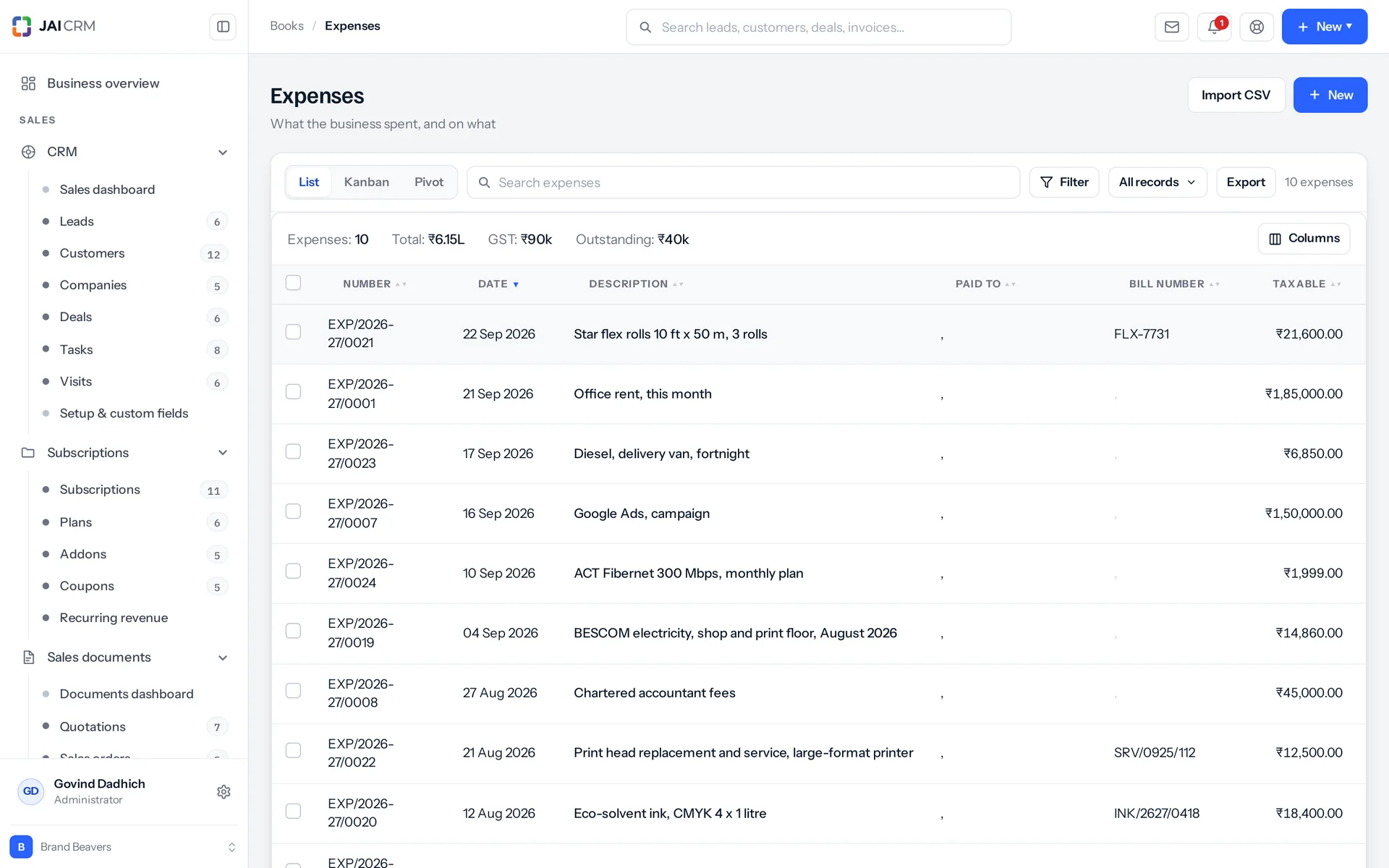
Yes, and nothing breaks. That is the normal case, and it is the case most software handles badly. One function reads both registers and gives back one result. The GST return, the profit and loss, payables ageing, cash flow and the dashboard all go through it. This mattered enough to be written into the source as a note. Before, a business that recorded its purchases properly, as bills, saw no cost in its profit and loss, no input credit in its GST, and nothing in its payables.
Does it handle GST composition, exports and reverse charge?
Yes, all three are normal here. A bill of supply is a real document type. It is for exempt, nil-rated or composition turnover: a supply like any other that simply carries no GST. It is declared in 3B table 3.1(c) and in the HSN summary, and never counted as taxable turnover. Leaving it out used to mean a composition dealer's whole turnover was missing from the return. Exports and SEZ supplies carry an LUT flag and report as zero-rated in 3.1(b). Reverse charge is split properly: the liability comes from every reverse-charge purchase, the credit only from the ones you can claim. CMP-08 (the composition dealer's return) is a supported return type, due on the 18th of the month after the quarter closes.
Can I give my accountant access without showing them salaries?
Yes. The Accountant role ships without payroll and employee data. An accountant who files GST has no business reading everyone's CTC. The reason is written into the source next to the two permissions it leaves out, because an earlier preset granted them by accident through one module-wide line. Finance has eight permissions that each gate a route: expenses, purchase bills, bank accounts, GST summary, TDS register, employees, payroll and financial reports. So you grant exactly the ones you mean. The preset also carries the financial reports, the trial balance and ledgers, and transaction locking, so an accountant can read the books and close a period without anyone adding them.
Where are the trial balance and the chart of accounts?
In Accountant, which switches on on top of this module. That is where entries no document ever produced go: depreciation, accruals, opening balances and corrections. It has a 56-account Indian chart of accounts written for a small business here: 18 asset, 13 liability, 4 equity, 5 income and 16 expense accounts. 39 of them are the accounts the automatic postings look up. It also has manual and recurring journals, budgets compared with posted journals, fixed assets, the trial balance and the balance sheet. They are separate because most businesses need GST and payroll from day one. They need a trial balance the first time they face a bank, an auditor or an investor, which is not the same day.
Does JAI CRM payroll file PF and ESIC returns?
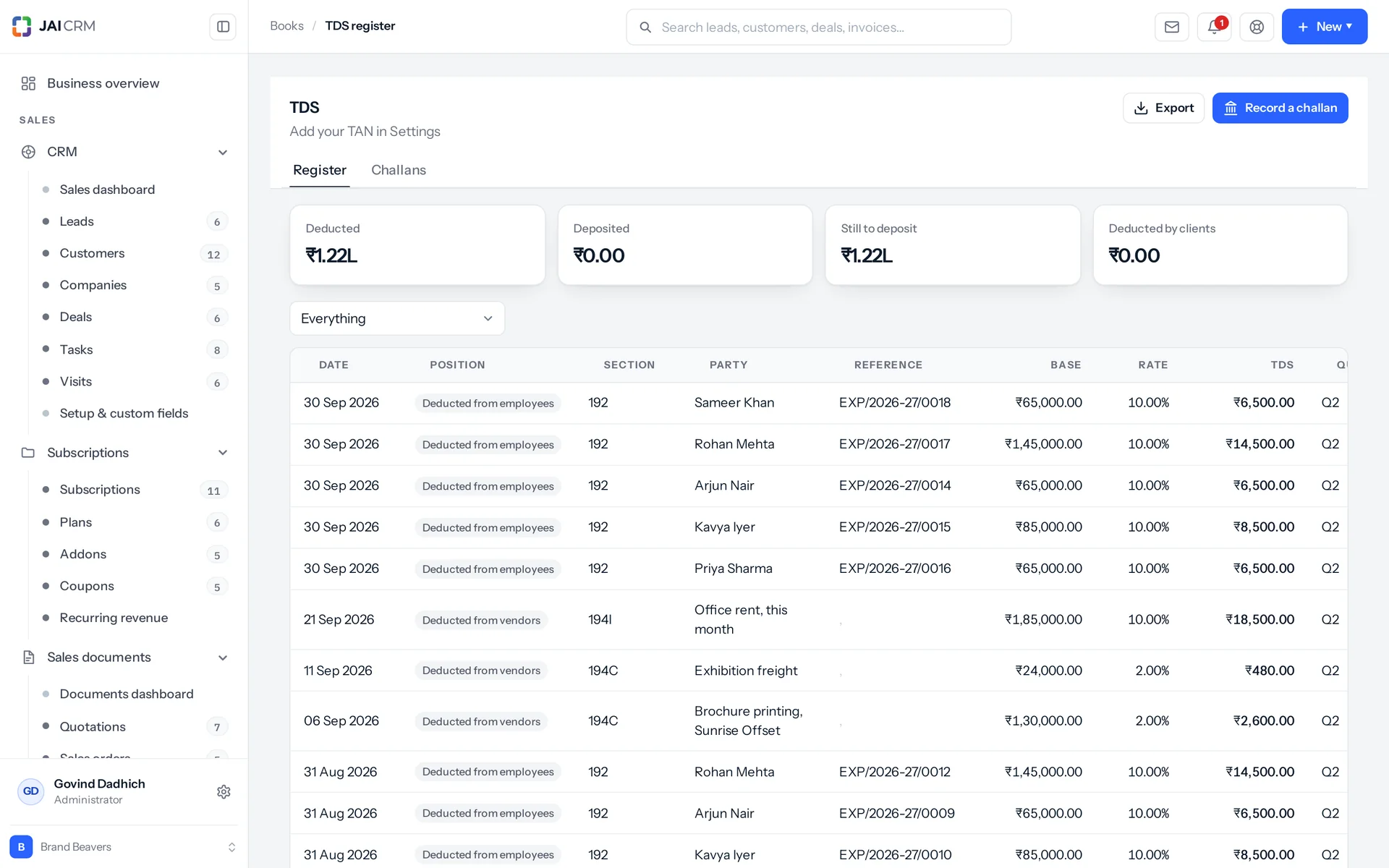
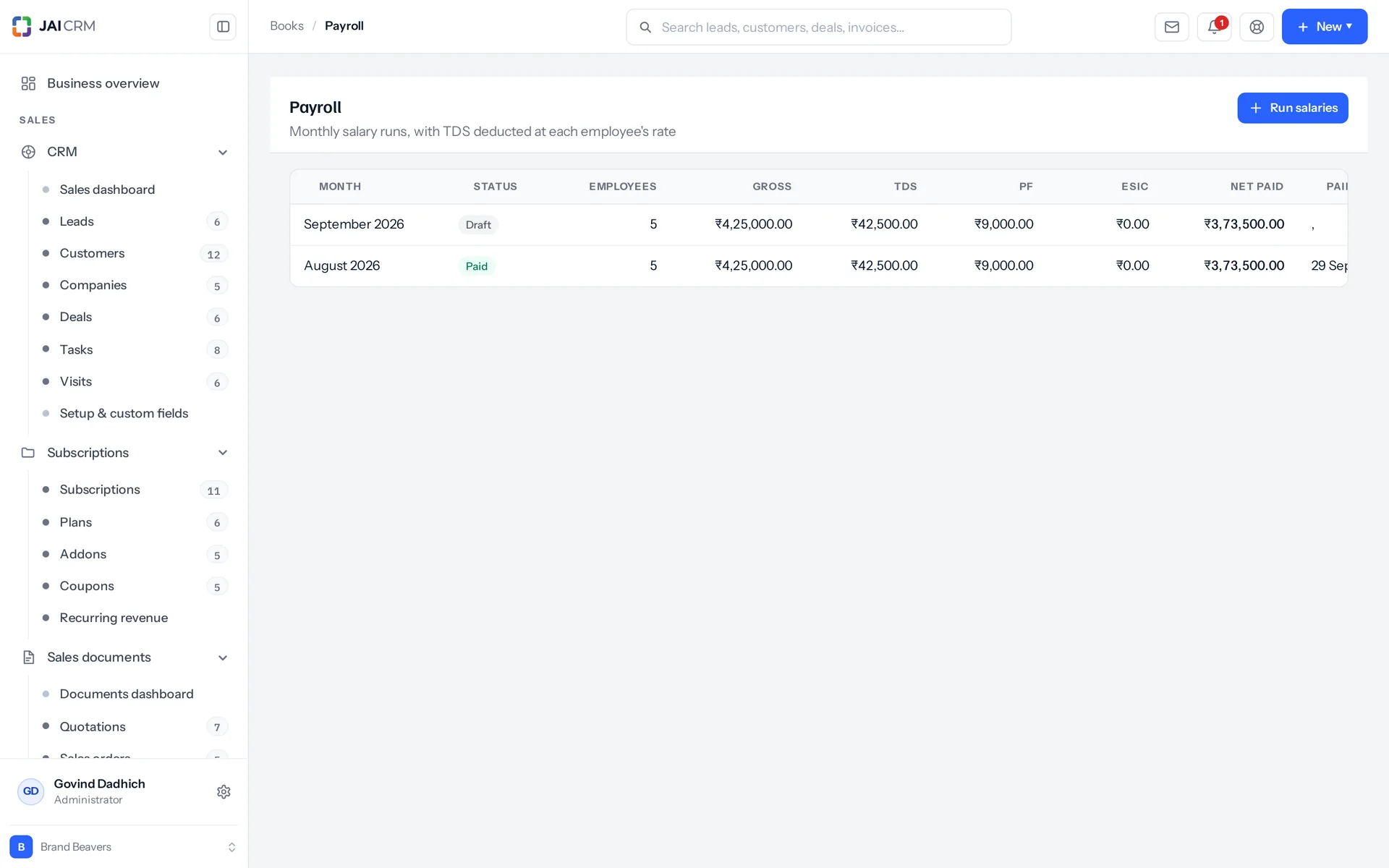
No. It works out PF and ESIC, deducts them on the run and totals them on it. PF is 12% of basic, capped at the 15,000 wage ceiling. ESIC is 0.75% of gross where gross is 21,000 or less. Provident fund payable, ESI payable and Professional tax payable come as accounts in the chart, under Salaries payable. The ECR (the PF return) and the ESIC return are still filed on their own portals. Section 192 TDS is different. The run writes a real register entry against each employee, so the quarterly picture is built, not pieced together later.
Can I lock a month so the books stop changing after I file a return?
Yes, with transaction locking in Accountant. A lock has a date, a reason and an area: Sales, Purchases, Banking, Accountant or Everything. Anything in that area dated on or before the date cannot be added, edited, cancelled or deleted. Instead you see why: "Everything is closed up to 2026-03-31 (FY closed and filed). Invoice INV/2025-26/0412 is dated 2026-03-28, on or before that, so it cannot be added, changed or removed. Move the lock date in Accountant, Transaction locking if that period really has to reopen." A payment dated after the lock can still settle an older invoice. Reopening is a deliberate step by someone who has the permission, and it is audited.
Can I export my accounting data to Excel or CSV?
Yes, everywhere, and at the size a real year of trading has. Expenses and bills export with 18 columns and up to 50,000 rows. The export follows your filters, the search box and your visibility scope, not just the 200-row page in front of you. The TDS register and the payments list export 20,000 rows. Employees, the GST summary, ageing, profit and loss and the bank statement all export too. Every file is written with a byte-order mark so Excel shows the rupee symbol instead of a question mark.
Which financial year does it use, and is Q1 April to June?
April to March by default. You set it once on the business profile, along with your GSTIN, PAN, TAN and state code. You can change the start month if yours is different. On the entries the books create themselves (payroll, vendor bills and challans), the quarter is worked out from that start month. So Q1 is the first quarter of your financial year, not of the calendar. Years are written the way people write them, 2025-26. Document numbers follow the Indian style and restart each financial year: EXP/2025-26/0042 for an expense, BILL for a purchase bill, JV for a journal.