What is subscription billing in JAI CRM?
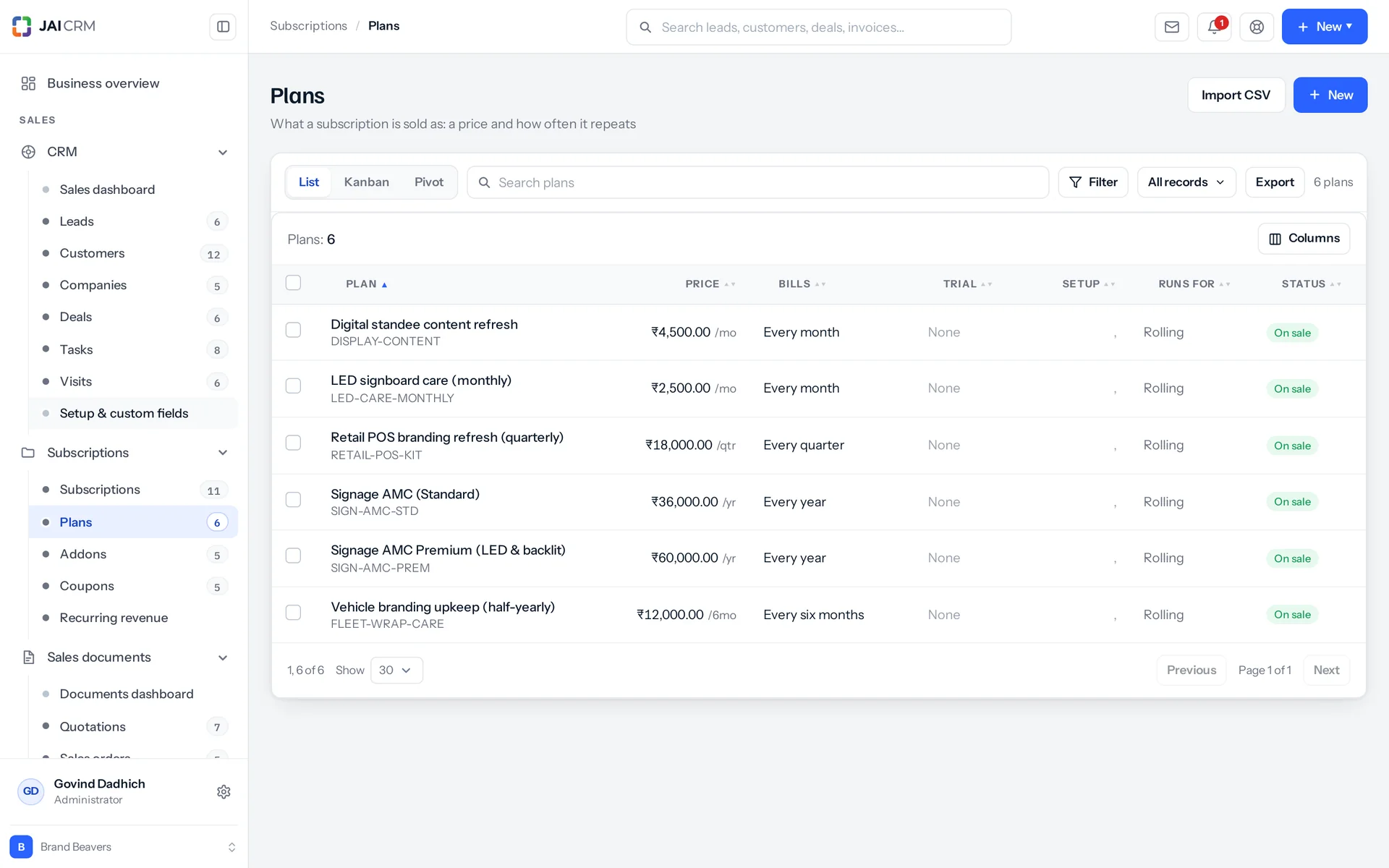
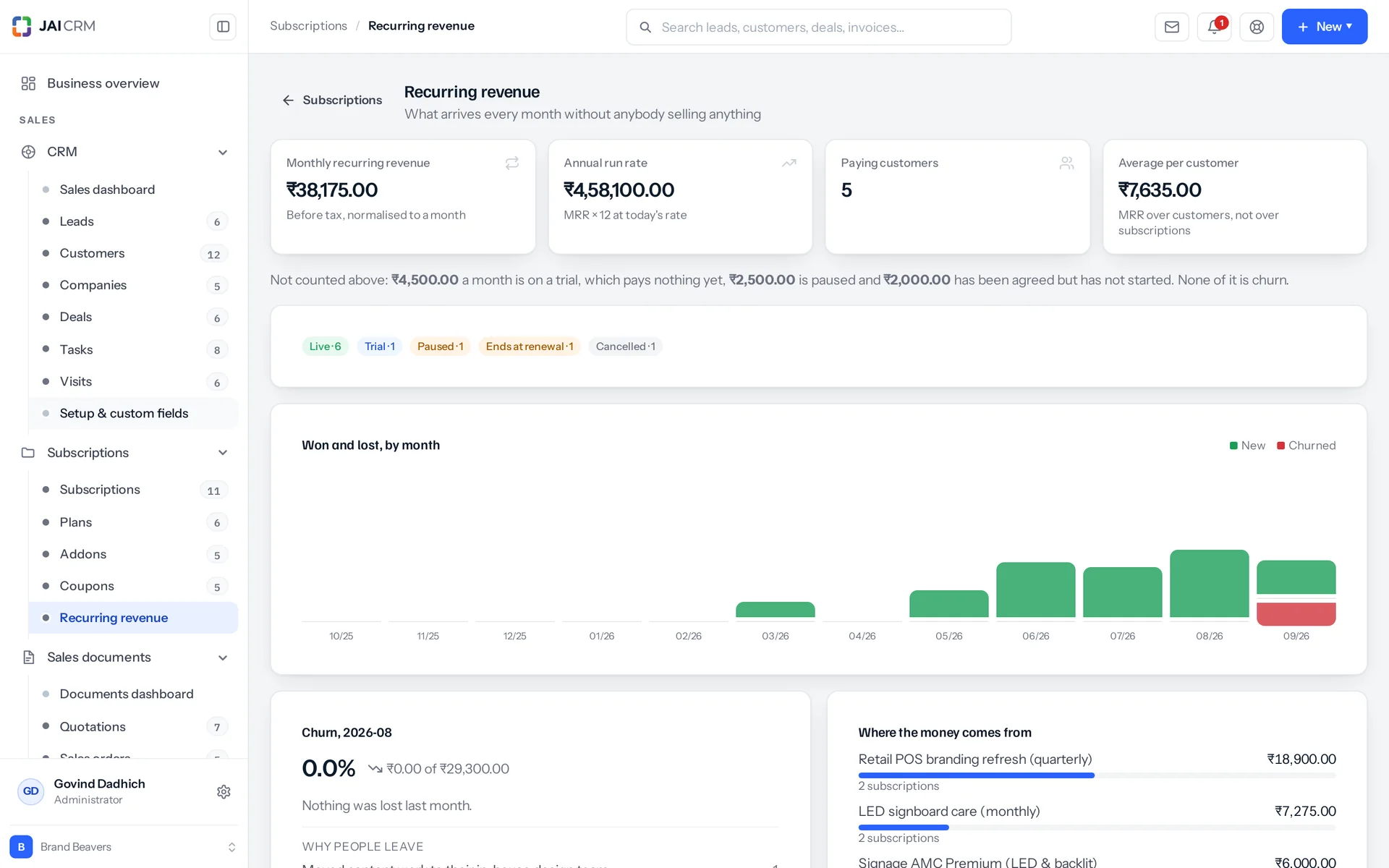
It is the Subscriptions module, for billing anything that repeats, like an AMC, a membership, a retainer or a delivery round. You set up plans, addons and coupons once. A job runs every night and raises each renewal as a normal GST invoice in your own number series. It also handles trials, part-month charges, pause and resume, and shows MRR and churn in rupees.
Who is JAI CRM subscription billing for?
It is for businesses that bill the same customers again and again. Examples are the AMC desk at a machinery, lift or HVAC company, a gym, club or coaching centre, an agency on retainers, hosting and managed IT firms, and delivery rounds for water, milk, tiffin or laundry. If what you sell is paid for once, you do not need this module at all.
How much does the JAI CRM Subscriptions module cost?
It starts from ₹149 per user per month. Renewal invoices are normal GST invoices in your own number series and on your own template. So there is no second billing tool to reconcile with your books at the end of each month.
Can one customer have more than one subscription?
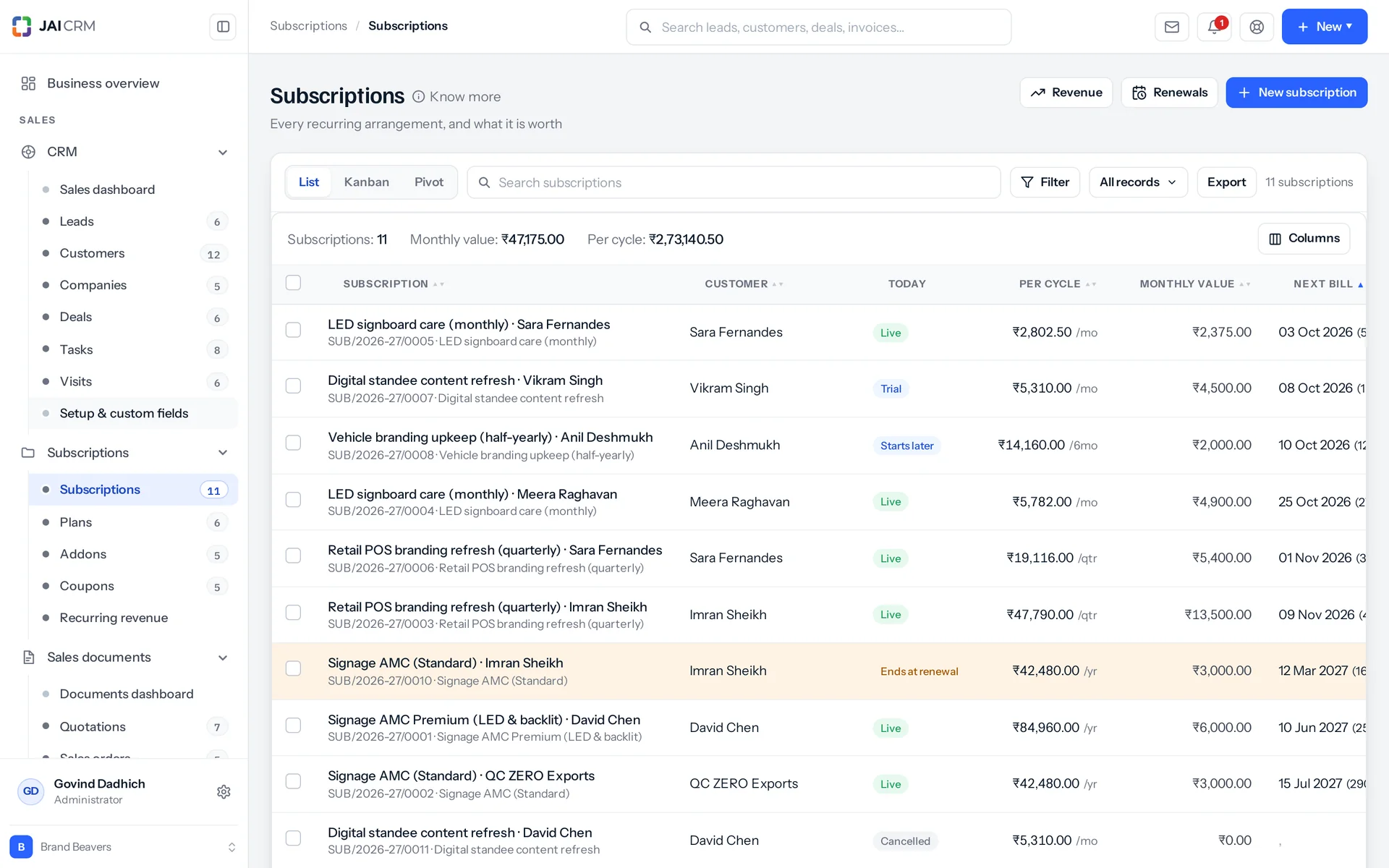
Yes, as many as you like, on different plans and different cycles. Their record gets a Subscriptions tab, with live ones above and finished ones below, counted. It adds them all into one monthly figure. That is the number an account manager gets asked for, and would otherwise work out by hand before every call. The tab is on the customer record. A lead does not get one, because nothing has been sold to them yet.
Can I charge a customer a different price from the plan?
Yes, just type it. The plan is only a starting point. The price on the subscription is what gets billed, and it is copied onto that subscription's own lines, not read back from the catalogue. Editing the plan next year does not touch them, and by default renewals keep the price that was agreed. A price of zero, such as a pilot, a free tier or a goodwill month, stays zero. It is not treated as "not set" and replaced with the list price.
Can I import my existing subscriptions?
Yes. Send the real start date and the term is worked out for each one: when the current term ends and when it next bills. Without these, the renewal has nothing to read and the subscription silently never bills. The import handles weekly, monthly and yearly cycles. For other cycles, and anything backdated, use the wizard. It steps forward through the calendar from the start date to find the cycle today falls in, and asks whether that cycle should be billed. Either way, future renewals line up with the original date, not the day you migrated.
Can a coupon and a negotiated discount apply together?
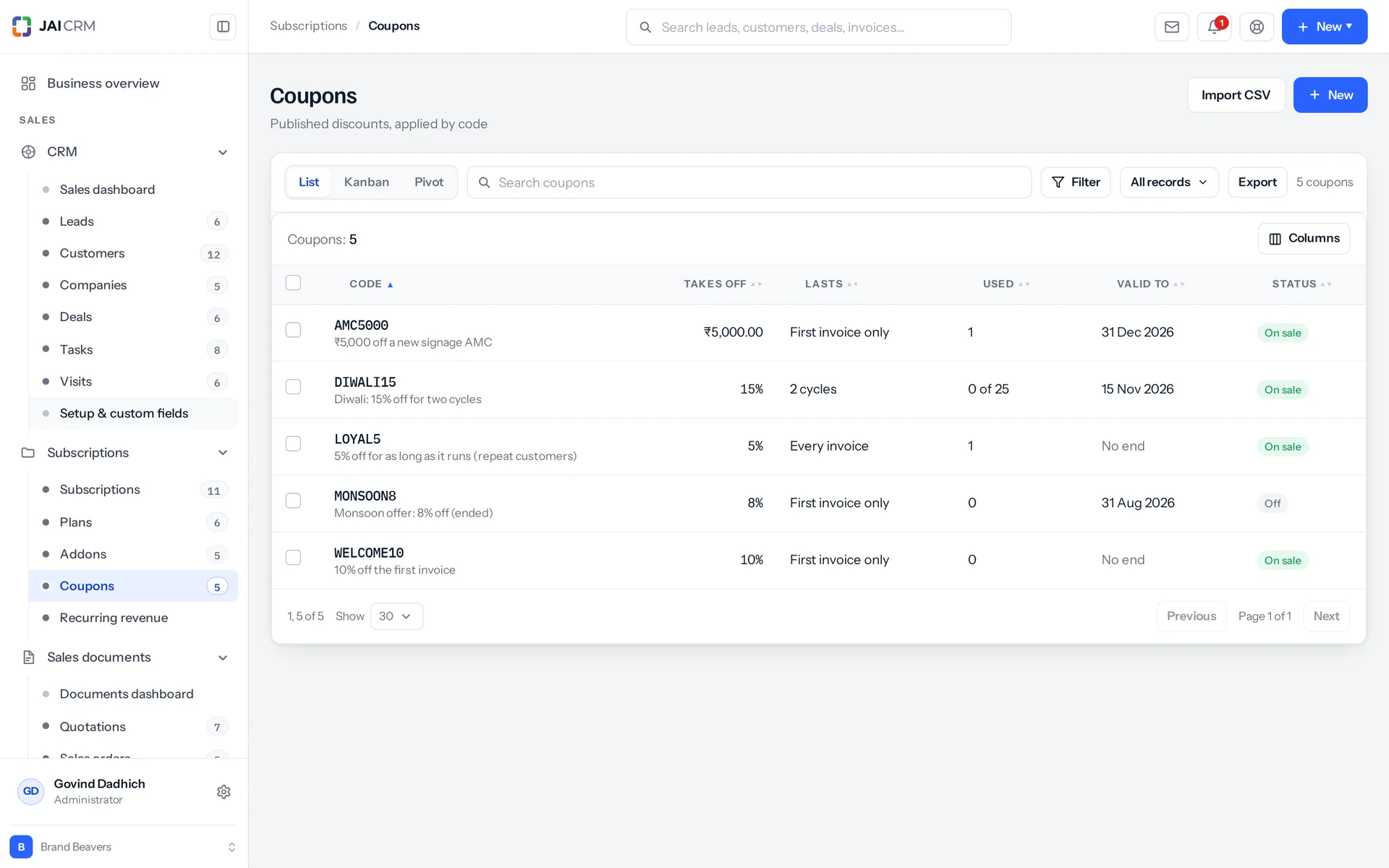
No, and this is blocked in three separate places. A coupon is published and the same for everyone. A discount is what this one customer agreed. Fifty per cent off fifty per cent would bill nothing at all. If both somehow reach the calculation anyway, the negotiated discount wins over the coupon, instead of both being taken. A coupon can be refused for five plain reasons: switched off, not started yet, expired, used as many times as allowed, or not valid for this plan.
What happens when a subscription invoice goes unpaid?
The subscription is marked past due, but only if it has a payment term, because past due is counted from the invoice's due date. The default term is on receipt. Set a term, and after a grace period you choose (seven days by default, anywhere from none to 120) the subscription is marked past due, on its record and in the register. It keeps billing, because an unpaid invoice alone is not a reason to stop delivering, unless you decide it is. It still counts in your recurring revenue, because the money is owed and the service is still going out. Recording the payment clears it, but only after checking that nothing is still owing.
Can I bill a customer for a year in advance?
Yes. Bill now raises up to 24 cycles in one go. Each cycle it raises moves the next billing date forward, so the night job has nothing left to bill for the terms you already collected. Separately, you can have every renewal invoice raised a few days early. Set this per frequency for the whole workspace, or give one subscription its own figure. That includes zero, for a customer who asked not to be billed in advance.
I just need the same invoice every month. Is this overkill?
Probably, and the suite has a simpler tool for that. A recurring invoice profile raises a saved invoice again on a schedule, with an end date or a maximum count. It suits a retainer, rent or maintenance contract, and it can be paused and resumed. It does not do trials, upgrades, proration, coupons or renewal pricing. It gives no recurring revenue figures, because a schedule is not a subscription. Use it where it fits, and keep subscriptions for arrangements that change over their life.
How do I record one payment that covers three invoices?
Record it against the subscription and it is applied to the oldest invoice first. That is what a customer sending one transfer for three invoices means, and what every accountant does by hand anyway. Anything left over stays on the customer as money on account. It is not forced onto an invoice that does not owe it. The payment can add to a bank account balance at the same time. It clears past due only once nothing is still outstanding.
Can someone change subscriptions without being able to create new ones?
Yes. Pricing a change needs edit permission, and pricing a new subscription needs create permission. These are separate. So a role that can adjust what an existing customer is on cannot open a new subscription. Subscriptions has seven permission areas in all: the subscriptions themselves, plans, addons, coupons, products, the revenue report and the workspace preferences.
Does a subscription invoice look different to the customer?
No, it looks like your normal invoice. It uses the same template, number series and letterhead, and the same GST rate and HSN the plan was set up with. The only difference is a line in the notes. It names the subscription and the period it covers, from start date to end date, because an invoice number alone does not tell a customer which month they are paying for.