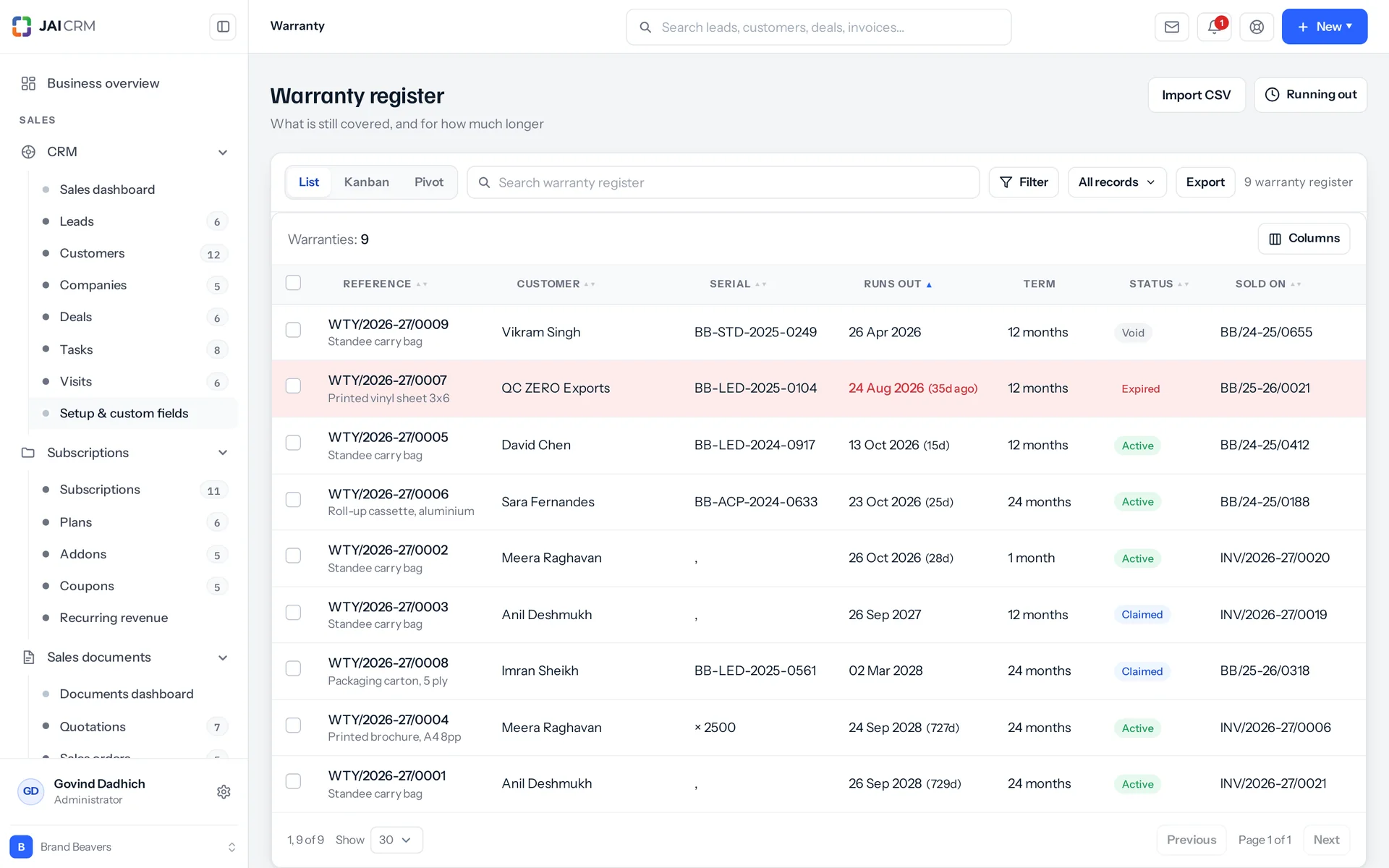
What is warranty management software in JAI CRM?
It is a warranty register that fills itself in from your invoices. You put a warranty period on a product once: a number and a unit, such as 18 months. Sending a GST invoice then creates a warranty for that product, dated from the invoice, with the end date worked out for you. A Running out list and two alerts tell you whose cover is about to end.
Who is the Warranty module for?
Any business that sells goods with a warranty attached and wants to know, quickly, whether a customer is still covered. That includes dealers whose products carry different terms, the person who answers customer calls, and whoever sells annual maintenance contracts when cover runs out. It is a register and an expiry list, not a claims or repair system.
How much does warranty management in JAI CRM cost?
Warranty starts from ₹149 per user per month. You also need the Inventory module switched on, because the warranty period lives on the product in Inventory. Warranty cannot be turned on without it.
What about everything I sold before I started using it?
Those sales have no warranty record. The register starts from the day you put a warranty period on the product, so anything invoiced before that is not in it. You can add older ones by hand on the register's own form. They still cannot be entered wrongly: the end date is worked out from the start date and the term when you save, so nobody can save a warranty that ends before it begins.
Does the serial number get filled in automatically?
No, and it is worth saying plainly. The invoice creates the warranty and fills in the product, the customer, the dates and the term. You type the serial yourself. Once it is there, it is a full part of the record. The register has a column for it, the search box reads it as one of four fields, and it shows on the expiry card and the customer's tab. It also prints on the seven-day email to the customer. If the individual unit matters, typing that one box at the sale is all the work there is.
Which invoices create a warranty?
A GST invoice, when it moves from draft to sent on the invoice itself. Three things do not create one: a bill of supply, an invoice sent for you by a recurring schedule, and an invoice raised by the subscription biller. If you bill on a cycle and the goods carry cover, add those warranties on the register by hand. The end date is still worked out for you, so they cannot contradict themselves.
If I sell three machines on one invoice, do I get three warranty rows?
No. One invoice line creates one warranty with the line's quantity. So three presses become one row with a quantity of three and one end date. They were sold on the same day under the same term, so the dates match. If you need them separate, for example a different serial on each, or one claimed while the others carry on, add the extra rows on the register and type each serial on its own.
Can I extend a warranty?
Yes. Change the term or the start date on the warranty record and the end date follows, because it is worked out, not stored. Extending by agreement is a real need, so both stay editable. The product's own warranty period does not move. The register keeps what was promised at the moment of that sale, even if you change the item later.
Is this a warranty claims system?
No, and this is the limit to know before you pay. Claimed is just a standing somebody sets on a warranty. There is no claim record, no RMA number (return authorisation number), no repair job and no cost tracking behind it. What you get is the register and the expiry list, which is the part most businesses are actually missing. It is not a claims desk.
Is a warranty the same as a subscription or AMC?
No. They are deliberately separate modules. Nobody buys a warranty, it has no price, it never renews and it includes no visits. The only thing it shares with a subscription is that it ends on a date, and that is not enough to make them one thing. An extended warranty that you sell is different. That is a subscription, and it belongs in the Subscriptions module.
Do I need Inventory as well, or can I buy Warranty on its own?
You need Inventory. A warranty is a promise about goods, and the warranty period lives on the item, so there is nowhere else for it to sit. Turning Warranty on without Inventory is refused with the message: Warranty needs inventory switched on first. And Inventory cannot be turned off while Warranty is still running.
What if an invoice is withdrawn and sent again?
Nothing is duplicated. Before writing each row, the system checks for a warranty already recorded against that invoice and that product, and skips it if one exists. A warranty is created once per invoice, however many times the invoice is sent.
What does the customer actually receive?
One email, seven days before cover ends. It names the product, the serial if the row has one, and the date cover runs out. That is all, and it is worth saying plainly. There is no customer portal view of warranties, and there is no printable warranty certificate in the product today. The print permission exists, but there is no template behind it yet.
Can I try the warranty register with sample data first?
Yes. A sample-data script adds three pieces of equipment: a digital press, a guillotine cutter and a laminator. Each is named Sample and has an HSN code (the product classification code used for GST) and a GST rate. It also adds four warranties, one for each state the screens show: years left, weeks left, just ended and long ended. Each of the four rows carries the note Sample data, safe to delete, so you can find and remove them in one go. Running the script twice does no harm.
Can I stop some people from opening the warranty register?
Yes. There is one permission, the warranty register, with seven actions: view, create, edit, delete, export, import and print. Every route checks it before reading anything, including both custom reports. So marking a colleague on a warranty they are not allowed to open gives them nothing at all.
What happens if I delete a warranty or a customer?
Deleting a warranty takes two steps. The first is refused with a note to check what depends on it. The second runs a dependency check before anything is removed. Deleting a customer is different, and worth knowing about: the database deletes their warranties along with them. So removing a customer removes their part of the register too.