

Write four things on the back of a visiting card: who they are, what they need, when they might buy, and the next step you promised. Do it within a minute of the conversation ending. A 10-second voice note does the same job faster, and keeps their exact words.
In short
- Who
- Their role and their business, beyond what the card already prints
- Need
- The problem in their words, with a number if they gave one
- Timing
- When they decide, and what the decision waits on
- Next step
- What you promised, and by which day
- When
- Within a minute of them walking away, before the next visitor
- Faster
- Say the same four parts in a 10-second voice note
Why do you remember the card but forget the conversation?
A visiting card keeps the name, the number and the company. It keeps nothing of what was said. After a full day at a stall, twenty conversations about price, lead time and samples merge into one by the next morning.
The details that fade first are the ones a follow-up needs most: the quantity they mentioned, the supplier they complained about, the month they gave.
There is a second reason. In many Indian businesses the owner meets visitors at the stall, and a sales executive makes the calls the following week. For that executive, your note is the whole handover.
A visiting card tells you who someone is. Only your note tells you why they matter.
What are the four parts of a good visiting card note?
Every useful note answers four questions: who, need, timing and next step. Keep them in the same order every time, so the note is quick to write, quick to say and quick to read back on a Monday morning.
| Part | The question it answers | Example |
|---|---|---|
| Who | What do they do, how big is it, and do they decide? | Purchase head, two tablet units in Baddi |
| Need | What problem did they describe, in their words? | Blister foil supplier late three times this year |
| Timing | When will they decide, and on what? | Trial order if samples pass, decides by 15 November |
| Next step | What did you promise, and by when? | Samples of 25 micron foil and a quote by Thursday |
Who: what the card does not already say
Skip the name, the number and the designation, because the card has them. Write what the card leaves out: what the business makes or sells, how big it is, and whether this person decides or only advises.
- “Owner, three retail pharmacies in Pune, buys direct”
- “Plant engineer, auto components unit in Chakan, recommends but does not sign”
The second example saves a wasted call. Your next step there is an introduction to the person who signs.
Need: their problem, in their own words
Write the problem, not your product. “Interested in pouches” tells you nothing. “Print on their pouches fades in two months” tells you what to say first. Keep every number they gave, because numbers make the follow-up precise.
- “Needs 5-ply corrugated boxes, about 20,000 a month; current boxes crush in the monsoon”
- “Pays ₹2.10 a pouch before GST, wants better print at the same price”
Timing: when they decide, and what it depends on
Timing tells you whether to ring tomorrow or next quarter. If they did not say, ask before they leave: “When are you deciding?”
- “Budget for the new line opens in April, with the new financial year”
- “Trial order this month if our samples pass their QC”
- “Just looking this year”, which is a real answer and stops anyone chasing a cold lead as if it were hot
Next step: what you promised, and by when
Write what you said you would do, with a day. Visitors remember promises made at a stall, and a promised quote that never arrives does more harm than no promise.
- “Send samples of three sizes by Thursday”
- “Our engineer to visit their Bhiwandi godown next week”
A full note, written and spoken
Written on the back of the card: Purch. head, 2 tablet units Baddi. Foil supplier late 3x this yr. Trial if samples pass, decides by 15 Nov. Samples 25 mic + quote by Thu.
Said as a voice note: Purchase head, two tablet units in Baddi. Foil supplier late three times this year. Trial order if our samples pass, decides by 15 November. Promised samples of 25 micron foil and a quote by Thursday.
Spoken, that note takes about ten to fifteen seconds. Written, it takes longer and pushes you into abbreviations.
Two extras earn their place. Add hot, warm or cold if your team grades leads at the stall (see grading exhibition leads). And add one detail that helps you recognise the person, such as “also from Rajkot”, but never a remark about how someone looks. Write every note as if the person might one day read it. For what India’s data protection law expects when you keep details about people, see visiting cards and the DPDP Act.
Should you write the note or say it?
Both work. The better method is the one you will actually use between two visitors.
| What matters | Writing on the card | A 10-second voice note |
|---|---|---|
| Speed | Slower, and the hurry pushes you into abbreviations | As fast as you can speak |
| Detail kept | What fits on the back, in shorthand | Their exact words, numbers and tone |
| Noise | A loud hall makes no difference | Needs a quieter corner, facing away from the aisle |
| Who hears it | Nobody | Anyone standing near you |
| Reading it later | Only if the handwriting is clear | Easy if your app writes notes out as text; otherwise you listen again |
Speak when you can step aside; write when the next visitor is already at the table. The one choice that never works is neither: trusting yourself to remember in the evening.
How to say a good voice note
- Wait until they have walked away. Describing someone within earshot is awkward for both of you.
- Skip what the card prints. A name costs seconds, and spoken names are easy to mishear when a note is written out.
- Say numbers slowly and in full: “twenty-five micron”, “twenty thousand a month”, “fifteenth November”.
- Speak the way you speak. English with Hindi in it is fine. The facts matter more than the grammar.
How to write a good note on the card
- Write on the back, never across the printed front, so the card still scans cleanly.
- Use four short lines, one per part, and circle H, W or C for the grade.
- Avoid private shorthand. “f/u int. pr” means something tonight and nothing to a colleague on Monday.
What does a good note look like next to a useless one?
Here are seven pairs from different trades. The useless notes show three common habits: a feeling, a grade with no reason, and a reminder with no content.
| Trade | Useless note | Useful note |
|---|---|---|
| Pharma retail | Nice guy, interested | Owns 3 retail pharmacies in Pune. Unhappy with his distributor’s fill rate. Wants a demo next week. Promised: call Monday to fix the day. |
| Pharma manufacturing | Big pharma co., send catalogue | QA head, injectables plant, Hyderabad. Needs 2 ml and 5 ml glass vials. Audits new vendors first, in January. Promised: our audit documents by Friday. |
| Packaging | Wants pouches, call | Owner, namkeen brand, Indore. Laminated pouches, 50,000 a month in 3 sizes, ₹2.10 each before GST; print fades in 2 months. Samples before the Diwali stock. Promised: quote by Wednesday. |
| Textiles | Surat, rate? | Buyer, saree wholesaler, Surat. 60 GSM georgette, 12 shades, 5,000 metres a shade. Buys for the season in January. Promised: shade card and rate per metre. |
| Engineering | Machine enquiry, HOT | Maintenance head, auto components plant, Chakan. Two CNC spindles failed last year, about ₹4,80,000 in repairs. Maintenance contract quote before the budget closes on 31 March. Promised: engineer’s visit, week of 16 November. |
| Distribution | Distributor, maybe | Distributor in Nagpur, about 600 retailers, no paints line yet. Wants margins and credit days. Decides after meeting his partner on 4 December. Promised: terms by email, call on 7 December. |
| Existing customer | Old customer came | Existing customer, Ahmedabad. Last two deliveries short by 2 cartons each. Wants dispatch to call, not sales. Promised: dispatch head calls tomorrow. |
Here is what makes the useless notes useless:
- A feeling is not information. Almost everyone at a stall is polite and “interested”.
- A grade with no reason tells you to hurry, but not what to say when you call.
- A reminder with no content (“call”, “send catalogue”) leaves you guessing which catalogue, and why.
- A note with no promise means the visitor remembers what you offered and you do not.
If a note could describe any visitor that day, it describes none of them.
How do you turn the note into the first line of your follow-up?
A good note is already most of your follow-up message. Each of its four parts has a job to do.
| Part of the note | Its job in the message |
|---|---|
| Who | How you address them, and how you describe their business back to them |
| Need | Your first line: their problem, in their words |
| Timing | Why you are writing now, and not next month |
| Next step | The action, with a day attached |
Open with their problem, not with your company. The first line should prove that you remember the conversation. Compare these two:
A first line that could go to anybody: Greetings from our company. It was a pleasure meeting you at the exhibition. We are a leading manufacturer of flexible packaging with 20 years of experience.
A first line built from the note: At our stall you said the print on your namkeen pouches fades within two months.
Packaging: a WhatsApp message
Built from the packaging note in the table above:
Hello Mr Jain, Neha from [your company]. At our stall you said the print on your namkeen pouches fades within two months. The quote for all three sizes is attached: ₹2.05 a pouch before GST, at 50,000 a month. Shall I send samples this week, so they reach you before your Diwali stock?
The need opens the message, the numbers prove you listened, and the timing gives a reason to answer this week.
Engineering: an email
Subject: Spindle failures at your Chakan plant: our engineer’s visit, week of 16 November
Dear Mr Kulkarni,
At our stall you told us that two CNC spindles failed last year, with about ₹4,80,000 spent on repairs. As promised, our engineer can inspect both machines at your Chakan plant in the week of 16 November. The maintenance contract quote will follow the visit, well before your budget closes on 31 March.
Which day that week suits your team?
Regards,
Arvind
The subject line carries the need and the next step, so the email is recognised before it is opened.
Distribution: the opening of a call
Mr Agrawal, Sameer here from [your company]. We met at our stall last month, when you were looking at a paints line for your 600 retailers. You were meeting your partner on 4 December, so I am calling as promised. Did the margins and credit days I sent work for you both?
A call made on the promised day needs no excuse and no “just checking in”.
Before you send anything, ask one question: could this message have gone to anyone else at the fair? If it could, go back to the note. For when to send each message, and what to send in weeks 2 to 4, see the 7-day plan for following up exhibition leads.
How does JAI CRM use your voice note?
The Exhibitions module in JAI CRM records the note with the card, writes it out as text, and puts the words where the follow-up happens.
Recording the note
There are two places to record. Which one you use depends on whether the card has reached JAI CRM yet.
- On the card’s own screen. With signal, each card opens on its own screen as soon as it has been sent. Below the fields is a panel headed “What was said at the stall”, with a “Record a note” button. Tap it and speak: the button turns red, shows Stop and counts the seconds. Tap it again to finish, and the app shows “Note saved”. This button needs signal. If the note cannot be sent, the app says “The note could not be saved”, so record it again.
- On the Scan cards screen. With no signal, the app says “Kept on this phone”. Close the camera, and your last five cards sit as small photographs under “Take a card”. Press and hold the photograph of the person you just met, speak, and let go. The prompt reads “Hold the photograph to say why they mattered”, then “Listening” while you hold. A small note mark shows on a photograph that has a note. The recording waits on the phone and is sent with the card when the signal returns.
After a quick run of cards you can still hold any of the five photographs: photograph the stack, then hold the three you remember. Back at the office, “Record a note” is on every card in the exhibition’s Still to file tab until the card is filed. The app sets no time limit; ten seconds is enough. Capturing leads without signal covers the offline side in full.
If the microphone was refused, the app says “The microphone is not available” and points you to Android Settings › Apps › JAI CRM › Permissions.
When the words are written out
The words are written out after the recording reaches JAI CRM and the card itself has been read, not on the phone. The job that does this runs every two minutes, and a note added to a card already read is queued straight away. Until then, the card says: “Being written out. It is added to the record as a comment once it is, and the recording goes with it either way.” If noise or silence defeats the transcription, the recording still plays.
A switch in Settings › AI writing, “Write out voice notes with AI”, decides what does the writing. Where the switch is on and a model is available, an AI model writes the note out; the setting describes that as faster and far better with Hindi and English mixed. Otherwise notes are written out on JAI CRM’s own server, and no recording leaves it.
Where the words appear
| Where | What you see | When |
|---|---|---|
| The card’s own screen | Under “What was said at the stall”: a player for the recording, and the words written out | As soon as the words are written out |
| The record’s Comments tab | A comment that starts “Voice note at”, then the exhibition’s name and the words, under the name of the person who scanned the card | When the card is filed, or when the words arrive if it was filed first; never twice |
| The record’s Attachments tab | The recording, labelled “What was said at the stall” with its length in seconds | When the card is filed |
| The follow-up task | A Call task, “Follow up:” and the person’s name, due 48 hours after filing, for the record’s owner. Its description gives their designation and company, “Met at” the exhibition, then “What was said:” and the note in full | When the card is filed as a lead or a customer, if the words were written out by then |
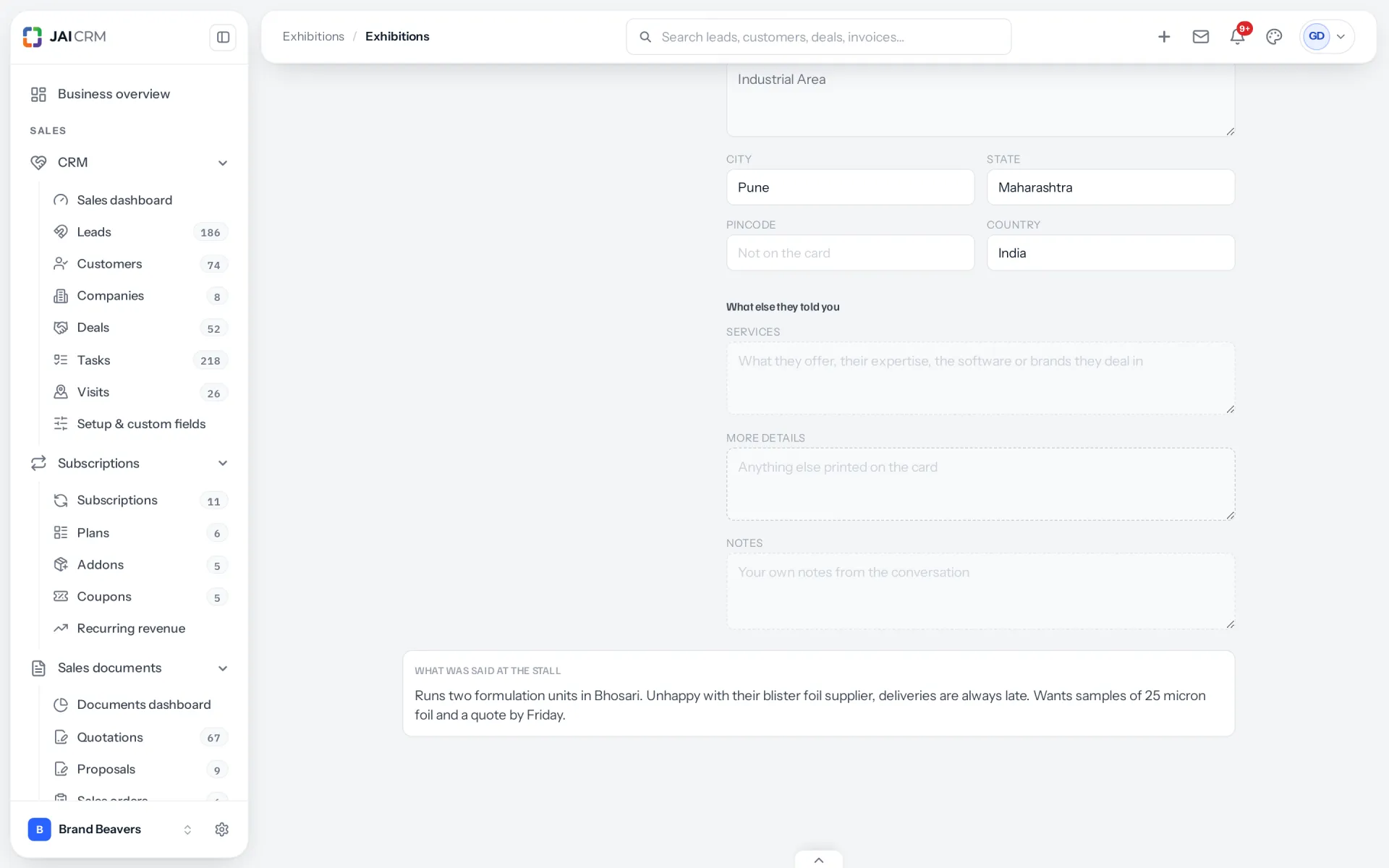
Wait for the words to appear on the card before you press “Keep it”. The follow-up task copies the note at the moment of filing. File first, and the words still reach the record as a comment, but the task will not carry them. A card filed as a supplier gets the comment and the recording, and no follow-up task.
The same screen holds “How warm” (hot, warm or cold) and “File it as” (Lead, Customer or Supplier). If you would rather type, the card has a Notes box under “What else they told you”, and what you type there goes into the record’s Notes. Typed notes do not reach the follow-up task, so the voice note travels furthest. For every field and where it lands, see Scan a card, check it, and where each field goes.
Common questions
What should I write on a business card after meeting someone?
Note who they are, what they need, when they may buy and the next step you promised. Four short phrases are enough to make your follow-up personal days later. Skip the name and number, because the card already carries them.
Is it rude to write on someone’s visiting card?
Writing on it while they stand in front of you can look careless. Wait until they have walked away, then write on the back, out of sight. Or record a short voice note on your phone instead.
How do I remember people I met at a trade show?
Record a note within a minute of each conversation, grade how interested they were, and follow up within days. Memory fades by the next morning; notes do not. Keep each note with the person’s record, not in a separate notebook.
Are voice notes better than written notes for networking?
Usually. A 10-second voice note is faster at a busy stall, keeps the person’s exact words, and can be written out as text afterwards. Write instead when the hall is too loud or the next visitor is already waiting.
How long should a voice note about a visitor be?
About ten seconds: one short phrase each for who, need, timing and next step. Longer notes drift into detail nobody reads. Skip the name and phone number, because the card already has them.
Where does the voice note go in JAI CRM?
The words are written out and shown on the card under “What was said at the stall”. When the card is filed, they are added to the record as a comment and the recording is attached. The follow-up task carries the words too, if they were written out before filing.
Correct as of October 2026. The people, businesses, places, quantities, prices, dates and messages above are examples. Screen labels are quoted from the JAI CRM app as it stood on 10 October 2026.
Next
See it with your own data
Start free, import a spreadsheet of your customers, and raise a real GST invoice in the first ten minutes. No card, no sales call.