

Follow up hot leads within 24 to 48 hours with a call and a WhatsApp message that names what you discussed. Email warm leads within 3 working days with the one thing they asked for. Send cold leads something useful within 7 days. Then keep every reply in one place, so nothing depends on memory.
In short
- Before the fair
- Agree the grades, the owners and the first messages
- Hot leads
- Call within 24 to 48 hours, then a WhatsApp
- Warm leads
- One email within 3 working days, with what they asked for
- Cold leads
- Something useful within 7 days
- Then
- Two or three more contacts over four weeks, and a polite close
- Measure
- Replies, meetings and money received, not cards scanned
The fair is over. You have a box of visiting cards, a phone full of photographs and three tired people. What happens in the next seven days decides whether those cards become customers or sit in a drawer. Here is the plan, day by day, with the messages to send.
Why do most exhibition leads go cold?
Not because the people were not interested. They stopped at your stall, talked for five minutes and handed over a card. Leads go cold for three ordinary reasons.
- The follow-up is late. Back at the office there is a week of work waiting, so the cards wait too. By the time somebody writes, the visitor has met forty other stalls.
- The follow-up is generic. The note on the card says “Rajesh, Medilux, interested”. The message that goes out could have gone to anybody, so it is treated like a cold approach.
- Nobody owns it. Three people stood at the stall, and each assumes another will write. A lead with no owner gets no follow-up.
The fix is three habits: decide how warm each person is before you leave the stall, write down what they actually said, and give every card an owner. Everything below depends on those three.
What should you decide before the fair starts?
The best follow-up is planned before the first visitor arrives. Spend thirty minutes with the stall team the week before, and settle four things.
- How you will grade people. Hot, warm or cold, with the same meaning for everyone. A shared definition stops one salesperson calling everyone hot. See Hot, warm or cold: grading leads at the stall.
- Who owns which leads. Usually the person who had the conversation. If you split by territory or product line, decide that now, not on Monday morning.
- What the first messages say. Write the day-1 WhatsApp and the day-2 email in advance, with blanks for the fair, the problem and the next step. Under pressure, a template gets used; a blank page does not.
- Where the notes go. One place for every card, note and reply. A shared phone gallery, three diaries and a WhatsApp group are four places.
Agree one more thing: what you will promise at the stall. “Samples by Thursday” is easy to say in a busy hall and hard to deliver if nobody knows it was said. Every promise goes on the card.
Day 0, before you leave the stall: sort and note
Do this between visitors, or in the last hour of each day. It takes seconds per card and saves hours later.
| Grade | What it means | Example |
|---|---|---|
| Hot | A real need, a budget, and a timeline within about three months | “Our current supplier keeps missing dates. Can you quote by Friday?” |
| Warm | A real need, but no timeline yet | “Send me your catalogue, we review suppliers in March.” |
| Cold | Curious, researching, or collecting brochures | “Just looking around this year.” |
Then add one line about the conversation: who they are, what they need, when they might decide, and what you promised. If writing is too slow at a busy stall, record a ten-second voice note instead. Their own words are what will make your follow-up worth reading. What to write on the back of a visiting card has the four-part formula and twenty examples.
A useful note: Runs two formulation units in Bhosari. Unhappy with blister foil supplier, deliveries always late. Wants samples of 25 micron foil and a quote by Friday. Prefers WhatsApp.
A useless note: Good contact, interested, follow up.
At the end of each day, count the cards by grade. If day one produced 60 cards and 2 hot leads, that tells you something about who is visiting, or about the questions being asked at the stall, while there is still time to change it.
Day 1: call your hot leads, then send a WhatsApp
Ring every hot lead within 24 to 48 hours of the fair. A call is harder to ignore than a message, and you can settle the next step there and then. Ring during working hours, roughly 10 am to 7 pm on a weekday, and not on the first morning back if the fair ended on a Sunday.
Keep the call to four moves:
- Who you are and where you met. “Priya from Sunrise Packaging. We spoke at Pune Pharma Expo on Saturday.”
- What they told you. “You mentioned your foil deliveries keep coming late.”
- What you promised. “I said I would get samples to you this week.”
- One next step, with a date. “Can I bring them to your Bhosari unit on Thursday at 11?”
After the call, or if nobody picks up, send a short WhatsApp that names the fair, their problem and the next step:
After a call: Hello Mr Joshi, this is Priya from Sunrise Packaging. Thank you for your time just now. As discussed at Pune Pharma Expo, I will send samples of 25 micron blister foil on Thursday, and the quote by Friday. Priya
If they did not pick up: Hello Mr Joshi, Priya from Sunrise Packaging here. We met at Pune Pharma Expo about late deliveries on your blister foil. I have samples ready for you. Is Thursday at 11 a good time to drop them at your Bhosari unit?
Keep it under 60 words. No brochure attached, no “greetings from”, no list of everything you make. Write in the language you spoke at the stall: if the conversation was in Hindi or Marathi, a first message in the same language reads as a continuation, not a sales pitch.
What if they asked for a quotation at the stall?
Then the quotation is the follow-up, and it should go out within two working days. A buyer who asked several stalls for prices starts comparing as soon as the first ones arrive, and a late quotation joins a decision already under way. Make sure it states the GST rate and whether prices include GST, the validity, the delivery time and the payment terms. Send it by email with a one-line WhatsApp saying it has gone, and call two days later to ask whether it answers what they needed.
Days 2 and 3: email your warm leads with the thing they asked for
A warm lead asked for something: a price list, a catalogue, a sample photo, a lead time. Send exactly that, within three working days, with one question at the end.
Subject: The price list you asked for at Delhi Medifair
Dear Ms Rao,
Thank you for stopping at our stall at Delhi Medifair on 23 January. You asked about lead times for printed cartons above 5,000 units, so I have attached our price list and a lead-time sheet.
One question: are you comparing suppliers for this quarter, or planning for next year?
Regards,
Tarun Shah, Medilux Packaging
The question matters more than the attachment. It gives them an easy reason to reply, and the answer tells you whether this lead is about to become hot.
Three details that make the email work:
- Put the fair in the subject line. “The price list you asked for at Delhi Medifair” is opened. “Greetings from Medilux Packaging” is not.
- Attach one file, not five. A single PDF of a few megabytes arrives almost anywhere. Five attachments look like a mass mailing, and some inboxes hold them back.
- Sign with a name and a mobile number. A warm lead who becomes hot will want to call, and should not have to search for how.
Days 4 to 7: give cold leads a reason to remember you
Cold leads are not ready, and a sales message will not change that. Send something useful instead, once, with no follow-up the same week. Some examples by trade:
| Your business | Something useful to send |
|---|---|
| Packaging supplier | A one-page guide to choosing carton board by product weight |
| Machine builder | A short video of the machine running a product like theirs |
| Chemical distributor | The storage and handling sheet for the grade they asked about |
| Textile mill | A swatch card and the minimum order for each quality |
| Software or service firm | A case from a business of their size and trade, with real numbers |
Avoid “just checking in”. It asks them to do work (remember you, work out why you are writing) and gives nothing back.
What does the whole first week look like?
| When | Who | Channel | What |
|---|---|---|---|
| Day 0 | Everyone at the stall | On the card | Grade, one-line note or voice note, promises made |
| Day 1 | The person who met them | Call, then WhatsApp | Hot leads: the next step, with a date |
| Days 1 and 2 | Sales | Quotations promised at the stall | |
| Days 2 and 3 | The person who met them | Warm leads: the thing they asked for, and one question | |
| Days 4 to 7 | Sales or marketing | Email or WhatsApp | Cold leads: one useful thing |
| Day 7 | Sales head | Review | Who has been contacted, who has not, and why |
The day-7 review is the step most businesses skip. Ten minutes with the list of people filed and the list of people contacted shows exactly who fell through, while they still remember your stall.
Weeks 2 to 4: the second touch most businesses never make
Most follow-up stops after one message. The people who reply are often the ones who heard from you a second or third time, when the need had come closer.
| When | What to send |
|---|---|
| Week 2 | A direct question: “Did the samples suit your line?” or “Shall I hold the quoted rate for this month?” |
| Week 3 | Something new: a product, a price change, a delivery slot opening up |
| Week 4 | A polite close: “Shall I close this for now and get in touch next quarter?” |
The polite close often gets the reply the first three messages did not, because it is easy to answer.
A polite close: Hello Ms Rao, I have not heard back about the cartons, so I will assume the timing is not right and stop writing for now. If you are planning for next year, I would be glad to send updated prices in February. Tarun, Medilux Packaging
Stop when somebody says no, and keep a note of why. “Price too high”, “already signed with a supplier” and “project cancelled” each tell you something different about the fair and the visitors it brings.
Do festivals and the year-end change the plan?
Yes. Indian business slows in predictable weeks, and a follow-up plan should bend around them rather than run into them.
- Diwali week: many offices close or run short-staffed. A fair that ends a week before Diwali should have its hot leads called before the holiday, and its warm and cold leads written to after.
- March: buyers are closing the financial year on 31 March. Some will place orders to use a budget; others will freeze spending until April. Ask which applies.
- Regional festivals and long weekends: Pongal, Onam, Durga Puja and Ganesh Chaturthi slow particular states. Check where the lead is before you count a silent week as a no.
When the calendar delays a contact, move the whole sequence, not just the next message. A four-week plan that loses ten days to a festival becomes a five-and-a-half-week plan.
Which mistakes waste a good fair?
- Typing every card before anyone follows up. The typing takes a week, so the hot leads wait a week. Call the hot leads from the cards first, and record them as you go.
- One mass email to everyone. It is quick, and it tells every recipient they were one of three hundred. Hot and warm leads deserve a message about their own conversation.
- Sending the full catalogue to a cold lead. A 40-page catalogue from a stall they barely remember is deleted unread. Send one useful page.
- Letting the stall promise outrun the office. If samples were promised for Thursday, somebody in the office needs to know on Monday.
- Judging the fair in week two. Business buyers take months to order and pay. An early verdict is usually an unfair one.
What should you measure after the fair?
Counting cards scanned tells you nothing about whether the fair worked. Count these instead:
- Replies: how many people answered your first or second message.
- Meetings and visits: how many conversations moved off the stall.
- Money received: payments from customers you met at the fair, against what the fair cost, including your people’s days.
Judge the money after about four months. Business buyers met at a stall rarely place and pay a first order within weeks, so an early verdict is usually an unfair one. What did your exhibition stall really earn? sets out the sum, with a calculator.
How JAI CRM runs this plan for you
The Exhibitions module in JAI CRM is built around this plan:
- At the stall, scan each visiting card, tag it hot, warm or cold, and hold a button to record a voice note. It is written out as text and kept with the person.
- Filing a card as a lead or a customer raises a follow-up task for its owner, due in 48 hours, carrying the voice note. Nothing waits in a drawer.
- People you already know are matched by GSTIN, mobile number and email, so an existing customer is not chased as a stranger.
- The exhibition report counts follow-up only when a call, email, meeting or message was actually done, and counts money received from the people you met, against everything the fair cost.
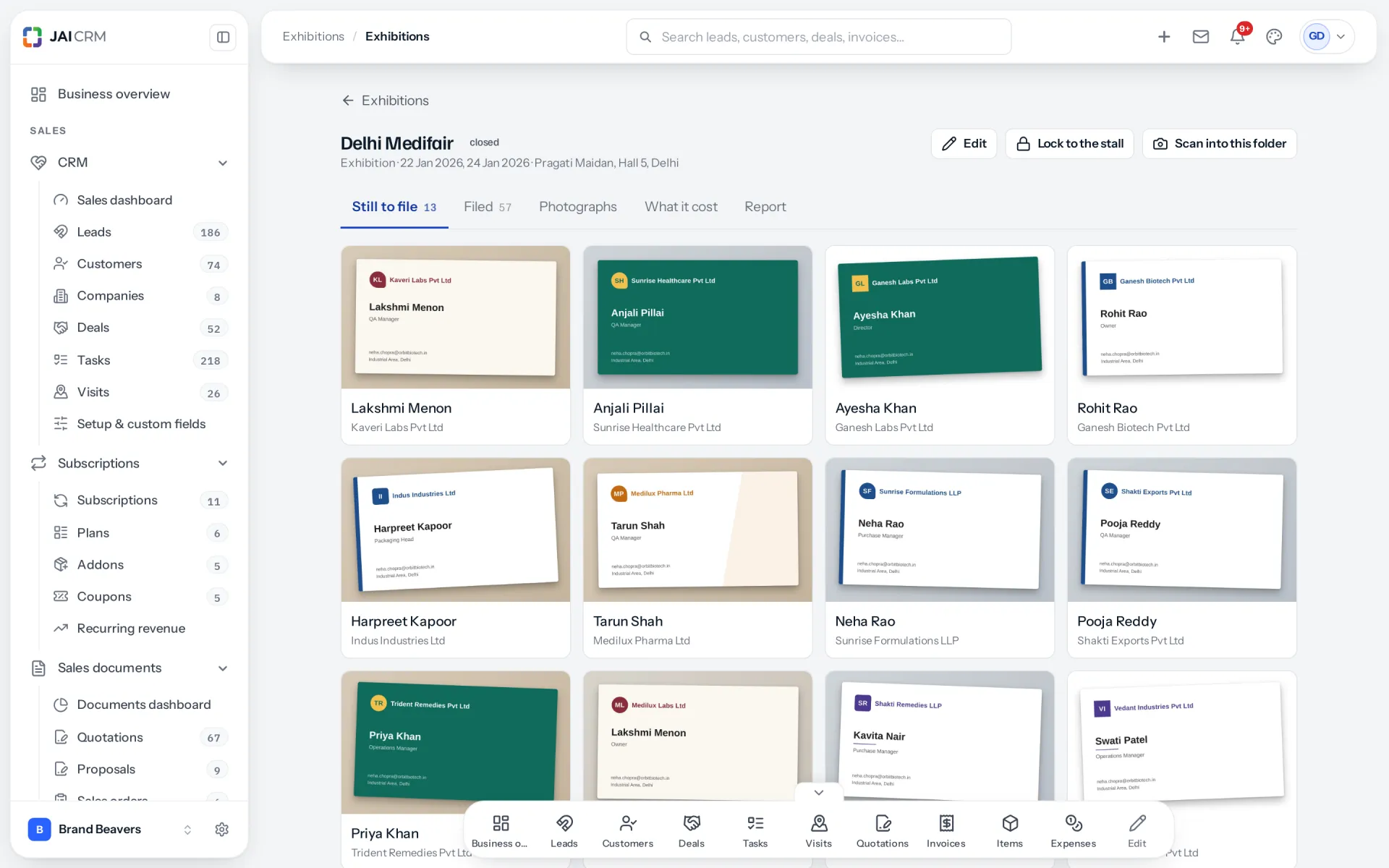
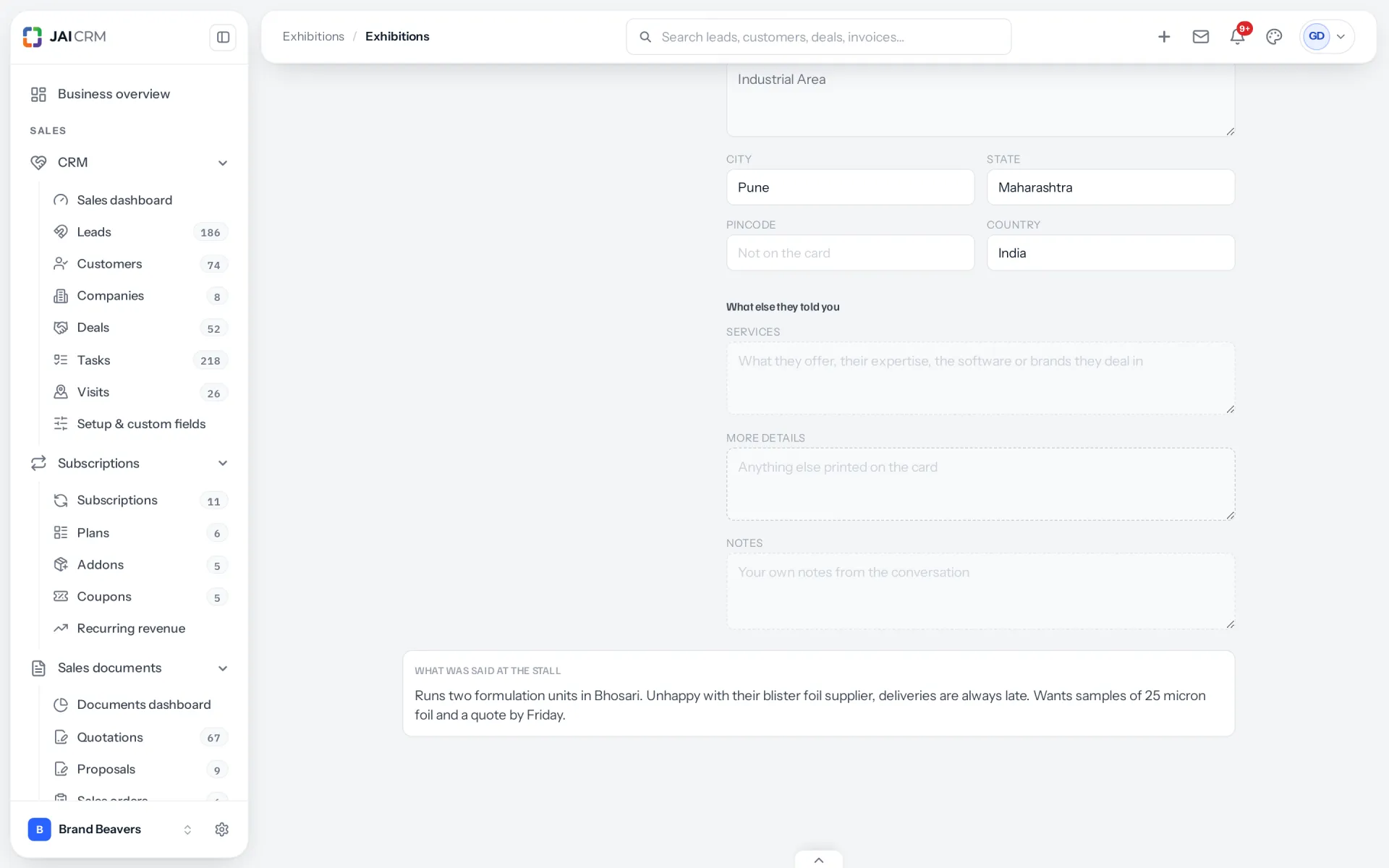
See From a card to a record for the steps, and the exhibition report for how the money is counted.
Common questions
How soon should I follow up after an exhibition?
Contact hot leads within 24 to 48 hours, warm leads within 3 working days, and cold leads within a week. After about a week, most visitors no longer remember the conversation, so your message reads like a cold approach.
Should I follow up on WhatsApp or by email?
Use both, for different jobs. WhatsApp suits a short, personal note that names your conversation. Email suits documents such as price lists and catalogues. Ask at the stall which they prefer and note it on the card.
What should a trade fair follow-up message say?
Name the fair, the problem they mentioned and one clear next step, in under 60 words. A message that could have gone to anybody gets ignored. One that recalls their own words gets a reply.
How many times should I follow up after a trade show?
Three or four contacts over four weeks works for most business leads: one within days, one with something useful, one direct question, then a polite close. Stop when they say no.
Who should follow up exhibition leads: the person at the stall or the sales team?
Whoever had the conversation, wherever possible. They remember what was said, and the visitor remembers them. If a lead belongs to another territory, hand it over with the note and a one-line introduction.
What if an exhibition lead never replies?
After three or four contacts over a month, send a polite close and stop. Keep the lead, with a note of what you sent, and contact them again when you have something new, such as a product or a price change.
Correct as of October 2026. The names, companies, fairs and messages above are examples.
Next
See it with your own data
Start free, import a spreadsheet of your customers, and raise a real GST invoice in the first ten minutes. No card, no sales call.