

Exhibition ROI is the money received from customers you met at the fair, divided by everything the fair cost, including your staff’s days. Count only payments in the bank, not quotes or pipeline. Judge it from the fourth month, because a first order from a stall takes time to be quoted, delivered and paid.
In short
- The formula
- Money received ÷ everything the fair cost
- Cost
- Space, stand, travel, printing, and staff days at a day rate
- Received
- Payments in the bank from people you met there, not quotes
- Owed
- Shown beside the return, never added to it
- When
- First verdict in month 4, final verdict at month 12
- GST
- Read the return with GST and without it
Why is “leads collected” the wrong way to judge a stall?
Most trade show ROI advice starts with cost per lead: divide the stall bill by the number of cards. The figure is easy to work out and tells you almost nothing. A stall can collect 300 visiting cards (business cards, as some call them) and produce no customers at all.
Cost per lead rewards collecting cards, not selling to the people on them. Take two example fairs that each cost ₹3,67,500:
| Fair A | Fair B | |
|---|---|---|
| Visiting cards collected | 300 | 75 |
| Cost per card | ₹1,225 | ₹4,900 |
| Money received within a year | ₹1,10,250 | ₹7,35,000 |
| Return (received ÷ cost) | 0.3× | 2.0× |
On cost per card, Fair A wins easily. On money, Fair B brought in more than six times as much. Perhaps Fair A’s stall sat by the entrance and the team took a card from everyone who stopped, while Fair B drew fewer people who had come to buy.
So the method below counts one thing: money from the people you met there, against everything the fair cost. It takes four steps, and then a decision about when to judge.
Step 1: what does an exhibition stall really cost?
Add up everything the fair took, not only the organiser’s invoice. Five headings cover almost every fair:
- Stall space: the organiser’s charge for the space, plus anything the organiser bills separately, such as extra power points or furniture hire.
- Stand build and design: the fabricator, graphics, lights and any design fee.
- Travel and stay: train or air fares, hotels, local cabs and meals away from home.
- Printing and everything else: brochures, samples, giveaways, freight for products on display, passes, and food at the stall.
- Your people: every person-day at the fair, set-up and dismantling days included, at a day rate.
How to set a day rate for your staff
Take what a person costs you each month (salary, plus your PF and other contributions) and divide it by the working days in a month. In the example, ₹60,000 a month over 24 working days is ₹2,500 a day. If salaries are private, use one average rate for the whole team. Count the owner too, at what you would pay a manager to stand there for the same days.
Staff days are a real cost, because days at the stall are days not spent selling elsewhere. Leave them out and every fair looks better than it was. In the example below, dropping ₹30,000 of staff days lifts the return from 1.5× to 1.63×.
Should costs include GST?
Enter each cost the way it actually reaches your pocket. If you claim input tax credit on the GST in a bill, enter the amount before GST, because that GST comes back to you. If you do not claim it, enter what you paid, GST included. Your accountant knows which bills you claim credit on.
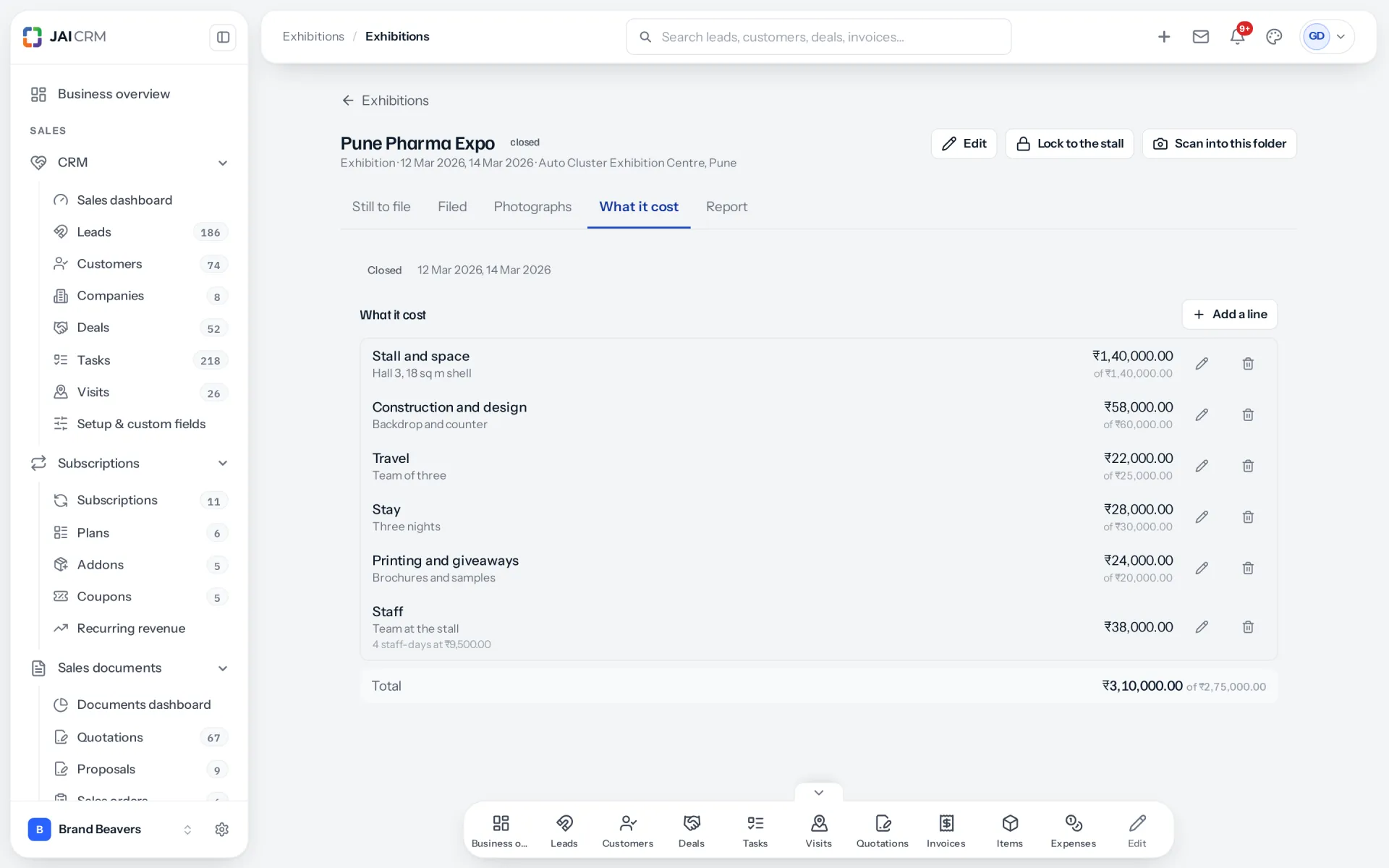
Here is the full cost of the example fair. The four days are a set-up day and three days of the fair, worked by three people.
| Cost | Example amount | Entered as |
|---|---|---|
| Stall space | ₹1,80,000 | Before GST (credit claimed) |
| Stand build and design | ₹80,000 | Before GST (credit claimed) |
| Travel and stay | ₹62,500 | As paid, GST included |
| Printing and everything else | ₹15,000 | Before GST (credit claimed) |
| People: 3 × 4 days × ₹2,500 | ₹30,000 | No GST on your own staff |
| Total cost | ₹3,67,500 |
Step 2: what counts as money received?
Count payments that have reached your bank, against invoices to people you met at the fair. Nothing else.
Count:
- Payments from new customers whose visiting card you took at the stall, however long their first order takes.
- Payments from customers you already had who came to the stall, but only for orders placed within a set window after the fair, such as 12 months. Without a window, one stall would claim every future order from an old account.
Do not count:
- Quotations and proposals, however large.
- Purchase orders you have not invoiced yet.
- Invoices raised and not yet paid.
- Business from people you did not meet at the fair, such as website or IndiaMART enquiries that arrived the same month.
The example business quoted ₹28,00,000 to people it met at the fair. Here is how that figure shrinks on its way to the bank, four months on. Every amount includes GST.
| Stage | Example amount |
|---|---|
| Quoted | ₹28,00,000 |
| Won | ₹6,71,250 |
| Invoiced | ₹6,26,250 |
| Received in the bank | ₹5,51,250 |
Only the last line is money. A return worked out on quotations would call this stall 7.62×. On money received, it returned 1.5×.
Step 3: why keep money owed out of the return?
Between won and received sits money you are owed: ₹1,20,000 in the example. That is ₹75,000 invoiced and not yet paid, plus ₹45,000 won and not yet invoiced.
Show money owed beside the return, never inside it. Owed money can be cut by a dispute, held up by a slow payer, or never paid at all. When it does arrive, it moves into money received and the return rises on its own.
A stall that has paid for itself on paper but not in the bank has not paid for itself.
The same example stall, worked out three ways:
On quotations: ₹28,00,000 ÷ ₹3,67,500 = 7.62×
Counting money owed: (₹5,51,250 + ₹1,20,000) ÷ ₹3,67,500 = ₹6,71,250 ÷ ₹3,67,500 = 1.83×
On money received: ₹5,51,250 ÷ ₹3,67,500 = 1.5×
Only the last one is money you can spend.
Step 4: how do you work out the return, and what does it mean?
Exhibition return = money received ÷ full cost, staff days included.
In the example, ₹5,51,250 ÷ ₹3,67,500 = 1.5×. For every rupee the fair cost, ₹1.50 has come back so far. Some people quote the same result as an ROI of 50%: (₹5,51,250 − ₹3,67,500) ÷ ₹3,67,500, where ₹1,83,750 is received less spent. The multiple is easier to read at a glance, so this post uses it.
Read the multiple together with how long ago the fair was. JAI CRM uses these words for each result, and the calculator further down uses the same rules:
| Return | What it means | Verdict |
|---|---|---|
| Below 1×, months 1 to 3 | Too soon to tell: orders are still being quoted and placed | Too early |
| Below 1×, months 4 to 11 | Not paid back yet: check the follow-up now | Watch |
| Below 1×, month 12 or later | Did not pay back inside its window | Reconsider |
| 1× to below 2× | The cost has come back in sales | Paid its way |
| 2× or more | At least twice the cost has come back | Book again |
At 4× or more, the fair is one of your best channels. Book early for a better position in the hall, and ask whether a second fair in the same trade would do as well.
With GST or without: which return is right?
The money in your bank includes the GST your customers paid. That GST belongs to the government, and you pay it over in your GST returns. The return without GST is the stricter figure: received less its GST, divided by cost.
At 18% GST, the GST inside ₹5,51,250 is ₹84,088.98, leaving ₹4,67,161.02. Divided by ₹3,67,500, that is 1.27×. The rate you charge changes the picture a great deal:
| GST rate on what you sell | Received without GST | Return without GST |
|---|---|---|
| 0% | ₹5,51,250 | 1.5× |
| 5% | ₹5,25,000 | 1.43× |
| 18% | ₹4,67,161.02 | 1.27× |
| 40% | ₹3,93,750 | 1.07× |
Since 22 September 2025, most goods and services carry GST at 5%, 18% or 40%, and some carry none, as the GST Council’s press release on its 56th meeting sets out (checked 10 October 2026). A few goods have special rates of their own: gold, silver and jewellery are at 3% under Notification No. 9/2025-Integrated Tax (Rate). If you sell at more than one rate, take the GST from your own invoices instead.
JAI CRM’s verdict reads the return with GST, and so does the calculator below. When the two returns fall either side of a line, say 2.1× with GST and 1.8× without, treat the lower one as the honest answer.
Sales are not profit: find your own break-even multiple
The return compares sales to cost. It does not say the fair made a profit. To know that, apply your gross margin: what is left of a sale after the cost of the goods sold.
Your break-even multiple is 1 divided by your gross margin, read against the return without GST.
| Gross margin | Return without GST needed for the margin to cover the stall |
|---|---|
| 20% | 5× |
| 25% | 4× |
| 30% | 3.33× |
| 40% | 2.5× |
| 50% | 2× |
In the example, a 30% margin on ₹4,67,161.02 is ₹1,40,148.31, well short of ₹3,67,500 four months in. That does not make the fair a mistake. A customer won at a fair can keep ordering for years, and a 12-month figure sees only the start. It does tell you the fair must keep producing orders. The verdict words say which fairs bring in business; your margin says whether that business pays.
When should you judge an exhibition?
Judge too early and every fair looks like a failure. Count the steps a first order from a stall goes through: a follow-up call, a meeting or a sample, a quotation, the buyer’s approval, a purchase order, delivery, and then your credit period. On 45-day terms, an order delivered in month 2 is paid in month 3 or 4.
JAI CRM counts the month the fair ended as month 1, so a fair that ended in March is in month 4 from 1 June. Here is how the example’s money arrived:
| Month | Received in the month | Received so far | Return so far | Verdict |
|---|---|---|---|---|
| 1 (the fair) | ₹0 | ₹0 | 0.0× | Too early |
| 2 | ₹1,10,250 | ₹1,10,250 | 0.3× | Too early |
| 3 | ₹2,94,000 | ₹4,04,250 | 1.1× | Paid its way |
| 4 | ₹1,47,000 | ₹5,51,250 | 1.5× | Paid its way |
Judged in month 2, the example would have looked like a 0.3× failure. By month 3 it had paid back its cost. A low return in the first three months means too early, not failed. The Too early mark applies only while the return is below 1×, so a fair that pays back sooner gets its verdict sooner.
Four check-ins after every fair
| When | What to look at | What it tells you |
|---|---|---|
| Months 1 and 2 | Has every person you met been contacted? Who has not? | Whether the follow-up happened at all |
| Month 3 | Quotations sent, deals won, invoices raised, money owed | Whether conversations are turning into orders |
| Month 4 | Money received ÷ full cost | The first verdict |
| Month 12 | The final return, repeat orders included | Book again, or reconsider |
Between months 4 and 11, a stall below 1× is on Watch. Look at the follow-up before you blame the fair: a stall whose cards were never called has not been tested yet. The 7-day follow-up plan covers what to send, and when.
Calculate your own stall’s return
Enter your own figures. The calculator adds up the full cost, staff days included, and shows the return with GST and without it, what you are owed (kept separate), and the verdict, by the same rules as the table in step 4.
What to put in each field
- Stall space: the organiser’s charge, plus anything billed separately.
- Stand build and design: the fabricator, graphics, lights and design.
- Travel and stay: fares, hotels, local travel and meals away.
- Printing and everything else: brochures, samples, giveaways, freight, passes and food.
- People at the stall: everyone who worked it, the owner included.
- Days at the fair: set-up and dismantling days included.
- Day rate per person (₹): what a person costs you each month, divided by working days.
- Money received from people you met there (with GST): payments in your bank against invoices to them.
- GST rate on what you sell (0%, 5%, 18% or 40%): the rate on your own invoices.
- Won but not yet paid: invoiced and unpaid, plus won and not yet invoiced. It is shown, never counted.
- Months since the fair: count the month the fair ended as month 1, as JAI CRM does.
Enter stall costs without GST if you claim input tax credit on them, and with GST if you do not.
Check it with the example: enter ₹1,80,000, ₹80,000, ₹62,500 and ₹15,000 for the four costs; 3 people, 4 days and ₹2,500 a day; ₹5,51,250 received at 18% GST; ₹1,20,000 won but not yet paid; and month 4.
You should see a total cost of ₹3,67,500, a return of 1.5× with GST and 1.27× without (1.3× when rounded to one decimal), ₹1,20,000 owed, and the verdict Paid its way.
How does JAI CRM work this out for you?
The Exhibitions module does this arithmetic from your own records, so nobody keeps a spreadsheet of who paid what after which fair.
- Costs: each exhibition has a What it cost tab. Every line has Budgeted, Actually spent, Staff days and Cost per person per day, and the staff days times the rate are added to what was spent. Until actual costs are entered, the budget stands in, and the report says so.
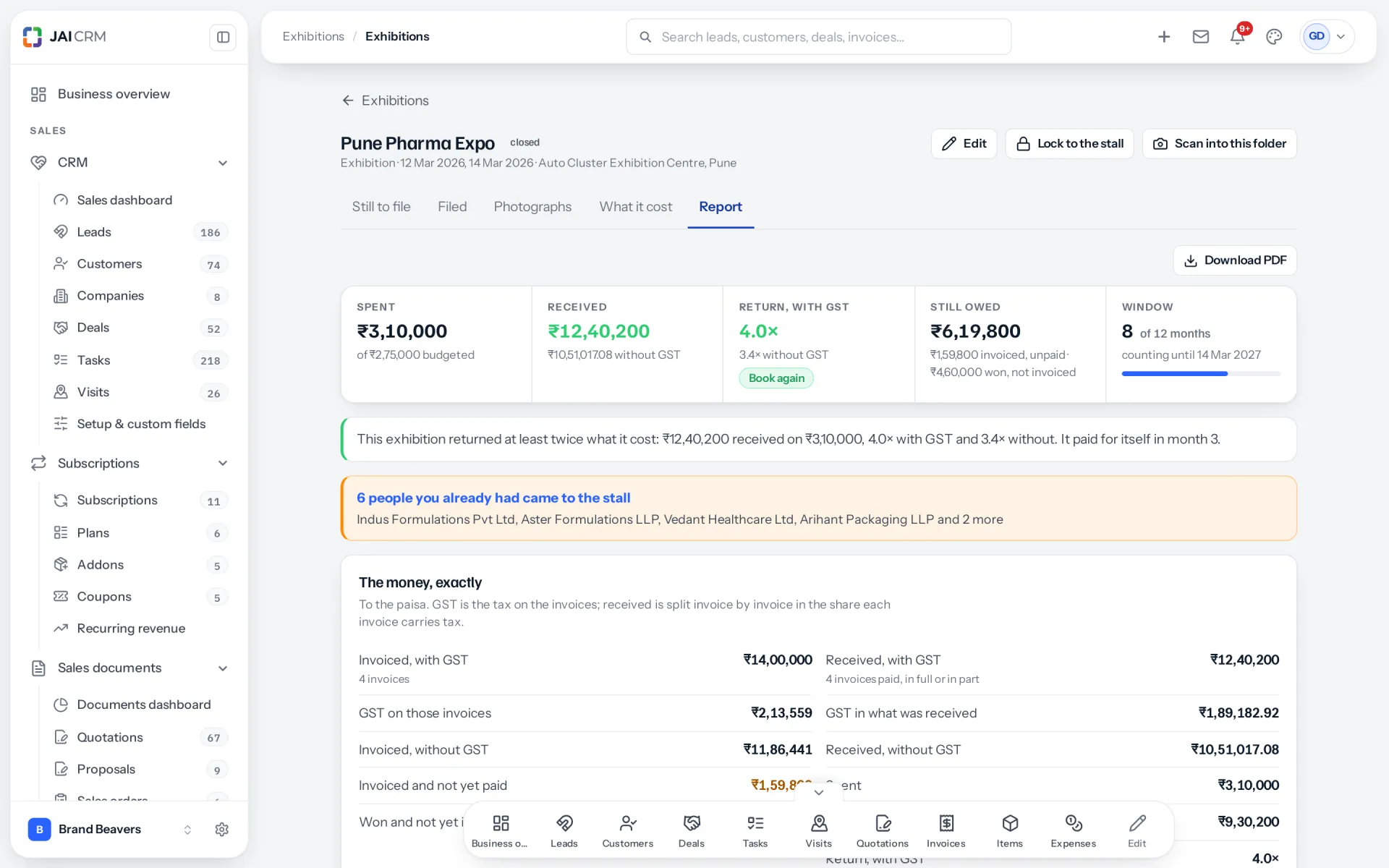
- Which invoices count: an invoice is tied to the exhibition when it is raised, through the lead a visiting card became, with no time limit, or through a customer met at the stall, inside the window. The window is the exhibition’s Count sales for how long, 12 months unless you change it.
- Received: only money paid against those invoices, exact to the paisa. Drafts and cancelled invoices are left out.
- The report: five figures head it: Spent, Received, Return, with GST (the return without GST beneath it, with the verdict), Still owed, and Window. Open deals appear as Still in the pipeline, and are not counted.
- When the money arrived: money received month by month, against what the exhibition cost, and the month it paid for itself.
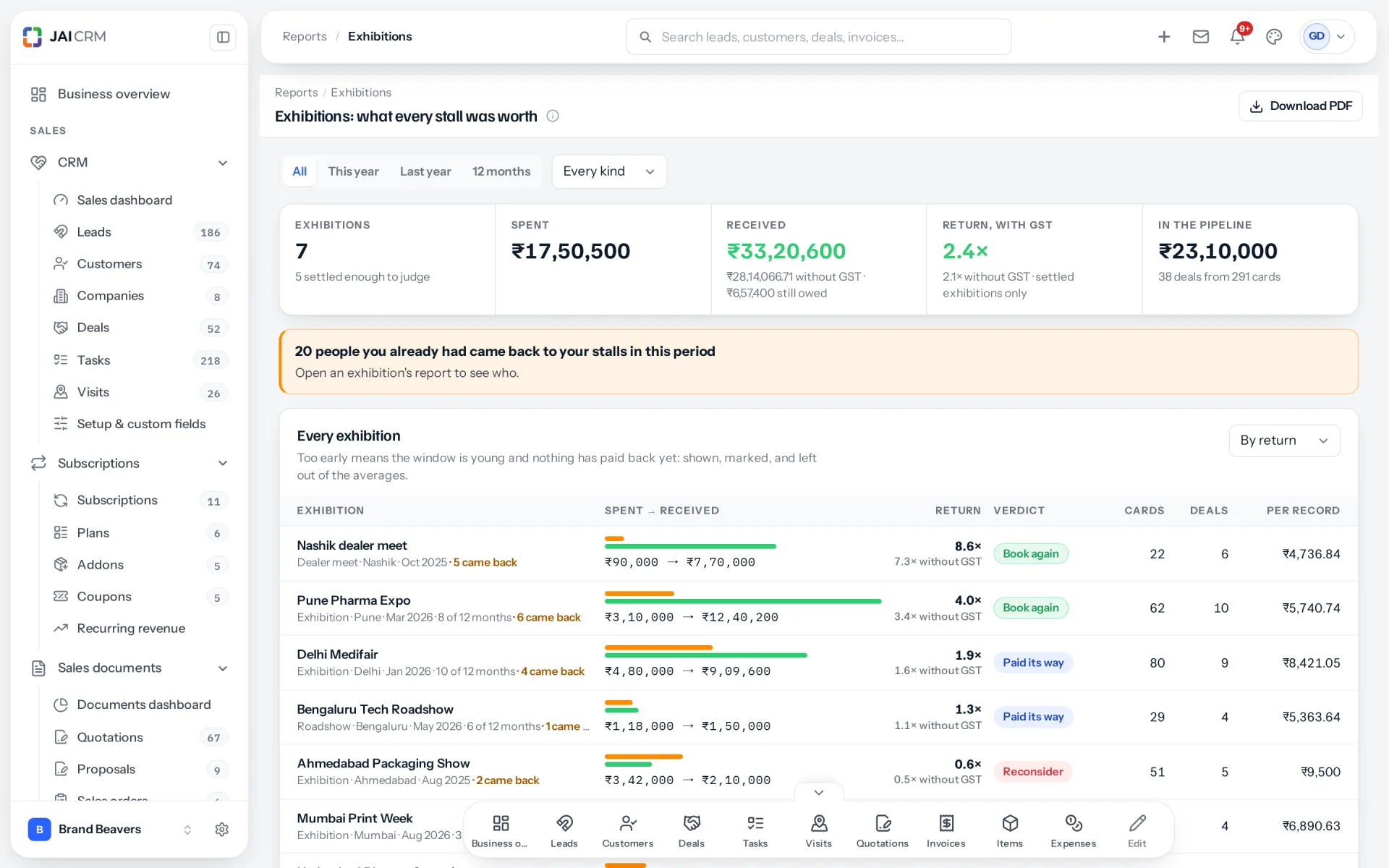
Reports, Exhibitions puts every fair side by side, with its return and verdict. Exhibitions marked Too early are shown but left out of the averages, so a young fair does not drag the rest down. Both reports download as a PDF for a partner or a review meeting. See Every exhibition side by side.
Each sale is also credited to the person who met the customer, through the card, which Which of your team brought in the money from the stall? explains. For every rule behind each figure, see What a stall was worth: the exhibition report and Where every figure comes from. The module is in every plan that has CRM and Sales Documents; see pricing.
Common questions
What is a good ROI for an exhibition?
A return of 2× or more, measured as money received against the full cost, is a strong case to book again. Between 1× and 2× the stall has paid its way in sales. Below 1× once a 12-month window has closed, change the fair, the stall or the follow-up. Check any result against your own break-even multiple: 1 divided by your gross margin.
How do you calculate trade show ROI?
Divide the money received from customers you met at the fair by everything the fair cost, including staff days at a day rate. Count payments in the bank only, not quotes or unpaid invoices. ₹5,51,250 received on ₹3,67,500 of cost is a return of 1.5×.
Should staff time count in exhibition cost?
Yes. Days at the stall are days not spent selling elsewhere. Value them at a day rate per person, set-up days included. Leaving them out makes every fair look better than it was.
Do I include GST when calculating exhibition ROI?
Enter stall costs without GST if you claim input tax credit on them, otherwise with GST. Then read the return both ways. The return without GST, which is received less its GST divided by cost, is the stricter figure, because that GST belongs to the government.
How long after a trade fair should I measure ROI?
Check in months 1, 3 and 4, counting the month the fair ended as month 1, and give the first verdict from month 4. Keep counting to month 12, because slow buyers and repeat orders keep arriving.
Should money still owed count as exhibition return?
No. Show it beside the return, never inside it. Owed money can be disputed, delayed or never paid. When it arrives, it becomes money received and the return rises on its own.
Correct as of October 2026. The fairs, the business and every amount in the examples are illustrative, not real results, and the screens show a demo business. GST rates were checked on 10 October 2026 against the GST Council’s press release of 3 September 2025 and Notification No. 9/2025-Integrated Tax (Rate).
Next
See it with your own data
Start free, import a spreadsheet of your customers, and raise a real GST invoice in the first ten minutes. No card, no sales call.