

Before ordering from a supplier you met at a trade fair, check their GSTIN on the GST portal, confirm their Udyam registration if they claim MSME status, ask for two customer references and a paid sample, and agree payment terms in writing. Approve them in your system before anyone raises a purchase order.
In short
- GSTIN
- Search Taxpayer on gst.gov.in: status Active, legal name matches, returns filed
- Udyam
- Verify Udyam Registration on udyamregistration.gov.in, and note micro, small or medium
- References
- Two customers of at least a year, ideally in different cities, phoned
- Sample
- Paid for, from regular production, invoiced like a real order
- Terms
- In writing, with payment in 45 days or less for a micro or small supplier
- Approval
- Recorded, by someone other than the person who met them
Why does a supplier you met at a stall need checking?
A trade fair is a good place to find suppliers: you handle the product, meet the owner and compare five vendors in an afternoon. But a stall is rented for three days, and a visiting card (or business card) only says who they claim to be.
A good stand proves a marketing budget, not a reliable business.
The first-order mistakes are the same every season:
- The advance goes to the wrong account, in a name that matches nothing else.
- The GSTIN is not active: it was cancelled or suspended months ago.
- The bulk lot is worse than the sample, which was a showpiece made for the stand.
- The credit terms break the law: you agreed 90 days with a small enterprise, but the MSMED Act caps written terms at 45 days.
Only the sample costs money. Allow one to two weeks, mostly waiting for the sample and the references.
Check 1: How do I verify a supplier’s GSTIN on the GST portal?
Anyone can look up a registered business by its GSTIN on the GST portal, without logging in. A GSTIN is 15 characters; the first two digits are the state code. Take it from the quotation, and check it matches the card.
- Go to www.gst.gov.in and open Search Taxpayer, then Search by GSTIN/UIN.
- Type the number in GSTIN/UIN of the Taxpayer.
- Type the characters shown in the image, and press SEARCH.
The steps follow the portal’s Search Taxpayer manual; the field names were checked on the live search page on 10 October 2026.
What the result shows, and what to look for
| Field on the result | What to check |
|---|---|
| Legal Name of Business | Matches the quotation, the invoice and the bank account. If not, ask why. |
| Trade Name | The brand on the stand. It may differ from the legal name, which is normal. |
| GSTIN / UIN Status | Must say Active. Cancelled or suspended means stop until it is explained in writing. |
| Effective Date of registration | A recent date is not wrong, but ask how long they have traded. |
| Constitution of Business | Proprietorship, partnership, LLP or company: who signs, and who is liable. |
| Taxpayer Type | Regular or composition. Composition is taxed differently, so ask your CA before agreeing a price plus GST. |
| Principal Place of Business | Matches the card, in the state given by the GSTIN’s first two digits. |
| Nature of Business Activities | If they said they make the product, the activities should say so. |
Check the filing record
Press SHOW FILING TABLE, choose the Financial Year and press SEARCH to list the returns filed. Show Return Filing Frequency says monthly or quarterly, so a quarterly filer does not look like one with gaps.
Look for returns filed regularly over the last twelve months. Months with nothing filed are a question to put to the supplier before you pay an advance.
If you search while signed in to your own GST login, the manual says you also see the proprietor or directors, annual aggregate turnover, and a GST Compliance Rating from 0 to 10.
Check 2: Is the supplier an MSME, and why does it change your payment deadline?
Many suppliers at Indian trade fairs are micro or small enterprises. For those, the law sets your payment deadline, and paying late costs interest and delays a tax deduction. Find out a supplier’s MSME status before the first order, not when the first bill arrives.
Verify the Udyam number
MSME registration is done on the Udyam Registration portal, which describes itself as the only government portal for it. To check a supplier’s number:
- Go to udyamregistration.gov.in, open the Print/Verify menu and choose Verify Udyam Registration.
- Type the number in the format UDYAM-XX-00-0000000, which the portal calls a 19 digit number.
- Type the Verification Code from the image (it is case sensitive), and press Verify.
Compare the result with the supplier’s Udyam certificate. You need the enterprise’s name, and whether it is micro, small or medium, because the payment rules below protect micro and small only. The portal gives these limits from 1 April 2025:
| Category | Investment up to | Turnover up to |
|---|---|---|
| Micro | ₹2,50,00,000 | ₹10,00,00,000 |
| Small | ₹25,00,00,000 | ₹1,00,00,00,000 |
| Medium | ₹1,25,00,00,000 | ₹5,00,00,00,000 |
When must you pay a micro or small supplier?
Section 15 of the Micro, Small and Medium Enterprises Development Act, 2006 (the MSMED Act) says the buyer must pay on or before the date agreed in writing.
Written credit terms with a micro or small supplier can never run beyond 45 days from acceptance.
With nothing agreed in writing, you must pay before the “appointed day”, which section 2(b) sets at the day after 15 days from acceptance. In practice, you have 15 days.
Acceptance is normally the day of delivery. If you object in writing within 15 days of delivery, it is the day the supplier removes your objection.
The Act protects a “supplier”, which section 2(n) defines as a registered micro or small enterprise. Medium enterprises are not covered.
What does paying late cost?
Section 16 makes a late buyer pay compound interest, with monthly rests, at three times the bank rate notified by the Reserve Bank of India. It applies whatever your agreement with the supplier says.
The RBI raised the Bank Rate to 5.75% on 7 October 2026, so three times the bank rate is now 17.25% a year. Section 23 of the MSMED Act adds that this interest is not deductible when your income tax is computed.
Worked example (illustrative). A small enterprise delivers packaging worth ₹2,36,000 (₹2,00,000 plus 18% GST) on 5 November 2026, and you accept it that day.
Your written terms say 45 days, so payment is due by 20 December 2026. Without written terms, it would have been due by 20 November 2026.
You pay on 20 February 2027, two months late. At 17.25% a year, compounded monthly (1.4375% a month), the interest is ₹2,36,000 × (1.014375 × 1.014375 minus 1) = ₹6,833.77. None of that ₹6,833.77 is deductible for income tax.
This assumes the bank rate stays at 5.75% throughout. Ask your CA to confirm the amount interest runs on.
The income-tax rule: section 43B(h), now section 37(2)(g)
Late payment also moves your tax deduction. Under section 43B(h) of the Income-tax Act, 1961, a sum payable to a micro or small enterprise beyond the section 15 time limit is deductible only in the year it is actually paid.
The Income-tax Act, 2025 came into force on 1 April 2026. The same rule is now section 37(2)(g), in the section titled “Certain deductions allowed on actual payment basis only”.
Most sums in that section stay deductible in the year incurred if paid by your return due date. Section 37(3) expressly denies that relief to late payments to micro and small enterprises. The 1961 Act did the same.
Worked example (illustrative). The same supplier delivers goods costing ₹2,00,000, excluding GST, on 10 March 2027, on 45-day written terms. Payment is due by 24 April 2027.
- If you pay by 24 April 2027, you are within the section 15 limit. On the usual reading, the ₹2,00,000 stays deductible in tax year 2026-27.
- If you pay on 30 May 2027, you are late. The ₹2,00,000 is deductible only in tax year 2027-28.
In the second case you pay 2026-27 tax on ₹2,00,000 of profit you did not make.
General information, not legal or tax advice. Check with your CA how these rules apply to you, especially for bills from before 1 April 2026 (under the 1961 Act) and for suppliers registered on Udyam as traders.
Check 3: What should I ask a supplier’s references?
Ask for two customers who have bought from the supplier for at least a year. Two references from different cities are better than five from one. A supplier may serve its home market well and ship badly elsewhere.
Phone them, because a call lets you ask the follow-up question. These six cover what matters:
- How long have you bought from them, and what do you buy?
- Do deliveries arrive on the promised date? When late, how late?
- Does the bulk order match the sample and the specification?
- Tell me about one problem you had. How did they handle it?
- What payment terms do they give you?
- Will you place your next order with them?
Listen for detail. A real customer remembers a late lot and how it was put right. Praise with no specifics may be a friend doing a favour, so look the reference’s own GSTIN up too.
For a large order, visit the factory or ask for a video call from the shop floor. The stand showed their best product; the factory shows how they make the rest.
Check 4: Should I pay for a sample from a new supplier?
Usually yes. A free sample at a fair is often a showpiece. A paid sample comes from regular production and travels through the supplier’s normal process.
That process is what you are testing: whether the tax invoice carries the GSTIN and legal name the portal showed, how they pack and dispatch, whether the promised lead time holds, and whether the bank account is in the firm’s legal name.
Worked example (illustrative). A sample lot costs ₹8,850 (₹7,500 plus 18% GST). The first order would be ₹4,72,000 (₹4,00,000 plus 18% GST). The sample costs under 2% of the order.
Test it against a written specification, and keep one piece, labelled and dated, as the reference for the bulk order.
Check 5: What terms should be in writing before the first order?
A conversation at a stall is not a contract. Before the first purchase order, put these terms in one email and have the supplier confirm them:
| Term | What to write down |
|---|---|
| Price | Rate per unit, with or without GST, whether freight and packing are included, and how long the price holds |
| Lead time | Days from purchase order to dispatch, and what happens if they miss it |
| Quality standard | The specification, tolerances, test reports, and the reference sample |
| Payment terms | Any advance, and credit days. With a micro or small supplier, no more than 45 days |
| Acceptance | How long you have to inspect, and that objections are raised in writing |
| Returns | What happens to rejected goods, who pays the freight, and when a credit note is issued |
| Bank account | Account name, number and IFSC, in the firm’s legal name |
The acceptance line matters: under the MSMED Act, a written objection within 15 days of delivery moves the day of acceptance, and so the payment date.
Treat any later change of bank account as a fraud risk. Confirm a new bank account by phoning a number you already had, never by replying to the email that asked.
Here is a message you can copy and adapt:
Subject: Terms for our first order, as discussed at [fair name]
Dear [name],
Thank you for meeting us at [fair name]. Before we place our first order, please confirm the terms below by reply.
Item: [item], to [specification], matching the sample dated [date].
Price: ₹[rate] per [unit], plus GST at [rate]%, [including / excluding] freight, valid until [date].
Lead time: [number] days from purchase order to dispatch.
Payment: [number] days from acceptance of the goods.
Acceptance: we will inspect within [number] days of delivery and raise any objection in writing.
Rejections: returned at your cost, with a credit note within [number] days.
Bank account: payments only to the account in your firm’s legal name shown on your cancelled cheque. Any change must be confirmed by phone.
Please also send your GST registration certificate, PAN, Udyam certificate if you are registered, and a cancelled cheque.
Regards,
[your name], [your company]
How do I make supplier approval a step, not a feeling?
Whoever met the supplier at the stall liked them; that is why they brought the card back. The person who approves a supplier should not be the person who found them.
Make approval a recorded step, against a fixed list:
- GSTIN Active, legal name matches, returns filed regularly
- Udyam verified and the category noted, or “not registered” written down
- PAN collected
- Bank account checked against a cancelled cheque, in the legal name
- Two references phoned, with notes kept
- Paid sample tested against the specification
- Terms confirmed in writing, with no more than 45 credit days for a micro or small supplier
Record who approved and when, so “who cleared this supplier?” takes one click a year later. Then keep one rule without exceptions: nobody raises a purchase order to a supplier until someone has approved them.
How does JAI CRM handle a supplier you met at a fair?
The Exhibitions module files each scanned visiting card as a lead, a customer or a supplier. Choose Supplier on the card, file it, and this happens:
- The firm becomes the supplier and the person its contact. The GST number, phones, emails, website and address fill the supplier’s own fields; services on the card become its Services list.
- A supplier you already have is found by GSTIN, mobile, email or company name, and the card can be filed to them with no new record made.
- A new supplier lands in Prospective vendors, with the status Pool: “Collected but not yet screened. Nothing has been verified.”
- No follow-up task is raised, unlike a lead or a customer. A supplier is checked, not chased.
- The card goes with it. The photograph and the voice note are attached, what was said at the stall is added as a comment, and the supplier is tagged with the exhibition’s name.
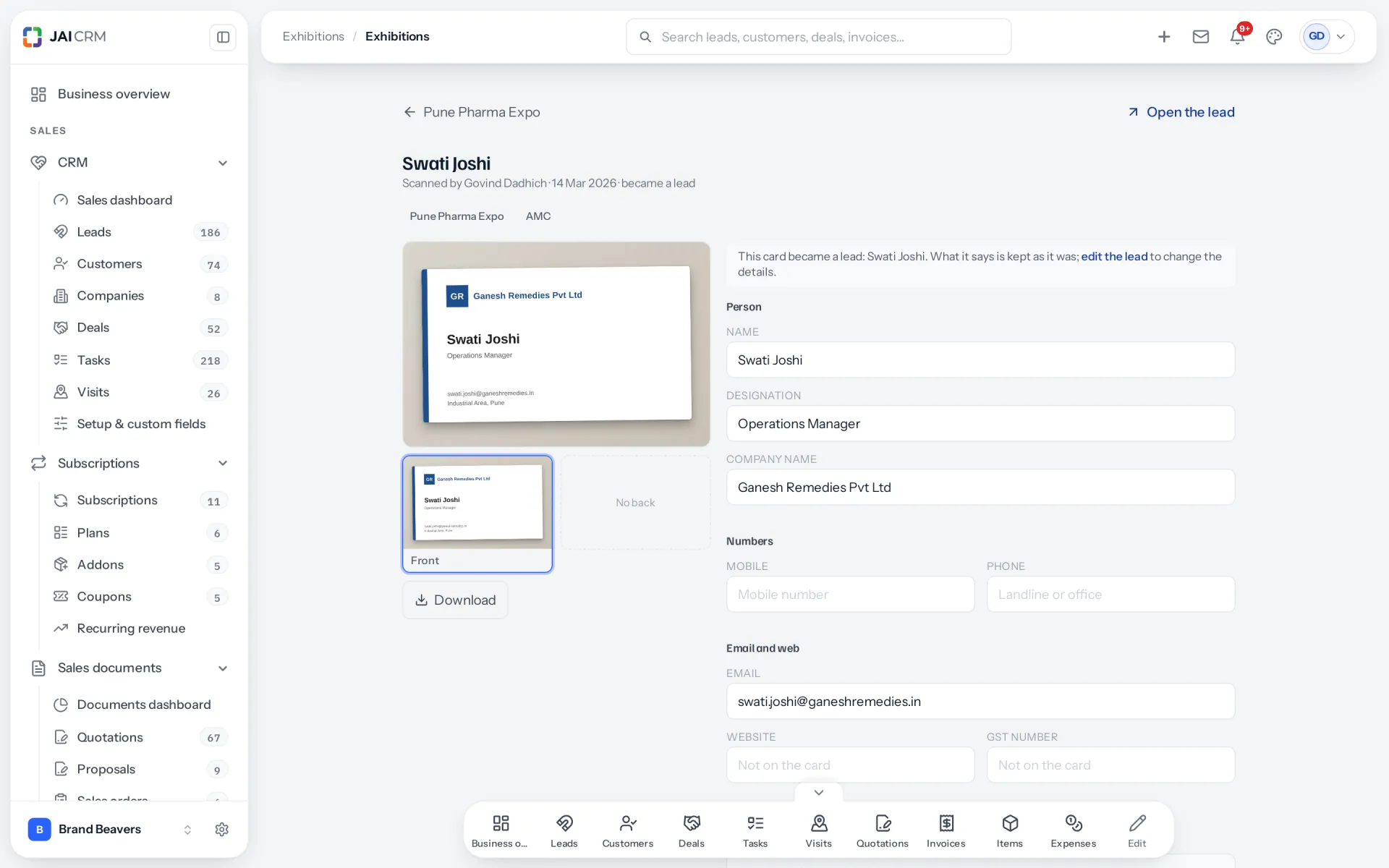
From there the supplier moves to Available or Shortlisted, then Approved; it cannot jump from Pool to Approved. A purchase order, purchase bill, debit note or payment against an unapproved supplier is refused, with a message naming their stage.
The supplier’s Tax & banking tab holds the GSTIN, PAN, MSME / Udyam and MSME type, and the bank details, which read “Nobody has checked” until somebody checks them. The overview shows Approved by and Approved on.
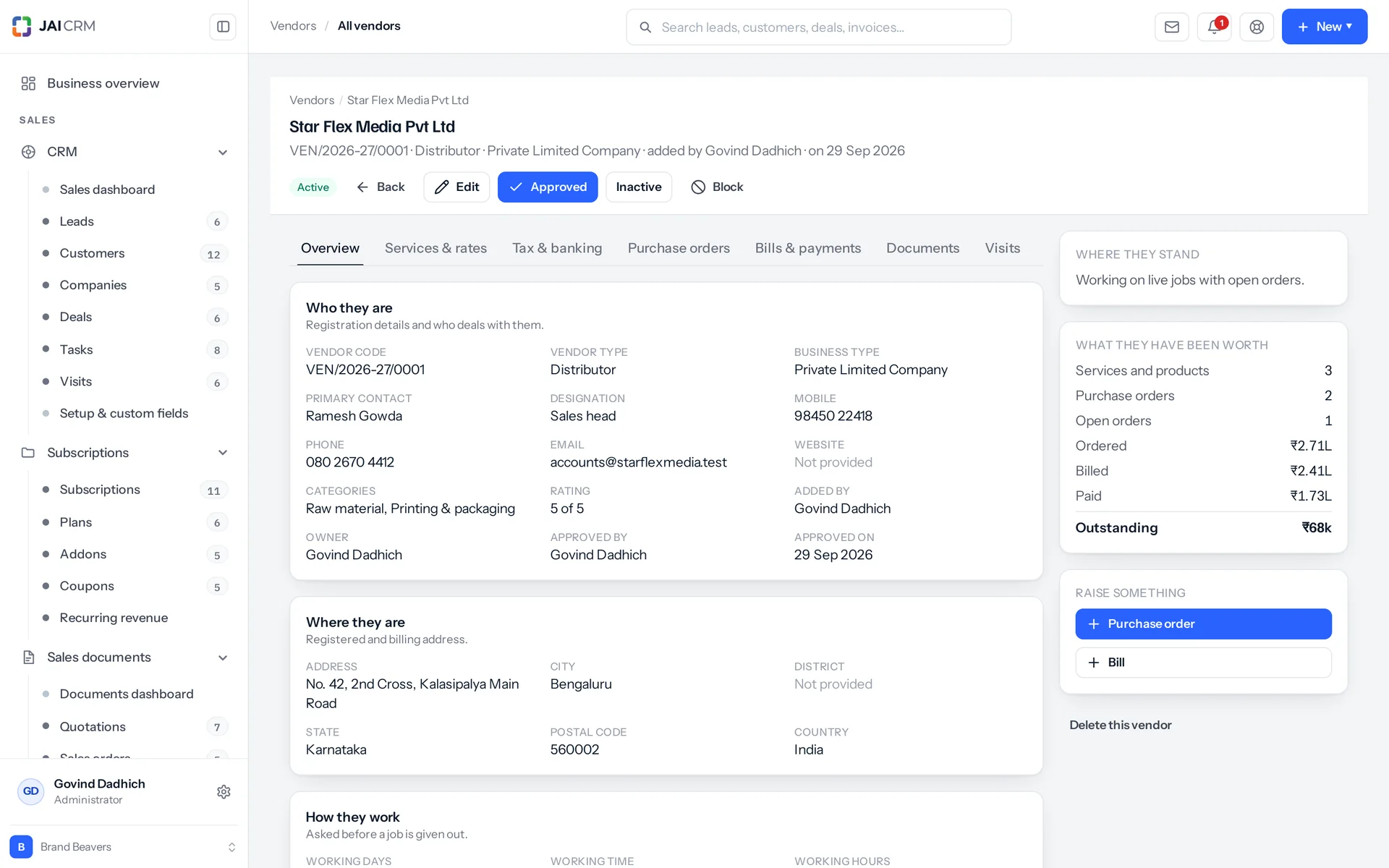
One limit, plainly: JAI CRM keeps the Udyam number on the supplier, but does not yet watch the 45-day rule or flag a bill past it. Record the payment terms at approval, and have accounts review micro and small suppliers’ bills by due date.
For the full approval steps, read From a name on a card to a purchase order. For how a card is filed, see From a card to a record.
Common questions
How do I verify a supplier’s GST number?
Enter the GSTIN under Search Taxpayer on the GST portal, gst.gov.in. Check that the legal name matches the supplier’s documents, the GSTIN / UIN Status is Active, and the filing table shows returns filed regularly.
How do I check a supplier’s Udyam registration?
On udyamregistration.gov.in, open Print/Verify and choose Verify Udyam Registration. Enter the Udyam number and the verification code, compare the result with their certificate, and note whether they are micro, small or medium.
Why does a supplier’s MSME status matter?
Micro and small suppliers must be paid by the date agreed in writing, never more than 45 days from acceptance, or within 15 days without written terms. Late payment carries compound interest and delays your income-tax deduction.
What should I ask a supplier’s references?
Ask how long they have bought, whether deliveries arrived on time and to standard, and how problems were handled. Two references from different cities are better than five from one.
Should I pay for a sample from a new supplier?
Usually yes. A paid sample reflects real production quality and shows how they invoice, pack and deliver, which a free showpiece sample does not.
What happened to section 43B(h) under the new Income-tax Act?
The Income-tax Act, 2025 took effect on 1 April 2026, and the rule is now its section 37(2)(g). A sum paid to a micro or small supplier after the MSMED Act deadline is deductible only in the year it is actually paid.
Correct as of October 2026. Portal steps, the MSMED Act, both Income-tax Acts and the RBI Bank Rate were checked on official sources on 10 October 2026. The amounts and dates in the worked examples are illustrative. This is general information, not legal or tax advice: check with your CA.
Next
See it with your own data
Start free, import a spreadsheet of your customers, and raise a real GST invoice in the first ten minutes. No card, no sales call.