
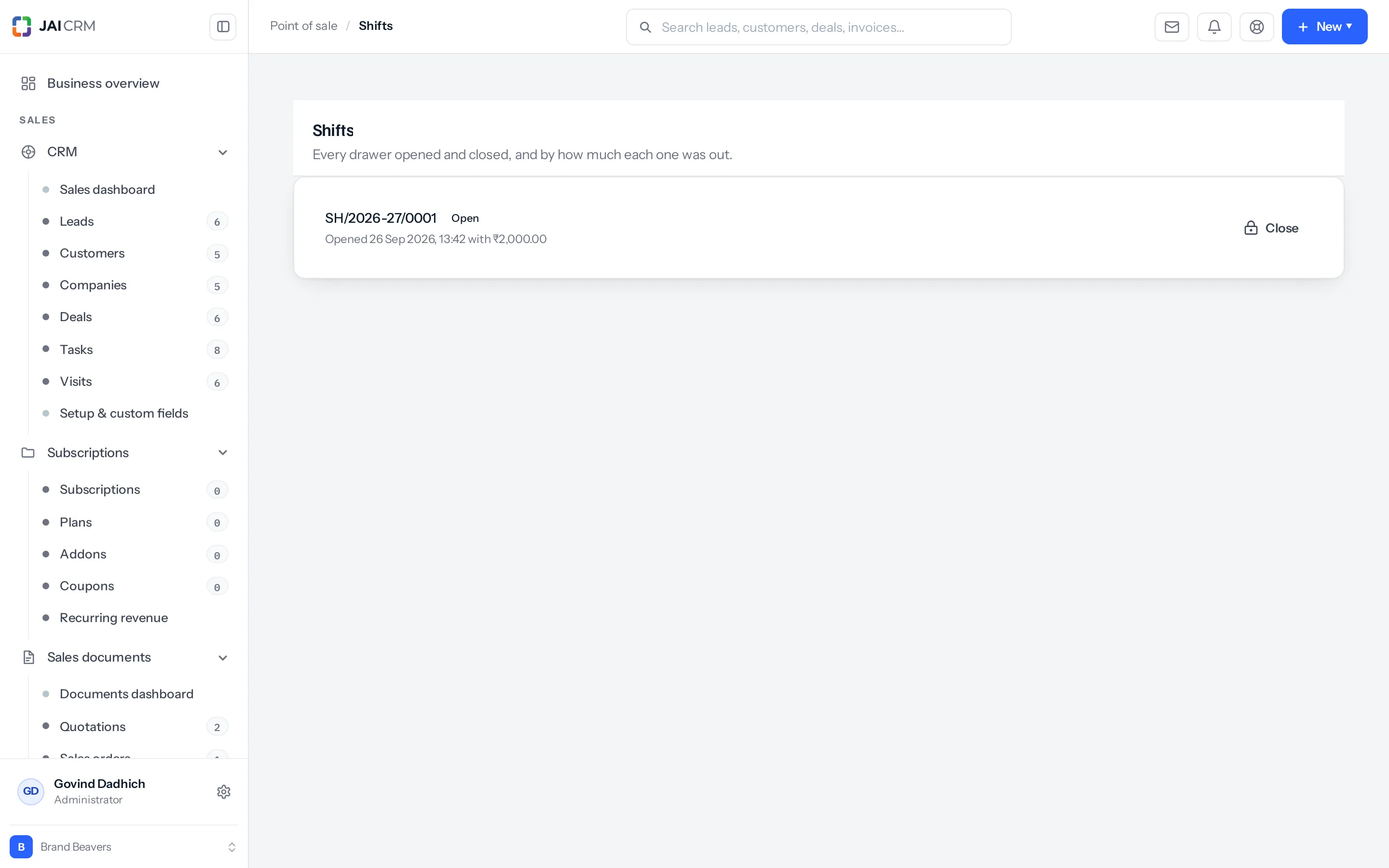
Cash needs somebody’s name on it. A shift is that: one drawer, one person, from the moment it is opened with a float until it is counted at the end.
The float
The money already in the drawer before anything is sold — the change you need to trade. Count it and enter it, because it is the number every other number is measured from. Guess it, and the variance at the end means nothing.
A shop whose till does not take cash never asks any of this. A kiosk in a lobby has no drawer, so it has no shift, no float and nothing to count.
Cash in and cash out during the day
Money moves in and out of a drawer for reasons that are not sales, and every one of them has to be written down or the count at the end is wrong.
| For example | |
|---|---|
| Out | Paying the courier. Petty cash for milk. A float taken to the other till. A drop to the safe. |
| In | More change fetched from the safe. Cash brought over from another drawer. |
Each one carries a reason, and the reason is not optional. “₹500 out” is a hole in the day; “₹500 out, paid the courier” is an expense somebody can check.
A drop to the safe is cash out. Leaving ₹40,000 in a drawer all day is a risk shops manage by moving it — but a drop nobody recorded looks exactly like a drawer that is ₹40,000 short.
One drawer at a time
A till has one open shift. Opening a second on the same till is refused, because two people answerable for one drawer is nobody answerable for it.
A cashier can open and close their own drawer and no one else’s. Closing somebody else’s is a manager’s job — see the next page.
Something missing or wrong here? Tell us. A question that needed asking usually means a page that needed writing.