

To exhibit at CPHI and PMEC India 2026 in Delhi NCR, first pick the right venue: ingredients go to CPHI at Yashobhoomi, Dwarka (23 to 25 November), machinery and packaging to PMEC at Greater Noida (24 to 26 November). Get a written stall quote now, staff two people per shift, and set up lead capture a week early.
In short
- Dates
- CPHI India 23 to 25 November 2026; PMEC India 24 to 26 November 2026
- Venues
- CPHI at IICC, Yashobhoomi, Dwarka; PMEC at IEML, Greater Noida
- Hours
- 10:00 to 18:00, and 10:00 to 17:00 on 26 November
- Stall prices
- Not published; ask the organiser’s sales team for a written quote
- Next deadline
- Space-only stand designs due in the Exhibitor manual by 25 October 2026
- Leads
- Scan, grade and note every visiting card; call hot leads within 48 hours
CPHI and PMEC India 2026 at a glance
CPHI & PMEC India is run by Informa Markets. It used to be one three-day show. For 2026 it is split across two venues on overlapping dates because, the organiser says in its FAQs, it has outgrown the largest venue available. Every detail below was checked on the organiser’s own pages on 10 October 2026.
| CPHI India | PMEC India | |
|---|---|---|
| What is shown | APIs, excipients, finished dosage, natural extracts, fine chemicals and intermediates | Pharma machinery and equipment, packaging, cleanroom technology, lab and analytical equipment |
| Dates | Monday 23 to Wednesday 25 November 2026 | Tuesday 24 to Thursday 26 November 2026 |
| Venue | IICC, Yashobhoomi, Dwarka, Delhi | IEML (India Expo Centre), Greater Noida, Delhi NCR |
| Hours | 10:00 to 18:00 each day | 10:00 to 18:00; 10:00 to 17:00 on 26 November |
| Halls and floor plan | Not on the public pages | Not on the public pages |
| Who is exhibiting | CPHI India 2026 exhibitor list | PMEC India 2026 exhibitor list |
Sources: the event home page for dates, venues and opening times; Venue and travel for what each show covers; and the organiser’s 2026 justification toolkit, which names IEML as the India Expo Centre. All checked 10 October 2026.
Who visits
The organiser’s 2025 post-show report counts 37,148 visitors in attendance from 120 countries, and more than 2,000 exhibiting companies on 120,000 square metres. Those figures cover both shows together. The organiser’s pages do not all agree: the PMEC page says “50k+” visitors for 2025. Plan on the lower, exact figure.
The same report says 52.5% of visitors were top management and 27.3% middle management. Half said they make purchase decisions, and another 26% said they influence them. In the 2026 sales brochure, the commonest reason for visiting was to find new suppliers (32%), then to find partners for future collaboration (27%).
Plan for senior buyers who are judging you as a possible supplier. They will ask about capacity, compliance documents and lead times, not only price.
Which venue is yours: CPHI at Yashobhoomi or PMEC at Greater Noida?
Your product decides the venue. The organiser’s FAQs put APIs, formulations, excipients, natural extracts and fine chemicals at CPHI. They put pharmaceutical and packaging machinery, packaging materials, lab and analytical equipment and cleanroom technology at PMEC.
- A trader in APIs or excipients: CPHI, at Yashobhoomi.
- A maker of blister foil, cartons, labels or bottles: PMEC, in the packaging zone.
- An engineering firm making tablet presses, filling lines, change parts or cleanroom HVAC: PMEC.
- Not sure: the sales brochure invites you to ask the sales team which show fits your business.
The split has three practical consequences:
- One badge covers both venues. The PMEC page confirms that a single registration admits you to both shows.
- The venues are far apart. The organiser’s own FAQ uses those words. Shuttles run between them on the overlapping days, 24 and 25 November, and the Venue and travel page says schedules and pickup points will be confirmed closer to the event.
- Book a hotel near your own venue. The organiser warns that rooms around the show dates book up quickly. Its hotel partner has separate pages for hotels near CPHI and hotels near PMEC.
Getting there: Yashobhoomi has its own metro station, Yashobhoomi Dwarka Sector 25, at the end of the Airport Express Line. The government’s announcement put the journey from New Delhi station at about 21 minutes. For IEML, the organiser’s route map from an earlier edition sent visitors to shuttle buses from Botanical Garden and from Knowledge Park II on the Aqua Line. The organiser says 2026 routes will be published closer to the event. IEML has parking, including an area the organiser calls NASA Ground Parking.
How much does a stall at CPHI and PMEC India cost?
The organiser does not publish stall prices. On 10 October 2026, neither the Book your stand page nor the 2026 sales brochure gave a rate per square metre, for shell scheme or for space only. Treat any rate on a third-party site as unconfirmed until the organiser quotes it to you.
To get a price, fill in the “Make an enquiry” form on the Book your stand page and choose CPHI India or PMEC India. The sales brochure also lists one sales contact for CPHI and one for PMEC for companies based in India, and a separate address for companies based abroad. Ask for the quote in writing, and ask these questions:
- What is the rate per square metre for shell scheme, and for space only? Is GST included?
- Is there an extra charge for a corner or for open sides?
- How many exhibitor passes come with the stall, and how many free visitor invitations?
- How much power is included, and what does extra power cost?
- What is the payment schedule, and what happens if we cancel?
- Which hall is the stall in? Please send the floor plan.
- What are the build-up and dismantling days and times?
What the organiser does publish
The sales brochure sets out the rules that shape your cost:
- Sizes: shell scheme has a minimum order of 12 m², and every stand below 27 m² must be shell scheme. A stand you design and build yourself therefore needs at least 27 m².
- What a 12 m² shell stand includes: white partition walls 2.5 metres high on up to three sides, carpet, a fascia board with your company name, four spotlights, a waste bin, and one 5/15 amp socket with 1 kW of power per 12 m².
- Furniture: the brochure prints two sets for 12 m². One has an information counter, a square table and three chairs; the other has one table and two chairs. Ask which applies at your venue.
- Damage: no woodwork or wooden flooring is allowed, and nothing may be drilled, nailed, stapled or tacked to the panels. The shell contractor charges ₹2,500 for each damaged panel.
- Lighting: only LED lights of up to 100 watts may be used.
One price is published. The start-up market page offers first-time CPHI India exhibitors a package at ₹1,75,000 plus tax: exhibition space, two exhibitor passes, matchmaking, lead retrieval, an event profile and a marketing toolkit. It is open to recognised start-ups up to ten years old, with turnover under ₹1,00,00,00,000 (₹100 crore), in pharma, packaging, drug delivery or medical devices. The page names neither a year nor a stand size, so confirm both before you plan around it.
Six weeks before: budget and booking
On 10 October you have about six weeks until the doors open. Use the first fortnight for money and paperwork.
Build the budget, staff days included
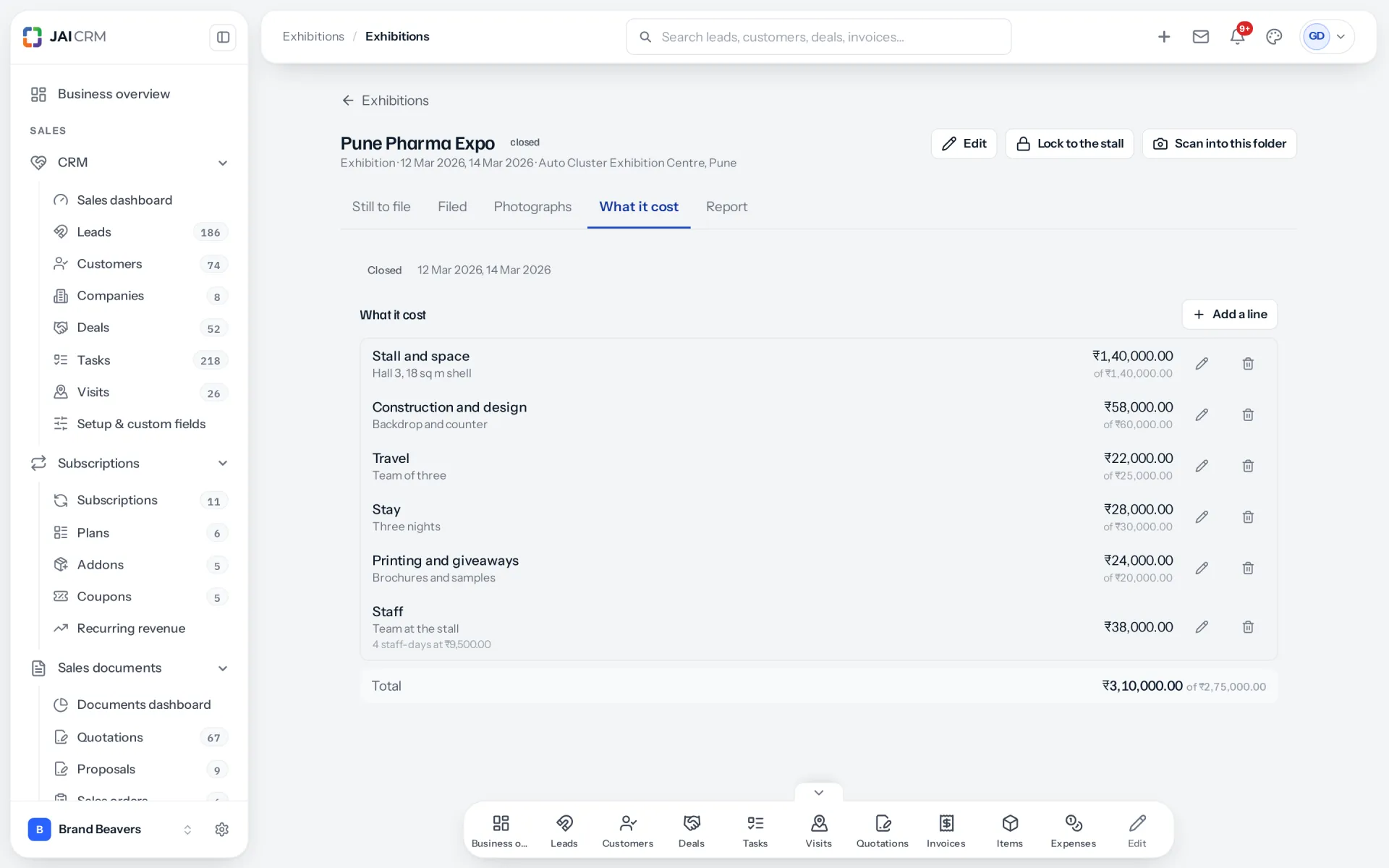
Count your own people’s days away from work as a cost. They are as real as the stall rent. The table is an example for a three-person team travelling to PMEC from outside Delhi. Replace every figure with your own; the stall itself comes from the organiser’s quote.
| Item | How to work it out | Example (replace with yours) |
|---|---|---|
| Stall space | The organiser’s written quote | Ask the organiser |
| Stand build, or extra furniture and power | Your contractor’s quote (space only) or the Exhibitor manual order forms (shell scheme) | Ask your contractor |
| Printing: specification sheets, visiting cards, one backdrop | Your printer’s quote | ₹25,000 |
| Travel | 3 return tickets × ₹12,000 | ₹36,000 |
| Stay | 2 rooms × 4 nights × ₹6,500 | ₹52,000 |
| Local cabs | 4 days × ₹2,500 | ₹10,000 |
| Meals | 3 people × 4 days × ₹1,200 | ₹14,400 |
| Staff days | 3 people × 4 days = 12 staff days, × ₹3,500 a day | ₹42,000 |
| Total before stall and build | ₹1,79,400 |
Enter stall and build costs without GST if you claim input tax credit on them, and with GST if you do not. The same rule keeps the return honest when you judge the fair later. What did your exhibition stall really earn? explains why, with a calculator.
Mark the organiser’s deadlines
The organiser’s exhibitor guide sets out the timeline. These are the dates that matter now:
| When | What | Who |
|---|---|---|
| Open since August | Exhibitor manual: order forms, passes, rules, recommended suppliers | Every exhibitor |
| Open since September | Event planner app, for booking meetings in advance | Every exhibitor |
| By 25 October 2026 | Upload stand designs to the Exhibitor manual | Space-only exhibitors |
| October | Order cleaning, furniture and electricity | Shell scheme exhibitors |
| October | Gather the documents for sharing a stand with a sister company | Shared stands |
| 1 November 2026 | Early visitor pass prices end | Customers who pay for their own pass |
| Last quarter of 2026 | Rebooking opens for 2027 | Every exhibitor |
25 October 2026 is a Sunday. Treat Friday 23 October as your real deadline. The Exhibitor manual sits behind a login, sent in a welcome email to your company’s main representative. If nobody in your office has it, ask your account manager today.
Sign no directory forms
Once your name is on the exhibitor list, expect official-looking forms from “exhibition guides”. The organiser’s exhibitor warning names ten, including Expo Guide, FairGuide.com and Construct Data Verlag. It says signing one can bind you to a three-year agreement you cannot withdraw from. None of them has any connection with the show. Sign nothing about the fair that did not come from the organiser.
Four weeks before: stall, materials and team
What to bring
Visitors come to find suppliers, so bring what a buyer’s purchase and quality teams will ask for. Leave behind anything that only fills bags.
| Bring | Why |
|---|---|
| One-page specification sheets, one per product | Buyers compare suppliers on paper after the fair |
| Copies of the certificates and compliance documents your buyers usually ask for | A quality team asks for them before any first order |
| Samples, or a sample request slip | A packaging buyer wants to handle the foil; a machinery buyer wants output and changeover figures |
| A QR code to your catalogue as a PDF | Lighter than printed catalogues, and always current |
| Two full boxes of visiting cards per person | Running out on day two looks careless |
| Charged phones and a power bank for every scanner | Scanning and voice notes use battery all day |
Leave out heavy printed catalogues and cheap giveaways. Giveaways attract collectors, not buyers.
How many people, and the shift plan
One person can hold one real conversation at a time. A stall where everybody is talking looks closed to the next visitor. That gives a simple rule of thumb:
| Stall | People on the rota | On the stall at any time |
|---|---|---|
| 12 to 18 m² shell scheme | 3 | 2 |
| 19 to 35 m² | 4 or 5 | 3 |
| Space only with a running machine | Add one operator per machine | The operator demonstrates; the others take the visiting cards |
Include one senior person who can talk about capacity, terms and timelines. Over half of the 2025 visitors were top management, and they expect to meet somebody who can decide. Here is an example rota for three people at PMEC:
| Time | On the stall | Off the stall |
|---|---|---|
| Before 10:00 (check the exhibitor entry time in the Exhibitor manual) | All three: restock, open the scanner | Nobody |
| 10:00 to 13:00 | Asha and Ravi | Imran: booked meetings, or visiting buyers at their own stalls |
| 13:00 to 14:30 | Two at a time | One at lunch, 45 minutes each in turn |
| 14:30 to 17:00 | Asha and Imran | Ravi: booked meetings |
| 17:00 to 18:00 | Two | One checks and files the day’s cards |
Passes and invitations
Register your team through the registration form in the Exhibitor manual. Each person brings the confirmation email and a visiting card to collect the pass on site.
Invite your own customers now. The “Invite your attendees” tool, under Marketing Tools in the Exhibitor manual, sends invitations with your coupon codes, so they visit free. The organiser warns that free invitations are limited and close without notice once they run out. Without one, a Standard visitor pass costs ₹999 plus tax until 1 November, against a full price of ₹2,499 plus tax (pass options, checked 10 October 2026).
Then use the organiser’s Event planner app to book meetings before you travel. A meeting booked in advance is a conversation you do not have to win from the aisle.
One week before: set up lead capture
Decide now how every visiting card will be recorded, graded and followed up. Left to the stall, cards end up in a bag. Here is how to set it up in the Exhibitions module of JAI CRM:
- Create the exhibition. In Exhibitions, press New exhibition. Give it a name your team will recognise, such as “PMEC India 2026”, with the venue, the First day and the Last day. Set Status to Happening now before the first morning: that is the folder the camera files into. The report counts sales from the Last day, for 12 months unless you change “Count sales for how long”.
- Enter the costs. On the What it cost tab, add each line of your budget with what you Budgeted and what you Actually spent. Add Staff days and a Cost per person per day; the two are multiplied and added to what you spent. Twelve staff days at ₹3,500 adds ₹42,000.
- Test the scanner on ten real cards. Use cards from your own suppliers. Check that mobiles, GSTIN, and the address split into city, state and PIN land in the right fields, and add the back of any two-sided card. Fields the reader is unsure of carry a warning mark, so you know what to check.
- Try stall mode in the office. Stall mode locks a shared phone to the scanner, and only a manager’s staff PIN unlocks it. JAI CRM will not lock a phone that nobody could unlock, and locking needs signal, so press Lock to the stall in the office, not on the morning of the fair. Lock the phone before you enter the hall.
- Plan for weak signal. Cards and voice notes stay on the phone and are sent when the connection returns, so the scanner never waits for the network. No signal in the exhibition hall? has the details.
- Agree the grades. Write down what hot, warm and cold mean for your products, so three people grade the same way. Hot, warm or cold: grading leads at the stall has definitions you can copy.
- Write the follow-up messages now. Nobody writes a good one on the train home. Draft one for each grade, naming the fair.
Hot lead, WhatsApp after a call: Hello Mr Iyer, this is Neha from Shree Packaging. Thank you for your time at PMEC India on Tuesday. As discussed, I will send the specification sheet for cold-form blister foil and two samples to your Baddi plant by Monday. Neha
Warm lead, email: Subject: The documents you asked for at CPHI India. Dear Ms Rao, thank you for stopping at our stall on 24 November. You asked about our excipient grades and lead times for 500 kg orders, so I have attached the specification sheets and current lead times. One question: are you adding a supplier this quarter, or planning for next year? Regards, Karan Mehta
At the fair: the daily routine
Before the doors open
- Phones charged, power banks packed, and the scanner open on the right exhibition.
- Stall mode on the shared phone, locked while you still have signal.
- Samples, specification sheets and visiting cards restocked from yesterday.
- Today’s booked meetings shared with everyone on the stall.
Every conversation
- Scan the front of the visiting card (the business card, to most overseas visitors), then the back if it has one. If one phone is shared, tap the Scanning as line under Scan cards and choose the person who met the visitor, so the record and the credit go to them. Check that line each time you come back to the scan screen: it returns to whoever is signed in.
- Grade the card hot, warm or cold.
- Hold to record a voice note of a few seconds: what they need, how much, by when, and what you promised. It is written out as text and kept with the person once the card is filed.
- If the visitor may already be a customer, use Look up. It reads the card only to check whether you know them, and keeps nothing.
Photographs of other stands or products go through the second camera mode, which keeps them out of the card queue. If you meet a useful supplier, file the card as a supplier: it waits for approval before anyone can order from them. Met a supplier at a trade fair? covers the checks.
At the end of each day
Spend the last half hour on the day’s cards. Open the Still to file tab, check each card and file it as a lead, a customer or a supplier. People you already have are matched by GSTIN, mobile, email, and company with city, and shown for you to choose. So an existing customer is not added twice.
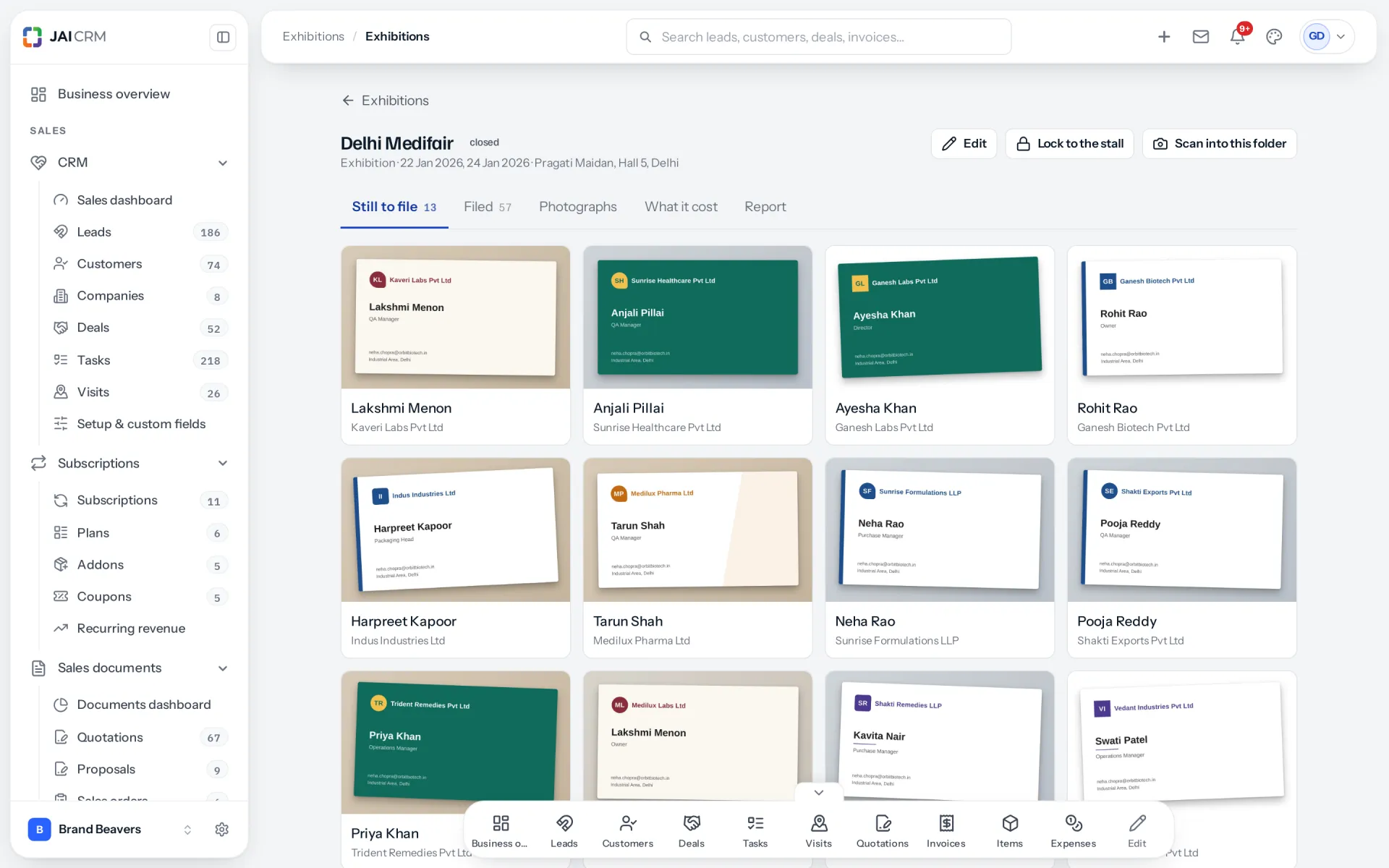
Filing a card as a lead or customer raises a follow-up task for its owner, due 48 hours later, carrying the voice note. The 48 hours is the same for every card. So a card filed on Tuesday evening at PMEC falls due on Thursday evening, the last day of the fair. PMEC closes at 17:00 that day: use the hour after closing for your hot calls.
Before you leave the hall each evening, post four numbers in the team group: cards scanned, hot leads, cards filed, and cards still to file. Three evenings of those numbers tell you more than any impression of how busy the stall felt.
After the fair: the first 48 hours
PMEC closes on Thursday 26 November, so its first 48 hours are Friday 27 and Saturday 28 November. CPHI closes a day earlier, on Wednesday 25 November.
- Hot leads: call within 24 to 48 hours, then send a short WhatsApp naming the fair and the next step.
- Warm leads: one email within three working days, with exactly what they asked for and one question.
- Cold leads: something useful within a week, not a sales push.
- Log every call, email or visit as done. The exhibition report counts only contact logged as done, so an unlogged call looks like no follow-up at all.
The full day-by-day plan, with messages to copy, is in How to follow up exhibition leads: a 7-day plan.
Was CPHI and PMEC India worth it?
Do not judge the fair in December. A pharma buyer usually has to approve a new supplier before the first order, and approval takes time.
The exhibition report in JAI CRM counts money actually received from the people you met, against everything the fair cost, staff days included. Won but unpaid orders are shown separately as owed. It gives no verdict before the fair, and shows Too early for the first three months, counting the fair’s own month as month 1, unless the fair has already paid for itself. For a fair that ends in November, the first verdict comes from 1 February 2027, two months before the financial year closes.
| Verdict | What it means |
|---|---|
| Book again | Money received is at least twice the cost |
| Paid its way | Money received is at least the cost |
| Watch | Below cost, with months of the counting window still to run |
| Reconsider | Below cost, and the counting window has closed |
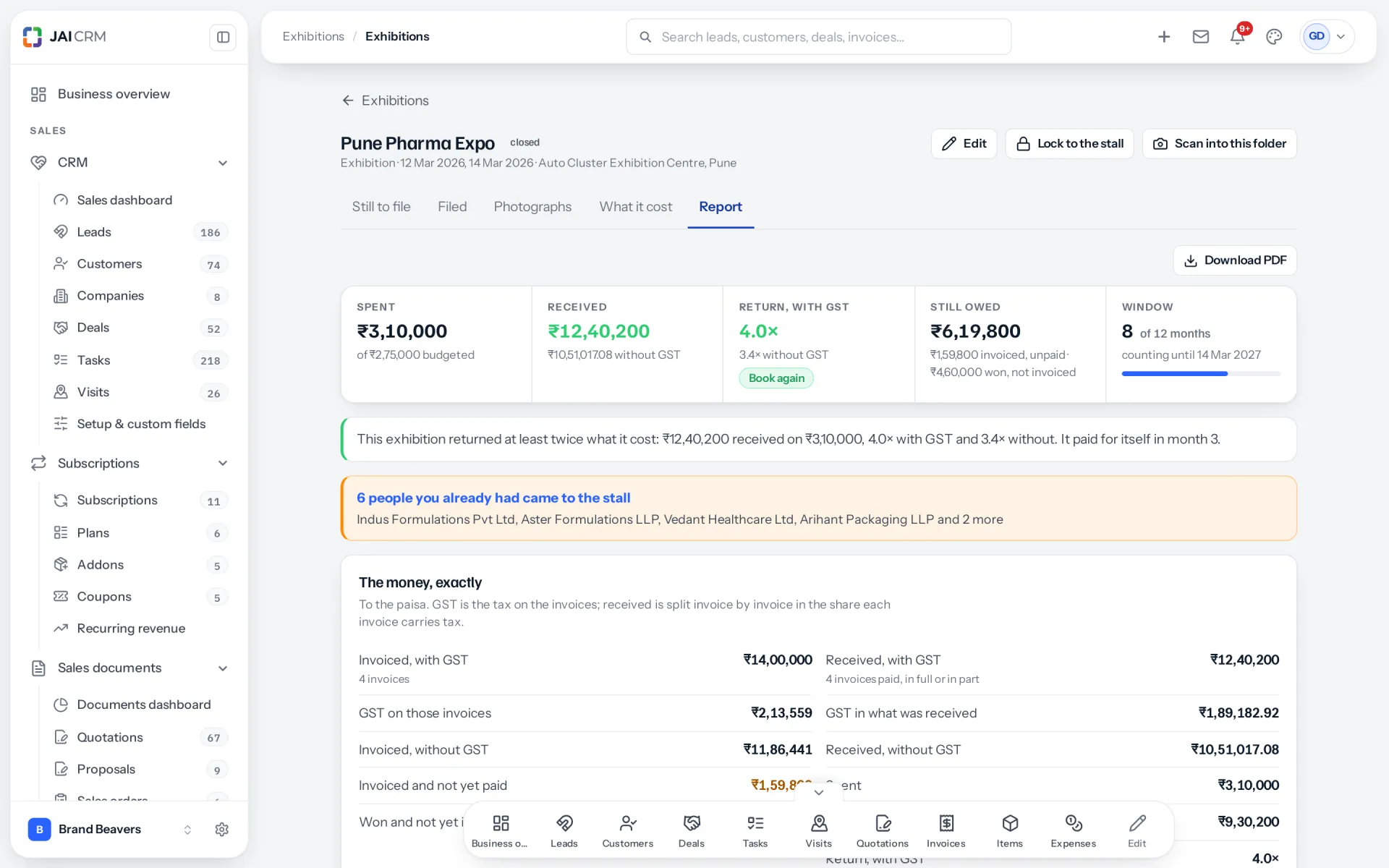
Here is the catch. The organiser says rebooking for 2027 opens in the last quarter of 2026, months before the money is in. You will rebook before you know whether this year paid. Decide on the evidence you have by then: hot leads called, meetings held, samples sent and quotes issued. Then check the verdict in February, and again in March before the year closes. What did your exhibition stall really earn? walks through the arithmetic.
Common questions
How much does it cost to exhibit at CPHI and PMEC India 2026?
The organiser does not publish stall rates (checked 10 October 2026). Ask for a written quote through the enquiry form on its Book your stand page. Its published rules say shell scheme starts at 12 square metres, and any stand under 27 square metres must be shell scheme. Add build, travel, stay and staff days to the stall price.
Should I exhibit at CPHI India or PMEC India?
Your product decides. APIs, excipients, finished dosage, natural extracts and fine chemicals go to CPHI India at IICC, Yashobhoomi, Dwarka, from 23 to 25 November 2026. Machinery, packaging, cleanroom and lab equipment go to PMEC India at IEML, Greater Noida, from 24 to 26 November 2026.
How many staff do I need at a CPHI or PMEC India stall?
For a 12 to 18 square metre shell stand, put three people on the rota with two on the stall at any time. Each person can hold one real conversation, and the third covers breaks across a 10:00 to 18:00 day. Include one senior person who can discuss terms.
What should I bring to CPHI and PMEC India?
One-page specification sheets, copies of the certificates and compliance documents your buyers ask for, samples, a QR code to your catalogue, plenty of visiting cards, and charged phones with power banks for scanning. Visitors come to find suppliers, so bring what a buyer’s quality team will need.
When should I book a stall for CPHI and PMEC India?
For 2026, ask the sales team now, because space-only stand designs are due by 25 October 2026. For 2027, the organiser says rebooking opens in the last quarter of 2026, and current exhibitors get a rebooking email about a month before the show.
Can my customers visit CPHI and PMEC India free?
Yes, if you invite them with your coupon codes from the Exhibitor manual, while the free invitations last. Otherwise a Standard visitor pass costs ₹999 plus tax until 1 November 2026, against a full price of ₹2,499 plus tax. One badge admits a visitor to both venues.
Correct as of October 2026. Dates, venues, opening hours, stand rules, deadlines and pass prices were checked on the organiser’s pages on 10 October 2026; the organiser can change them, so check its site before you book. The budget figures, the rota, and the people and companies in the messages are examples.
Next
See it with your own data
Start free, import a spreadsheet of your customers, and raise a real GST invoice in the first ten minutes. No card, no sales call.