

Compare trade fairs and IndiaMART by money received per rupee spent, over the same six months, not by the number of leads. IndiaMART usually brings more enquiries at a lower cost each. A fair brings fewer, longer conversations. Record the source of every lead, keep it on the customer, and divide after six months.
In short
- The measure
- Money received divided by full cost, for each channel, over the same six months
- Full cost
- The stall or the package, plus your people’s time, without GST if you claim input tax credit
- Source
- Set on every lead, and kept on the customer when the lead converts
- Timing
- Compare at six months at the earliest, then look again at nine
- Ignore
- Lead counts and cost per lead, which favour the cheaper, smaller enquiry
Why does counting leads give the wrong answer?
The easy comparison is a count. Six months on IndiaMART brings several hundred enquiries. A three-day fair brings a box of visiting cards, perhaps 150. On that count IndiaMART wins easily, and on cost per lead it wins by a distance.
Neither count answers the question you are paying to answer: which channel puts money in the bank. An enquiry and a visiting card are different things. Many marketplace enquiries are a buyer checking prices with several suppliers at once. A visiting card from the stall, the Indian name for a business card, usually follows a real conversation, with your product in front of the buyer.
Lead counts also hide order size. Ten enquiries that each become a ₹20,000 order bring in the same money as one conversation that becomes a ₹2,00,000 order. A lead count says the first channel is ten times better.
Count payments, not leads: a lead is a cost, and a payment is the result.
What one measure works for both channels?
Divide the money received from each channel’s customers by the full cost of that channel, over the same six months. Call the answer the return. A return of 2× means every rupee spent brought two rupees back.
Five rules keep the two figures comparable:
- The same period. Six months that start with the fair, and IndiaMART over the same six months.
- New customers only. Count customers first reached through the channel, not people who were already buying from you.
- Money received, not quoted or invoiced. A quotation is a hope and an unpaid invoice is a debt. Keep won but unpaid business as a separate “still owed” figure.
- The same GST basis. Money received with GST on both sides, or without GST on both. If the two channels sell goods at different GST rates, compare without GST.
- Full cost on both sides, including your people’s time. The next section lists what that means for each channel.
Put a second figure beside the return: money received less cost, in rupees. The return shows which rupee worked harder. The rupees left over show which channel paid more of your bills. The worked example below shows the two disagreeing.
What does each channel really cost?
The invoice is never the whole cost. For both channels, add your own people’s time, priced at what a day of their time costs you.
A trade fair
| Cost | What to include |
|---|---|
| Stall space | The organiser’s invoice, with power, furniture and any other hire |
| Stand build and design | Fabrication, graphics, setting up and dismantling |
| Travel and stay | Tickets, hotels, local travel and meals for everyone at the stall |
| Printing and the rest | Brochures, samples, freight for display goods, giveaways |
| Staff days at the fair | People multiplied by days, set-up day included, at a day rate |
| Follow-up afterwards | The days your team spends calling, visiting and quoting the people it met |
The last line is the easiest to forget, yet a fortnight spent chasing fair leads costs money, just as IndiaMART replies do. Our stall return calculator works through the fair side line by line.
IndiaMART
IndiaMART publishes prices for some of its seller packages on its own paid services page (updated 31 August 2026, checked 10 October 2026):
| Package | 1 year | 2 years | 3 years |
|---|---|---|---|
| Mini Dynamic Catalog | ₹35,000 | ₹72,000 | ₹90,000 |
| TrustSEAL Pro | ₹60,000 | ₹90,000 | ₹1,20,000 |
| Maximiser Pro | ₹85,000 | ₹1,30,000 | ₹1,70,000 |
| IM Star Pro, IM Leader Pro and IM Industry Leader | On request | On request | On request |
The page does not say whether these prices include GST, and it marks the Mini Dynamic Catalog prices with an asterisk it does not explain. Check the figure on your own IndiaMART invoice. Each package also carries a weekly BuyLead quota, listed on the same page.
For six months, take half of a one-year package, or the matching share of a longer one. Then add anything else bought from IndiaMART in the period, any photographs, videos or writing done for your catalogue, and the staff time spent reading enquiries, replying, calling and quoting.
Your people’s time
On IndiaMART, staff time can cost more than the package itself, as the example below shows. To price it, time one ordinary week. Note the minutes spent on IndiaMART enquiries each day, multiply up to six months, and price the hours at that person’s cost to you.
A day rate is the simplest unit. Take the person’s monthly cost to the company and divide it by working days: a coordinator costing ₹52,000 a month over 26 working days costs ₹2,000 a day.
Enter costs without GST if you claim input tax credit on them, otherwise with GST. Use the same rule for both channels.
How do you know which customers came from where?
The comparison is only as good as the source on each record. Three habits make the source reliable:
- Set the source when the lead is created. Nobody remembers in September where an April enquiry came from.
- Keep the source when the lead becomes a customer. Invoices and payments are raised on the customer, so a source left behind on the lead is lost to this comparison.
- Let the first contact win. A buyer who enquired on IndiaMART in February and visited your stall in April came from IndiaMART. Write the rule at the top of the worksheet and apply it to both channels.
Ask “Where did you find us?” on every new phone call too. A buyer who found you on IndiaMART and rang the number on your website is an IndiaMART customer, and no system will know unless somebody asks.
How IndiaMART enquiries reach JAI CRM
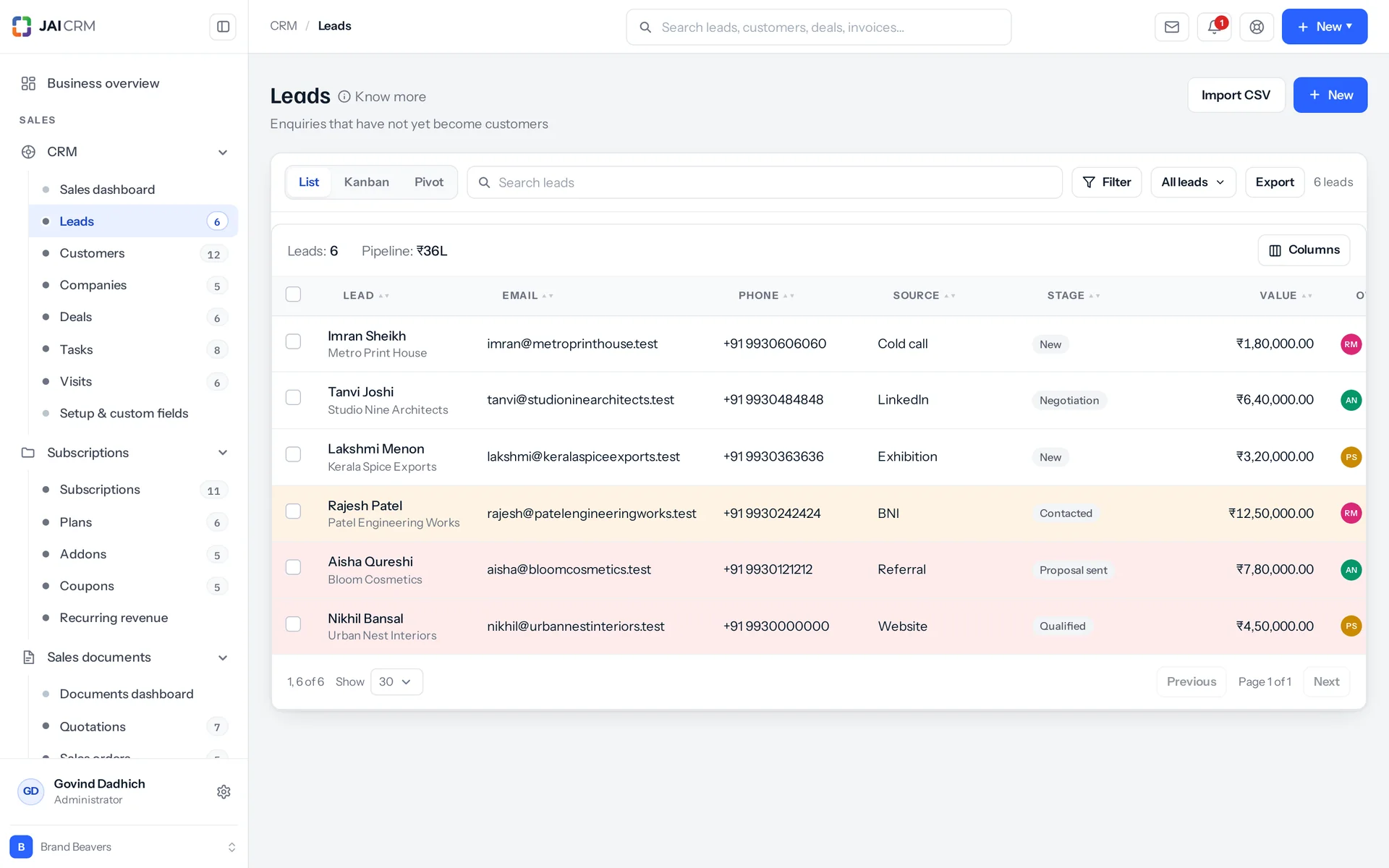
In JAI CRM, IndiaMART is an integration, included in every plan that has CRM. You set it up in Settings, Integrations: press Set up on the IndiaMART card and paste your key. From then on:
- JAI CRM asks IndiaMART for new enquiries every 15 minutes by default. You can choose anything from every 5 minutes, the limit IndiaMART sets, to once a day.
- Each enquiry becomes a lead with the source IndiaMART, carrying the buyer’s name, company, phone, email, address, city, state, PIN and what they asked about.
- By default, a repeat enquiry from somebody you already have, matched on phone or email, is written onto that lead or customer instead of making a second record. The record keeps its first source: the first-contact rule, applied for you.
- When a lead converts, its source carries to the customer and to the deal. Visiting cards filed from an exhibition carry the source Exhibition, and the exhibition’s name as a tag.
On IndiaMART’s side, the key comes from Lead Manager on seller.indiamart.com: open the three-dot menu, then Import/Export Leads, then Pull API. IndiaMART’s help page on the Pull API (checked 10 October 2026) says the API is for paid sellers, so a free listing cannot connect.
On your side, add IndiaMART to your Lead source list if it is not there yet: Settings, Fields & rules, Lists, spelt exactly IndiaMART. The leads carry the source either way. The list entry is what lets you choose IndiaMART in a filter on leads, customers and deals.
A worked example: one business, both channels, six months
An illustrative example. Meher Steelcraft is an invented business, and every figure here is made up to show the method. The arithmetic is exact.
Meher Steelcraft makes stainless steel kitchen equipment for hotels and caterers in Rajkot. From 1 April to 30 September 2026 it paid for two channels: a three-day trade fair for the hotel trade in Mumbai, 2 to 4 April, and IndiaMART’s Maximiser Pro at its published ₹85,000 a year. Costs are without GST, as Meher claims input tax credit. Money received includes GST. Both channels sold the same range, so GST does not change the ranking.
| What the fair cost | Without GST |
|---|---|
| Stall space | ₹1,44,000 |
| Stand build and design | ₹88,000 |
| Travel and stay | ₹45,600 |
| Printing, samples and the rest | ₹14,400 |
| Staff at the fair: 3 people for 4 days, so 12 days at ₹3,500 | ₹42,000 |
| Follow-up afterwards: 10 days at ₹3,500 | ₹35,000 |
| Total | ₹3,69,000 |
| What IndiaMART cost | Without GST |
|---|---|
| Maximiser Pro: six months of ₹85,000 a year | ₹42,500 |
| Product photographs and listing text | ₹6,000 |
| Replies, calls and quotations: 2 hours a working day for 156 days, so 39 days at ₹2,000 | ₹78,000 |
| Total | ₹1,26,500 |
Notice the staff line. The package cost ₹42,500 for six months; answering its enquiries cost ₹78,000.
| By 30 September 2026 | Trade fair | IndiaMART |
|---|---|---|
| Leads | 150 visiting cards | 550 enquiries |
| Cost per lead | ₹2,460 | ₹230 |
| New customers who paid | 6 | 11 |
| Share of leads that paid | 4.0% | 2.0% |
| Money received, with GST | ₹6,45,750 | ₹2,40,350 |
| Received per paying customer | ₹1,07,625 | ₹21,850 |
| Cost per paying customer | ₹61,500 | ₹11,500 |
| Return, with GST | 1.75× | 1.90× |
| Received less cost | ₹2,76,750 | ₹1,13,850 |
| Still owed: won, not yet paid | ₹2,21,400 | ₹37,950 |
| Return if everything owed is paid | 2.35× | 2.20× |
What the example teaches
- Lead counts exaggerated the gap. IndiaMART brought more than three and a half times as many leads, each at less than a tenth of the cost. On money per rupee, the two channels are close.
- Return and rupees can disagree. IndiaMART returned more per rupee, 1.90× against 1.75×. The fair left more money over: ₹2,76,750 against ₹1,13,850.
- Owed money can reverse the order. If the fair’s ₹2,21,400 arrives, its return rises to 2.35×, ahead of IndiaMART at 2.20×.
- Leaving out staff time flatters IndiaMART. On the package alone, ₹2,40,350 against ₹42,500 reads 5.66×, almost three times the true 1.90×.
The sensible decision for Meher is to keep both channels and look again at nine months, counting the same customers. Each channel has one thing to fix. IndiaMART takes two hours a day, which ready replies with one qualifying question could cut. The fair’s money is slow to arrive, so the ₹2,21,400 still owed needs chasing, and a quicker follow-up plan for the next fair would help.
How do you work the comparison in JAI CRM?
JAI CRM does not yet have a report of money received by lead source. Its Lead sources report counts leads, conversions and the leads’ estimated value, which is not money received. So the comparison takes one report for the fair, a filtered list and one report for IndiaMART, and a short worksheet.
The fair: the exhibition’s report
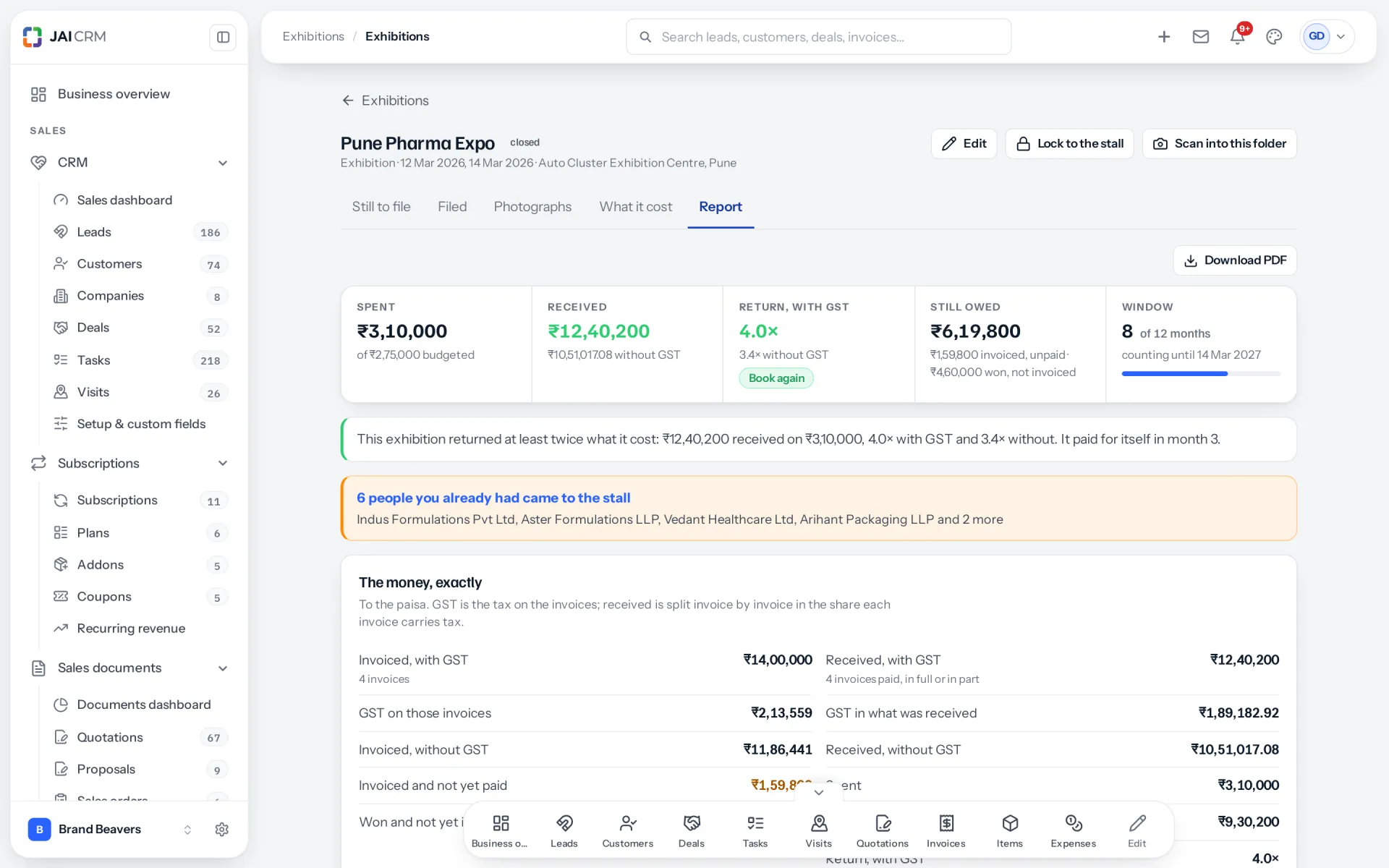
Enter the fair’s costs on the exhibition’s What it cost tab as the invoices arrive. Any cost line can carry Staff days and a Cost per person per day, so add one for the follow-up days. The report then shows Spent, Received (with GST, and without GST beneath it), Return, with GST, Still owed and the Window, to the paisa.
Received counts every rupee paid so far against invoices for the people you met there, including any TDS they deducted. Open the report at the end of your six months and Received is your figure. Later, read Received so far at the sixth month of the chart When the money arrived, where the month the fair ended is month one.
In the example, the fair at 1.75× in month 6 of its 12-month window would read Paid its way. At 2.35× it would read Book again, the verdict for at least twice the cost. What a stall was worth: the exhibition report explains every figure.
IndiaMART: a filter, a report and a sum
- List the IndiaMART customers. Open Customers, choose Filter, set Source is IndiaMART, then Export as CSV.
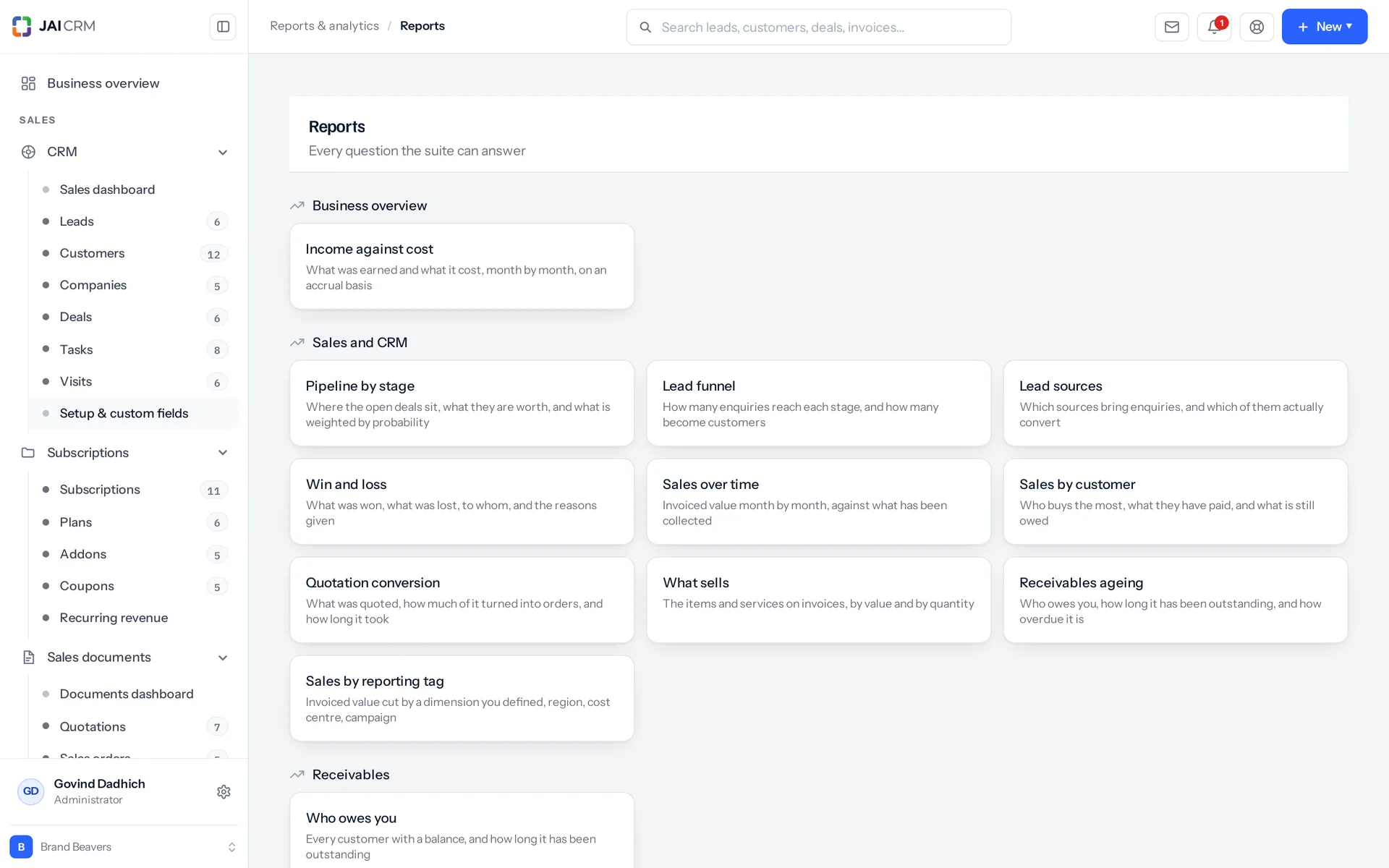
- Run Sales by customer for the six months. In Reports, open Sales by customer, set Period to Custom dates, from 1 April to 30 September, and download the CSV. Each row shows a customer’s Invoiced, Paid and Outstanding for invoices dated in the period.
- Run the same report for the twelve months before. Any IndiaMART customer on that list was already buying, so leave them out.
- Add up in a spreadsheet. For every customer on the IndiaMART list and not on the earlier report, total Paid for money received and Outstanding for still owed.
The sum, in Excel or Google Sheets. Open the six-month report. Names sit in column A, Paid in D and Outstanding in E, from row 8. Paste the IndiaMART customers’ names into column J and the earlier report’s names into column K. In H8 type:
=AND(COUNTIF(J:J,A8)>0,COUNTIF(K:K,A8)=0)
Fill it down. Money received is =SUMIF(H:H,TRUE,D:D) and still owed is =SUMIF(H:H,TRUE,E:E).
Paid already includes TDS, because an invoice is settled when payment plus TDS covers its total. Both sides therefore count money the same way. Check by hand any two customers who share a name. For deals won but not yet invoiced, filter Deals by Source is IndiaMART and your won stage, and add their value to still owed.
What the built-in reports tell you
- Lead sources: leads per source, how many converted, the conversion rate, and the leads’ estimated value. Enquiry quality, not money.
- Win and loss, grouped by Source: deals won and lost per source, and the value won. Deal values, not payments.
- Sales by customer: invoiced, paid and outstanding per customer, for any dates.
- Reports, Exhibitions: every exhibition side by side, with cost, money received and verdict.
A worksheet to copy
| Line | Trade fair | IndiaMART |
|---|---|---|
| Period | 1 April to 30 September | 1 April to 30 September |
| Full cost | Spent, on the exhibition’s report | Package share, extras and staff time |
| Money received, with GST | Received, at month six | Sum of Paid for new IndiaMART customers |
| Still owed | Still owed | Sum of Outstanding, plus won deals not yet invoiced |
| Return | Received divided by cost | Received divided by cost |
| Received less cost | In rupees | In rupees |
| Look again | At nine months, same customers | At nine months, same customers |
When does each channel suit your business?
The worksheet decides, but the shape of your business often hints at the answer before you start:
| Signal | Tends to suit IndiaMART | Tends to suit a fair |
|---|---|---|
| What you sell | Standard catalogue items, compared on price and specification | Custom, engineered or high-value goods that buyers want to see and handle |
| Order size | Many small and mid-sized orders | Fewer, larger orders |
| Sales cycle | Days to a few weeks | Months, with samples, visits and negotiation |
| Who buys | Buyers searching for a supplier today | Dealers, distributors and buyers planning next year |
| Your team | Somebody free to reply within minutes, all day | People who sell well face to face |
A business with both kinds of product may find that both channels pay, for different products. In that case, run the worksheet once for each product line.
A fair also does work no worksheet measures: existing customers visit, and you see what competitors show. The exhibition’s report lists those customers under People who came back. Treat them as a reason to go, not as new money.
Common questions
Is IndiaMART better than trade fairs for B2B leads?
Neither is better everywhere. IndiaMART usually brings more enquiries at a lower cost each, while fairs bring fewer, deeper conversations. Compare money received per rupee spent on each, over the same six months, with staff time in both costs.
How do I measure IndiaMART ROI?
Add your package’s share for the period to the staff time spent on its enquiries. Divide the money received from new customers who first came through IndiaMART by that cost. Record the source on every lead so each payment traces back.
Why do IndiaMART leads feel low quality?
Many marketplace enquiries are early price checks from buyers comparing several suppliers. A quick reply with one qualifying question separates real buyers from comparisons. Judge the channel by money received, not by how many enquiries feel promising.
How long should I compare lead sources before deciding?
At least six months for business buyers, so both channels have time to convert and pay. Look again at nine months with the same customers. Shorter comparisons favour the channel with faster, smaller orders.
Does the IndiaMART integration cost extra in JAI CRM?
No. It is included in every JAI CRM plan that has CRM, from ₹149 per user per month paid annually, plus GST. You also need a paid IndiaMART package, because IndiaMART offers its lead API to paid sellers.
Correct as of October 2026. Meher Steelcraft, its fair, costs, leads and payments are invented examples. IndiaMART’s package prices and API rules are as published on its help centre, checked 10 October 2026; check the current pages before you budget. JAI CRM prices are on the pricing page.
Next
See it with your own data
Start free, import a spreadsheet of your customers, and raise a real GST invoice in the first ten minutes. No card, no sales call.