

Credit each sale from a fair to the person who first met that customer at the stall, and count money received, not cards scanned. Compare people on payments received, follow-up done and customers won. The person who scans the most cards is not always the one who brings in the most money.
In short
- Credit
- The person who met the customer at the stall, through their card
- Count
- Money received, with and without GST, not cards scanned
- Compare
- Received, customers won, follow-up done and money still unpaid
- No card
- Its own row, Not from a card, never shared out among the team
- When
- About four months after the fair, once buyers have ordered and paid
Why does “most cards scanned” reward the wrong thing?
The easiest number to collect after a fair is how many visiting cards (business cards, if you call them that) each person brought back. It is also the easiest number to win: take every card offered, scan, smile, next. By the last evening one person has 60 cards and another has 20, and the first looks like the star.
A card count measures speed at the stall, not the quality of the conversation. A student, a competitor’s salesman and a brochure collector each hand over a card, just as a buyer who needs a new supplier by March does. Reward cards and people stop asking the second question, because the second question costs them the next visitor.
JAI CRM shows the gap. In its exhibition report, Cards counts every card a person took, including those later thrown away. Filed counts the cards that became a lead, a customer or a supplier. Cards binned as “A competitor”, “Not relevant” or “Personal” are the difference.
Money received is slow to arrive, but it cannot be inflated at the stall. That makes it the measure to settle on.
Who should get the credit when one person meets the customer and another closes the sale?
Decide the credit rule before the fair, not after you have seen the results. A rule made up afterwards always looks as if it was made to fit somebody’s numbers.
The fairest rule for a stall: credit each sale to the person who first met that customer at the stall. The reasons:
- It rewards what only the stall can do. A good first conversation is what makes the follow-up call welcome rather than cold.
- It is a fact on the day. Who met the visitor is known when the card is taken. Who “really” closed a deal is an opinion weeks later.
- It does not move. Credit that changes whenever somebody edits a record is credit nobody trusts.
- Closing can be rewarded separately. A deal has its own owner, and the Win and loss report in Reports can be grouped by Owner.
Do not split one sale between two people; splits produce arguments about percentages. If two people work a visitor together, whoever has the main conversation takes the card.
How does JAI CRM decide who met each visitor?
In the Exhibitions module, the scan screen decides. Under the title Scan cards a line reads Scanning as, followed by a name. Every card taken while that line names Priya is Priya’s card.
On your own phone, signed in as yourself, there is nothing to do. On a shared stall phone, tap the line whenever the phone changes hands. The choice lasts while Scan cards stays open: come back to the screen and the line names whoever is signed in again, so check it before each visitor. Who is scanning? lists the people in your team who are allowed to scan, each with their email, so two colleagues with the same name cannot be confused. If nobody is chosen, the cards belong to whoever is signed in. JAI CRM records each time someone starts scanning on a colleague’s behalf.
The same person owns the lead or customer the card becomes, unless an assignment rule sends it elsewhere. Credit does not follow the owner. A lead routed to a specialist by a rule is still credited to the person who met them.
Deals and invoices follow the card
Every deal and every invoice of the exhibition is credited to exactly one person:
- A deal through its lead’s card, or else its customer’s card.
- An invoice through its deal’s card, or else its customer’s card.
- Invoices and bills of supply count. Drafts, cancelled and void documents and replaced revisions do not.
Whether a deal belongs to the exhibition at all is decided once, when the deal is made. A deal from a card’s lead belongs to it with no time limit. A deal raised directly on a customer met there counts only inside the exhibition’s window: 12 months from its last day, unless you change it. The full rules are in Where every figure comes from.
A lead that became a customer
When a lead from a card is converted, the customer keeps the lead’s card for crediting. An invoice raised on the customer in August is still credited to whoever scanned the lead in March. Invoices on a deal from that lead count however long it takes; invoices raised straight on the customer count inside the window.
Somebody met twice
Priya meets a buyer on the first morning and Rohan meets him again on the last afternoon. Each card counts in Cards for whoever took it. The money is credited once, to the first card taken.
Across two fairs the rule is the same. Each lead, customer and supplier has an Event field naming the first exhibition they were met at, set once and never moved, and their business is credited there. At the later fair they appear under People who came back, with the earlier exhibitions where you met them.
Money with no card behind it
A customer you already had walks up, a colleague records them with Met at the stall, and they order the next month. Or a manager attaches a deal to the exhibition by hand. Neither has a card, so neither has a person.
Money with no card behind it belongs on its own row, never shared out. JAI CRM calls the row Not from a card, described on screen as “Walk-ups, and deals or invoices attached by hand”, and puts it at the bottom.
Read that row. A large figure means the fair brought existing customers back, which is good news, or your team talked to people without scanning them, which is a habit to fix. (A walk-up counts for the fair only if no earlier exhibition is already credited with them.)
What does the “Who did the work” table show?
Open an exhibition, go to its Report tab, and scroll to Who did the work. There is one row per person:
| Column | What it counts |
|---|---|
| Person | The name, with the share of their cards filed and how many of their deals were won |
| Cards | Every card they took, including ones later thrown away |
| Filed | Cards that became a lead, a customer or a supplier |
| Deals | Deals credited to them through their cards: open, won or lost |
| Won | Deals won, with their total value |
| Invoiced | The total of the invoices credited to them, with GST |
| Received | What has been paid on those invoices, with the amount without GST underneath |
Rows from cards come first, highest Received at the top. Not from a card comes last, and Everybody adds them all up. Every deal and invoice sits in exactly one row, so Everybody matches the exhibition’s own totals.
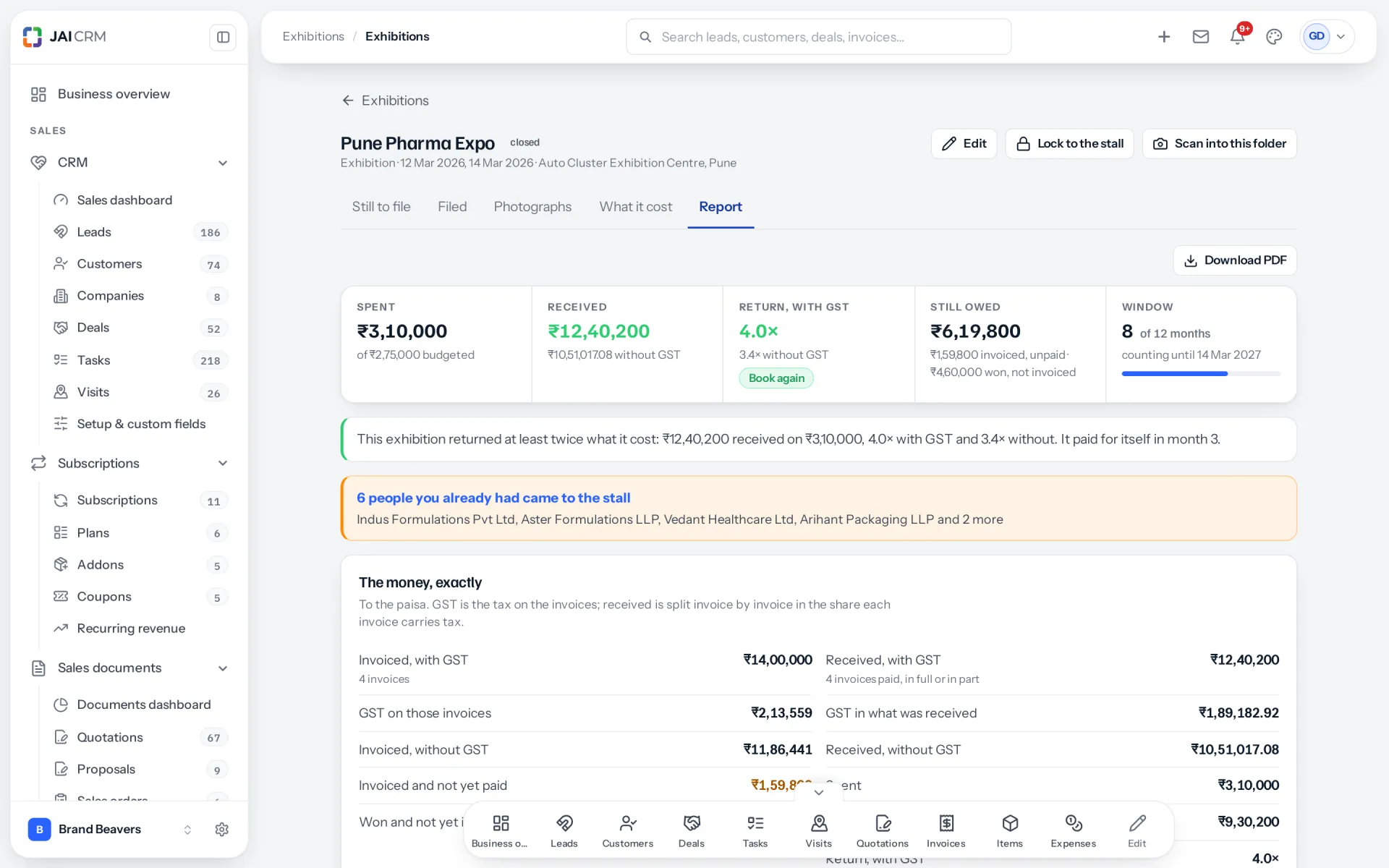
Press a number to see the records behind it
Press Filed, Deals, Won, Invoiced or Received on a row (any figure but Cards, unless it is zero) and a side panel opens with the actual records, in four tabs:
- Records: the leads, customers and suppliers their cards became. A converted lead shows “became customer” and the customer’s name.
- Deals and Won: each deal with its amount, and whether it is open, won or lost.
- Invoices: number, customer, date and total, split into the amount and its GST, then “Paid in full” or what has been paid, with the totals underneath.
Each item opens its own page. A number someone can check is a number they will accept.
The same table across every fair
Reports, Exhibitions has the same table, called Who worked the stalls, adding up each person across every exhibition in the period: All, This year, Last year or 12 months. Its panel says which exhibition each record came from. The Reports catalogue has it too, and both reports download as PDF. See Every exhibition side by side.
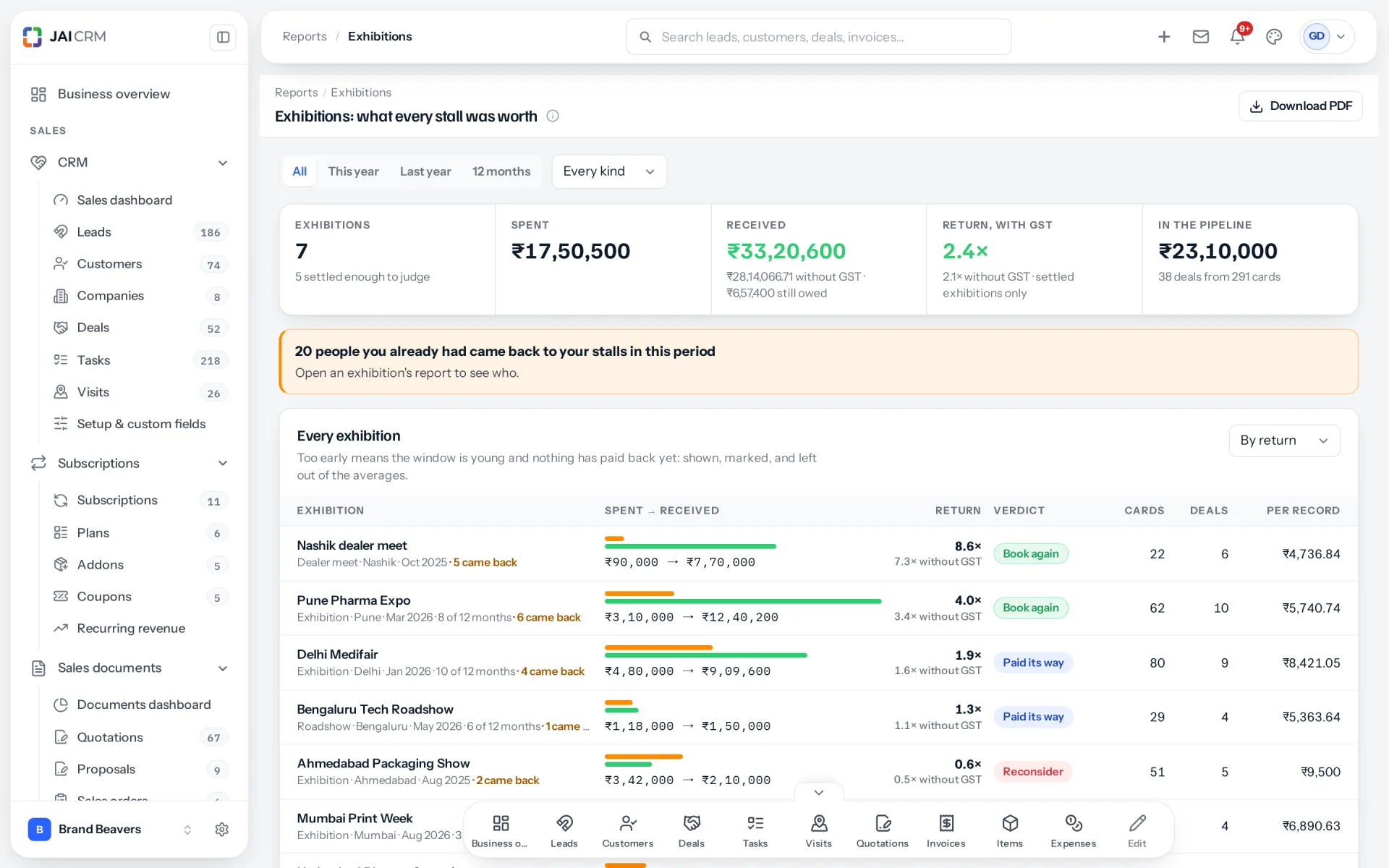
A worked example: three people, one fair
Example. A firm takes a stall at a three-day trade fair. Priya, Rohan and Farhan work it, each scanning on their own phone. There are no assignment rules, so each person owns the records from their own cards. Every invoice carries GST at 18%. The fair cost ₹3,85,000 including staff days, entered without GST because the firm claims the input tax credit. This is the report five months after the fair. The names and amounts are made up to show the method.
The stall work, in the order the report lists it (highest Received first):
| Person | Cards | Filed | Deals won |
|---|---|---|---|
| Rohan | 22 | 21 | 4 of 8 |
| Farhan | 35 | 30 | 2 of 5 |
| Priya | 64 | 58 | 2 of 6 |
| Not from a card | 0 | 0 | 1 of 1 |
| Everybody | 121 | 109 | 9 of 20 |
Under Priya’s name the screen reads “91% of cards filed · 2 of 6 deals won”. Won also shows the value of the deals won, which this team enters before GST: ₹6,00,000 for Rohan, ₹1,80,000 for Farhan, ₹2,00,000 for Priya and ₹90,000 not from a card.
The money received:
| Person | Received, with GST | Received, without GST |
|---|---|---|
| Rohan | ₹5,90,000 | ₹5,00,000 |
| Farhan | ₹2,12,400 | ₹1,80,000 |
| Priya | ₹1,91,600 | ₹1,62,372.88 |
| Not from a card | ₹1,06,200 | ₹90,000 |
| Everybody | ₹11,00,200 | ₹9,32,372.88 |
Priya’s paise come from a part-paid invoice: ₹50,000 received on ₹94,400. The report takes GST out of a part payment in the same share as the whole invoice carries it, so ₹7,627.12 of that ₹50,000 is GST and ₹42,372.88 is not. Her other invoice, ₹1,41,600, is paid in full.
Invoiced, and still unpaid:
| Person | Invoiced, with GST | Not yet paid |
|---|---|---|
| Rohan | ₹7,08,000 | ₹1,18,000 |
| Farhan | ₹2,12,400 | Nothing |
| Priya | ₹2,36,000 | ₹44,400 |
| Not from a card | ₹1,06,200 | Nothing |
| Everybody | ₹12,62,600 | ₹1,62,400 |
Not yet paid is Invoiced less Received, worked out by hand; the table has no such column. The exhibition’s own Still owed figure also adds deals won and not yet invoiced.
The fair as a whole received ₹11,00,200 on ₹3,85,000 spent: 2.9× with GST, 2.4× without, and the verdict Book again. The fair worked. The question is who made it work.
What the example tells you
- The busiest scanner brought in the least. Priya took more than half the cards, 64 of 121. Her customers paid less than a fifth of the money received.
- The quietest scanner brought in the most. Rohan took under a fifth of the cards. His customers paid more than half.
- Received per card turns the ranking over. Divide Received (with GST) by Cards: ₹2,993.75 for Priya, ₹6,068.57 for Farhan, ₹26,818.18 for Rohan. The report does not show this figure; a calculator does.
- Follow-up explains part of it. The report’s Following up section lists everyone Never contacted, longest waiting first, with their owner: here 17 of Priya’s people, 4 of Farhan’s and 1 of Rohan’s. The screen shows the eight waiting longest and how many more; the PDF lists up to 25.
- Unpaid is not lost. Chase Rohan’s ₹1,18,000 before you judge anyone on it.
The table does not tell you why. Priya may have had the front of the stall at the busiest hours, among browsers. Her deals panel shows which of her other four deals are still open. And one large order can move a person from the bottom to the top. Judge a person across several fairs before you judge them on one.
How do you share these numbers without starting a fight?
- Agree the rule before the fair, in writing, so nobody can say it was invented to suit a result. A message to copy is below.
- Wait for the money. Before about four months the table mostly shows who scanned fastest. JAI CRM marks an exhibition Too early in its first three months, counting the fair’s own month as month 1, unless it has already paid back. Treat each person’s row the same way.
- Open the records, not just the totals. Go through each person’s panel with them. A disputed figure is usually settled by the list behind it.
- Talk about habits, not rank. Ask what Rohan did in his conversations, and what Priya would need to do the same. Keep the table off the office WhatsApp group.
- Make logging part of the rule. Follow-up counts only a call, email, meeting, WhatsApp or SMS logged as done, or a visit made. A call nobody logged is invisible, and the person who made it will feel cheated.
- Pay on money received, if you pay at all. An incentive on cards buys more cards. Say in advance that any reward follows money received inside the window.
- Judge supplier work as supplier work. Someone who met suppliers for your buying team shows filed records and no sales. Measure them on the suppliers they found.
A message to send before the fair: For [fair name]: whoever takes a visitor’s card gets the credit for what that visitor buys from us. Scan every conversation that matters, add a grade and a note, and log every follow-up call. On the shared phone, check the “Scanning as” line before every card and choose your own name. We will look at the results together in [month], four months after the fair, counting money received, not cards.
What should you change for the next fair?
The point of the table is the next stall, not the last one.
Put your converters on the stall at the busy hours
The report’s When the stall was busy section shows cards taken by day and by hour. Put the people with the highest received per card on the stall when traffic peaks.
Set a target of conversations, not cards
Ask each person for real conversations, each with a grade and a note. A card marked hot, with ten seconds of the visitor’s own words, gives the follow-up more than five bare cards. See grading leads at the stall and what to note on a visiting card. The report’s Hot, warm or cold section shows how many of each grade became a deal.
Fix the handover on shared phones
Add one line to the stall checklist: whoever picks up the shared phone checks the “Scanning as” line before each visitor, and taps it to choose their own name. Two taps on the day save an argument five months later. Better still, give each person their own phone, signed in as themselves.
Clear the never-contacted list first
Before you book the next stall, ring the people from this one that nobody has called. Each card filed as a lead or customer raised a follow-up task for its owner, due 48 hours later and carrying the voice note, so every one of them has a name on it. The 7-day follow-up plan has the messages to send.
Then compare again across both fairs in Who worked the stalls. One fair shows a result; several show a pattern you can manage.
Common questions
How do I measure each salesperson’s performance at a trade fair?
Credit each sale to the person who first met the customer at the stall. Then compare money received, customers won and follow-up done, rather than the number of visiting cards each person collected. Judge after about four months, once buyers have had time to order and pay.
Who should get credit when one person meets a lead and another closes it?
Decide before the fair and apply the rule to everyone. Crediting the person who met them rewards good conversations at the stall. Reward closing separately: in JAI CRM a deal has its own owner, and the Win and loss report can be grouped by Owner.
Why doesn’t the person with the most cards bring in the most business?
A card count rewards speed. A short conversation rarely uncovers a need, a budget or a date, so the follow-up has little to work with. Fewer, longer conversations with the right visitors give the follow-up something to build on.
When should I compare team performance after an exhibition?
After about four months, once business buyers have had time to order and pay. Earlier comparisons mostly measure who scanned fastest. JAI CRM marks an exhibition Too early in its first three months, counting the fair’s own month as month 1, unless it has already paid back.
What happens to sales from a fair that did not start with a scanned card?
Keep them visible on their own line. In JAI CRM they sit on a row called Not from a card: customers who walked up and were recorded with Met at the stall, and deals or invoices attached to the exhibition by hand. They are never shared out among the team.
Should team performance be compared with GST or without?
Look at both, and compare everyone on the same basis. The GST in a payment is owed to the government, so the figure without GST is the fairer one for incentives. JAI CRM shows Received with GST and, under it, without GST, exact to the paisa.
Correct as of October 2026. Priya, Rohan and Farhan, the fair and every figure in the worked example are examples, made up to show the method. The two screenshots are from a demo business. Screen labels are as JAI CRM shows them on 10 October 2026.
Next
See it with your own data
Start free, import a spreadsheet of your customers, and raise a real GST invoice in the first ten minutes. No card, no sales call.