

A hot lead has a need, a budget and a timeline within about three months. A warm lead has a real need but no timeline yet. A cold lead is curious or researching. At a stall, ask what they use now, what is not working and when they want it fixed, then grade the card before the next visitor.
In short
- Hot
- A need, money to spend, and a date within about three months
- Warm
- A real need, but no date or budget yet
- Cold
- Curious, researching, or collecting brochures
- Ask
- What do you use now? What is not working? When do you want it fixed?
- When
- Grade the card before the next visitor, not that evening
- Check
- After the fair, see whether hot leads became deals more often than warm and cold
What do hot, warm and cold leads mean?
The three grades sort visitors by how soon they are likely to buy, so your time after the fair goes where the money is. A grade is not a score for how pleasant the conversation was. Sales teams know the same idea from checklists such as BANT (budget, authority, need, timing).
Hot lead
A hot lead has a clear need, money to spend and a timeline within about three months. Hot leads talk about quantities, dates, delivery and price. Many have a current supplier who has let them down.
Example: the purchase head of a pump maker in Coimbatore says their casting supplier has missed two dispatches. They use about 2,000 impeller castings a month and want a trial lot of 500 next month.
Warm lead
A warm lead has a real need but no timeline or budget yet. The problem is real; the decision is not close. Warm leads ask for a catalogue or a price range “for later”.
Example: a pharma plant in Baddi plans a new blister packing line next financial year. The plant head wants to know your foil grades and minimum order, but nothing is approved.
Cold lead
A cold lead is curious, researching or collecting brochures, with no need you could name. Some cold leads become customers much later, which is why a cold lead is still a lead.
Example: a trader from Indore walks the hall to see what is new in packaging and takes a brochure from every stand.
| Grade | What you hear | Examples from other trades |
|---|---|---|
| Hot | “Can you quote by Friday?” | A Faridabad panel builder needs 400 MCBs for a hospital project starting next month. |
| Warm | “Send me the details, we review suppliers in March.” | A Vapi dye house will replace its effluent pumps when a new unit opens, date not fixed. |
| Cold | “Just looking around this year.” | A consultant collecting supplier names for a client report. |
People who are not leads at all
A competitor’s salesperson, a job seeker or a student on a project is not a cold lead. Keep those cards out of your lead list, or they will bend every figure you measure later. A visitor who wants to sell to you is a possible supplier, not a lead: see checking a supplier you met at a trade fair.
Which three questions grade a visitor at the stall?
You do not need a form. Three open questions, asked in whatever language the visitor is speaking, show need and timing within a minute.
- “What do you use now?” The answer shows whether they buy this at all, from whom, and in what quantity.
- “What is not working?” The answer finds the need. A late supplier, a rejected batch, a machine that stops twice a week: a named problem is the strongest sign of a real buyer. “Nothing really” usually means warm at best.
- “When do you want it fixed?” The answer sets the timeline. “Before the next audit” or “this quarter” points to hot. “Sometime next year” points to warm.
Why not simply ask “Are you interested?” Everyone says yes, because no feels rude. Questions about the visitor’s own business get honest answers, and those answers grade the visitor for you.
How the three answers add up:
| Uses something now? | Named problem? | Date within about three months? | Grade |
|---|---|---|---|
| Yes | Yes | Yes | Hot |
| Yes | Yes | No | Warm |
| No, but starting a new line | Yes | Yes | Hot if the project is approved, otherwise Warm |
| Yes or no | No | No | Cold |
Finding the budget without asking for it
“What is your budget?” feels pushy in most Indian business conversations, and the answer is rarely true. Ask about volume and the current price instead, and work the budget out yourself.
Worked example: a visitor buys 5,000 printed cartons a month at ₹14 each. That is ₹70,000 a month, or ₹8,40,000 a year before GST. You know the size of the account without asking, and whether a plant visit is worth a day.
Who decides?
Glance at the visiting card while they talk. The title on a business card shows who could sign, not whether anyone will. A purchase executive can be a hot lead if the owner has asked them to find a new supplier this month. If it matters, ask one more question: “Who else looks at this before you order?”
Which signals can you trust, and which can you not?
Visitors are polite, and many signals that feel warm at a stall cost the visitor nothing.
| Signal | Trust it? | Why |
|---|---|---|
| “Can you visit our plant next week?” | Yes | They are giving you time and access to their shop floor. |
| They name a quantity and a date | Yes | People do not make up numbers for a stranger. |
| They ask about payment terms, credit days or GST invoicing | Yes | Those are the questions a buyer asks just before an order. |
| They ask what you need for their vendor registration | Yes | They are already planning the paperwork to buy from you. |
| They come back to the stall with a colleague | Yes | A second person means the decision is shared and moving. |
| They give a personal mobile and say “call me” | Mostly | A personal number is more than a card, but check the three answers too. |
| “Send me your catalogue” | No | Asking for a catalogue is often the polite way to end a conversation. |
| A long, friendly conversation | No | Friendliness measures the visitor’s manners, not their need. |
| “We will definitely order” | No | A promise without a quantity or a date is usually a goodbye. |
| A senior title on the card | Not alone | Seniority shows who could sign, not whether anyone will. |
One rule covers the whole table: a signal you can trust costs the visitor something to give.
Why grade the card before the next visitor arrives?
By the second afternoon of a fair, the conversations blur. A grade given that evening is a guess based on the company name.
Grading later fails because you grade the card, not the conversation. The card says “Operations Manager” at a pharma company in Pune. Only the conversation said “deliveries are always late, and we need a quote by Friday”.
Make grading a two-second habit:
- Grade as the visitor walks away, before you greet the next one.
- Add one line on why. Speak it if writing is too slow.
- If you are unsure between two grades, choose the lower one and say what you did not find out, such as “no date yet”. A lead graded too high takes a first-day call that somebody else needed; one graded too low still hears from you within days.
A one-line note that anybody on the team can copy:
Grade. Problem. Quantity. Date. Promise.
Example: “Hot. Casting supplier late twice. 2,000 a month. Trial lot next month. Promised a quote by Friday.”
Example: “Warm. New blister line next financial year. Quantity not known. Wants foil grades and minimum order.”
Why the grade matters on the first day back
Grading decides who gets your best hours. Say your team brings back 240 cards, and a good first call takes about 15 minutes with preparation (an example figure; time your own). Calling all 240 takes 60 hours. If 30 are hot, those calls take seven and a half hours and can all happen in the first two days.
Why three grades, and not a lead score out of 100?
Points-based lead scoring suits website leads, where software records every page visited and email opened. At a stall, nothing is recorded except what your people notice, and two people will score the same visitor differently. Three grades with clear rules give the same answer whoever is standing at the stall. All you need is the order of calls on Monday morning.
What should each grade get after the fair?
The grade decides the channel and the weight of the first contact. How to follow up exhibition leads: a 7-day plan has the full schedule and the messages to send. In short:
| Grade | First contact | Channel | What to send | After that |
|---|---|---|---|---|
| Hot | Within 24 to 48 hours | A call, then a WhatsApp | The next step you agreed: samples, a visit or a quote date | Weekly contact until there is a decision |
| Warm | Within 3 working days | The one thing they asked for, plus one question | Something useful every two to four weeks | |
| Cold | Within 7 days | Something useful, not a sales push | An occasional update, such as a new product or price list |
These timings are your team’s plan, not a software setting. Two points matter more than the exact days.
- The grade decides what you send, and the visitor’s own words decide how it reads. A message that names their late supplier gets a reply. A message that could go to anyone does not.
- Regrade after the first real conversation. A warm lead who says “our supplier just let us down again” is now a hot lead.
For what to say in the first ten seconds of a voice note, see what to write on the back of a visiting card.
How do you check your grading after the fair?
A grade is a prediction, and a prediction should be checked against what happened. Good grading means hot leads became deals more often than warm ones, and warm more often than cold.
Check twice. At about four weeks, look at how many cards were graded at all. At about four months, look at which grades became deals: business buyers met at a fair rarely decide within weeks, so an earlier verdict is unfair to the warm leads.
What good grading looks like
An example exhibition with 210 cards:
| Grade | Cards | Became a deal | Share |
|---|---|---|---|
| Hot | 32 | 13 | 41% |
| Warm | 78 | 16 | 21% |
| Cold | 85 | 3 | 4% |
| Not marked | 15 | 2 | 13% |
The share steps down cleanly from hot to cold, so the team called the right people first. Even the 15 unmarked cards produced two deals, so grade every card next time.
What weak grading looks like
Another example with the same 210 cards:
| Grade | Cards | Became a deal | Share |
|---|---|---|---|
| Hot | 64 | 9 | 14% |
| Warm | 52 | 8 | 15% |
| Cold | 60 | 3 | 5% |
| Not marked | 34 | 4 | 12% |
Here hot did no better than warm. Almost a third of all cards were called hot, so “hot” had come to mean “a nice conversation”. And 34 cards were never graded, most likely in the rush hours.
What to change for the next fair
- If hot did no better than warm: make hot stricter. Ask for all three answers: something they use now, a named problem, and a date within about three months. Two out of three is warm.
- If many cold leads became deals: either your light follow-up worked, or the team graded quiet visitors too low. Ask the people who met those buyers.
- If many cards were not marked: grading broke down when the stall was busy. Put an extra person on the stand at those hours, or make “say the grade first” the rule for every voice note.
- Before the next fair: brief the team with three real examples from this one, one per grade, in the visitors’ own words.
Do not borrow a conversion rate from somebody else’s industry. Your own last fair is the benchmark that matters.
How does JAI CRM handle hot, warm and cold?
In the Exhibitions module, the grade is one press on each card, and the exhibition report checks your grading for you.
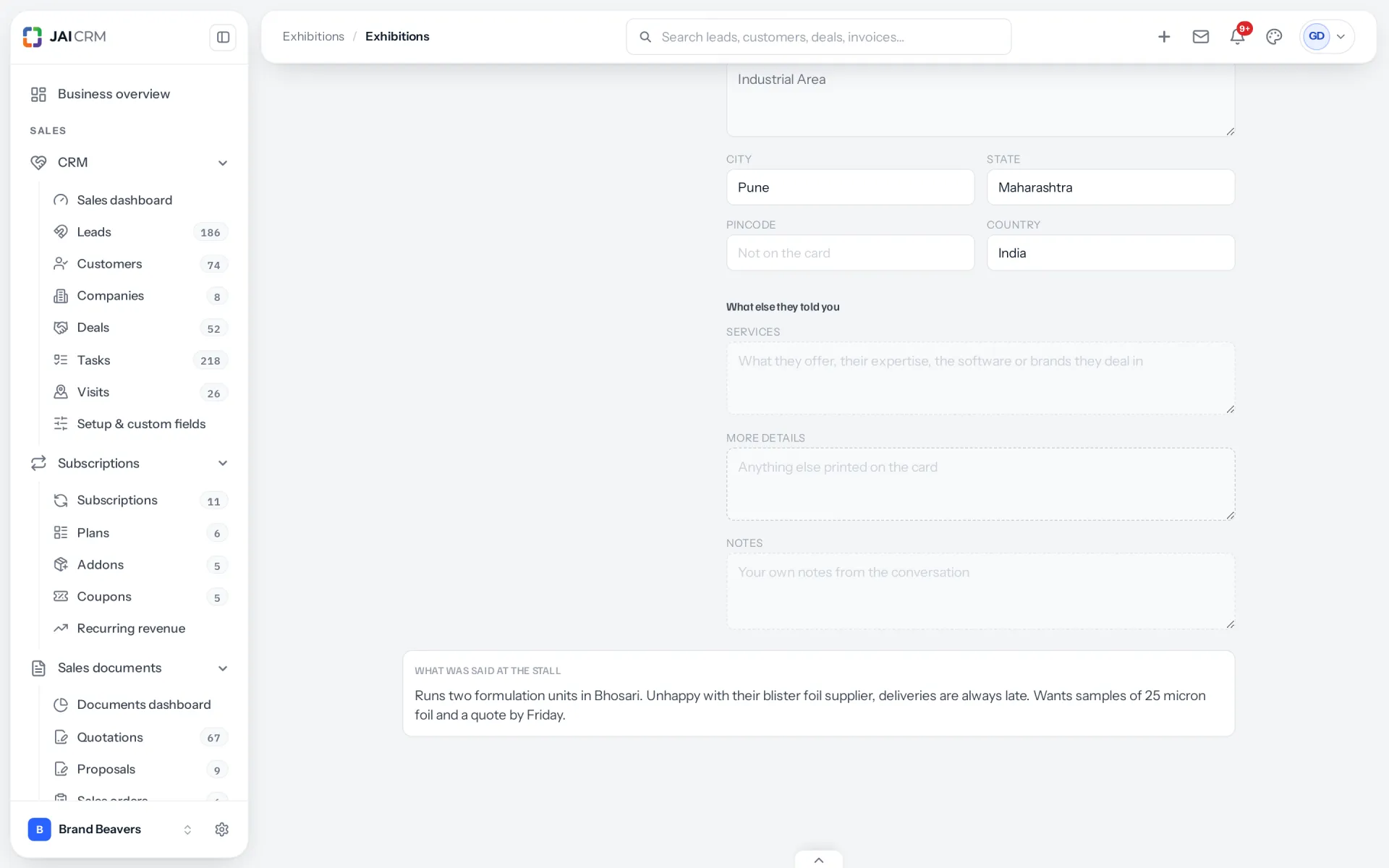
- Where you grade: on a phone with signal, taking a card opens it. Once the fields fill in, usually within a few seconds, How warm shows three buttons: Hot, Warm and Cold. Press one (press it again to clear it), choose File it as (Lead, Customer or Supplier) and press Keep it.
- With no signal: the card waits on the phone and opens for checking once it has been sent. Grade it then, from the exhibition’s Still to file tab. Meanwhile, hold its photograph on the scan screen to record a voice note (“Hold the photograph to say why they mattered”), and say the grade first.
- Grade before you file: once a card has become a lead or a customer, its grade is fixed, so the report compares what you thought at the stall with what happened.
- Follow-up timing is the same for every grade. Each card filed as a lead or customer raises a task such as “Follow up: Swati Joshi”, due 48 hours later, whether the card is hot, warm or cold. No screen changes the 48 hours. The grade decides what you do when the task comes up: a call for hot, an email for warm, something useful for cold.
- The voice note travels with the person. The task carries the voice note word for word, under “What was said:”, while the grade stays with the card and feeds the report. So say the grade first (“Hot. Wants a quote by Friday.”) and whoever makes the call sees it. The card’s Notes go into the record’s Notes too.
- A lead’s own Rating is a second grade. Leads also have a Rating field (Hot, Warm, Cold), set on the lead’s page; the Leads board can be grouped by it. Filing a card does not fill it in. Set it after your first call, and you have a stall grade and an after-the-call grade to compare.
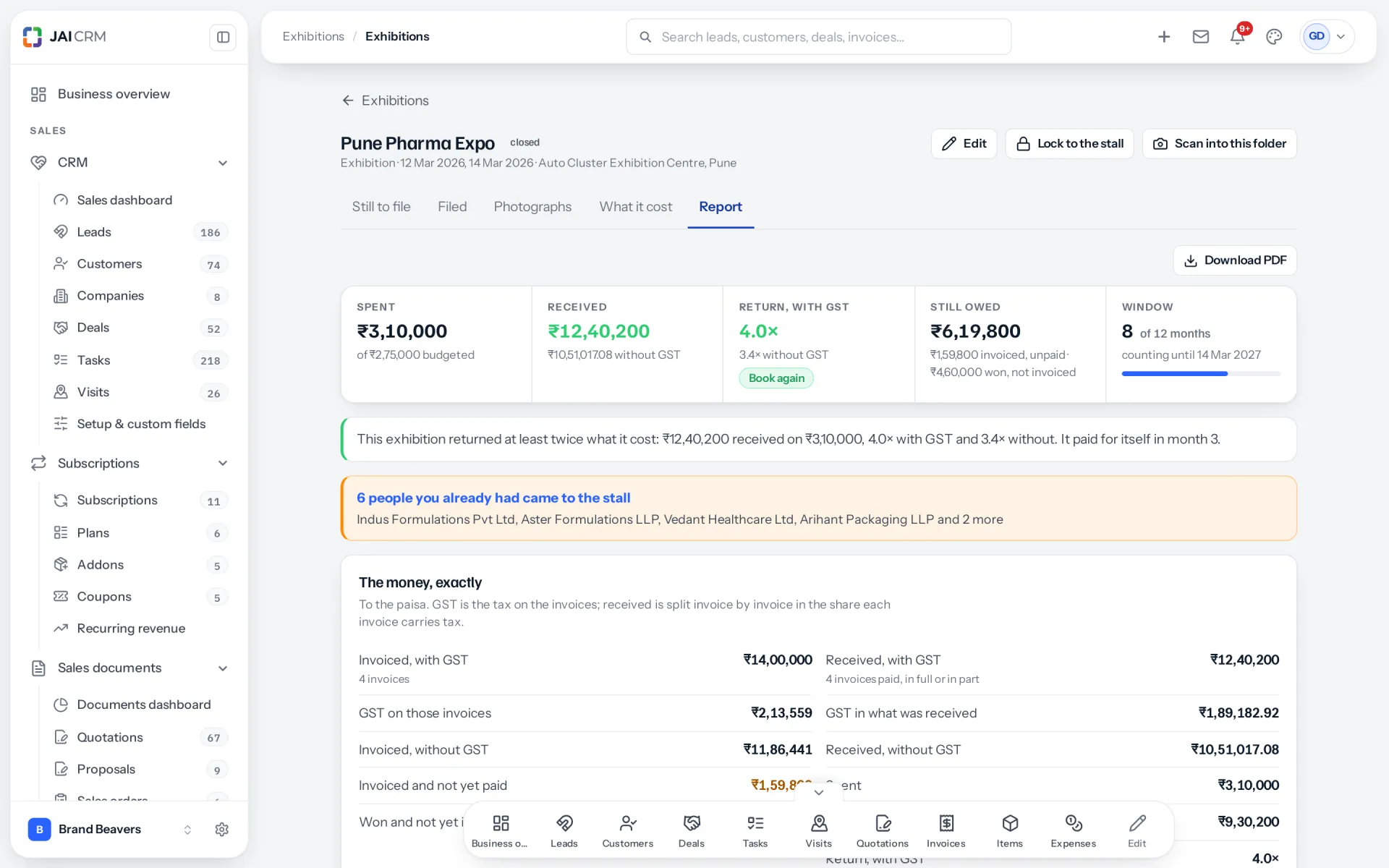
The Hot, warm or cold section of the report
Each exhibition’s Report tab has a section called Hot, warm or cold: “How the people at the stall were marked, and how many of each became a deal.” Rows for Hot, Warm, Cold and Not marked show the number of cards and a line such as “13 became a deal · 41%”.
Three things to know when you read it:
- It counts every card scanned into the exhibition, filed or not. File the Still to file queue first, or unfiled cards sit in the counts with no chance of a deal.
- A card counts as a deal when its lead or customer has a deal credited to that exhibition, open, won or lost. For what was won and paid, read Deals from this exhibition and Who paid the most on the same report.
- Not marked also holds cards nobody needed to grade, such as suppliers you met. Read that row with suppliers in mind.
The section counts deals, not rupees. For what the fair earned, see What a stall was worth: the exhibition report and what your exhibition stall really earned; for who brought in the money, see which of your team brought in the money.
Common questions
What is a hot lead?
A hot lead has a clear need, money to spend and a timeline within roughly three months. They ask practical questions about price, quantity, delivery or a visit. Contact a hot lead within 24 to 48 hours, starting with a call.
What is the difference between warm and cold leads?
A warm lead has a real need but no timeline or budget yet. A cold lead is browsing or researching, with no need you could name. Warm leads need regular, useful contact; cold leads need an occasional reminder.
How do I qualify a lead at a trade fair stall?
Ask three questions: what do you use now, what is not working, and when do you want it fixed. The answers show need and timing within a minute, so you can grade the card before the next visitor.
Should I follow up cold leads from an exhibition?
Yes, but lightly. Send something useful within a week, then occasional updates. Some cold leads become customers months later, and a light touch costs little.
Does JAI CRM follow up hot leads sooner than cold ones?
No. Every card filed as a lead or customer gets a follow-up task due 48 hours later, whatever its grade, and no screen changes that. The grade decides what you do in that task, and the exhibition report shows how many of each grade became a deal.
Correct as of October 2026. The businesses, people, quantities, prices, call times and report figures above are examples, not real customers or results. The Exhibitions module was called Events until 10 October 2026.
Next
See it with your own data
Start free, import a spreadsheet of your customers, and raise a real GST invoice in the first ten minutes. No card, no sales call.