
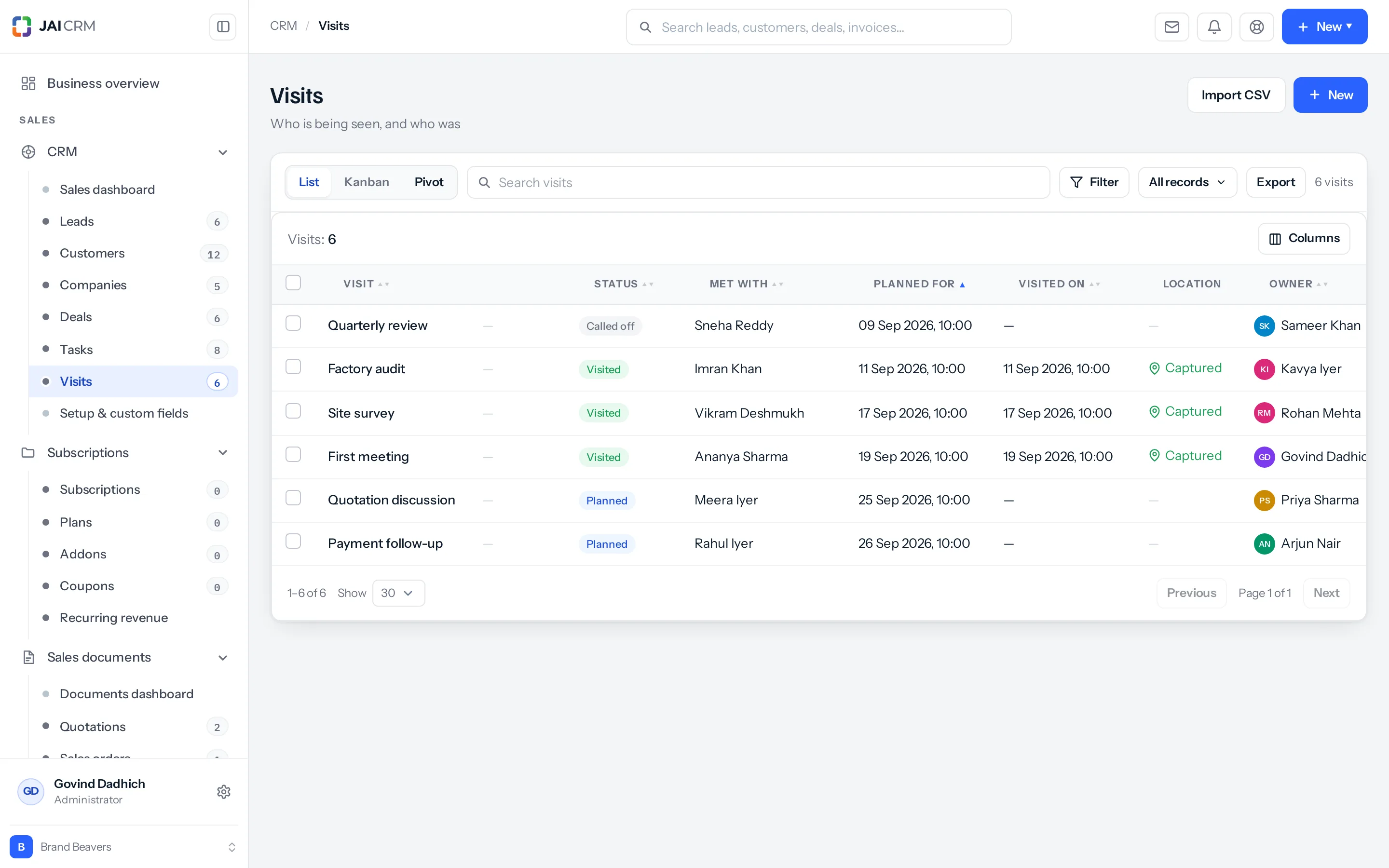
A visit is a trip to go and see somebody. It is its own record rather than a note, because a visit has things a note does not: somewhere it happened, somebody who was met, and a real difference between intending to go and having gone.
Planning one
- Go to CRM → Visits and click New. Or open a lead or customer and add the visit from there, which links it automatically.
- Write the purpose — why you are going.
- Set the planned date.
- Set the owner — who is going.
- Save.
The visit is now planned, and shows as a map pin mark on the customer’s row in the list until it is done.
Writing it up at the gate
This is the part that matters, and it is meant to be done on your phone, standing outside, not from memory on Friday afternoon.
- Open the visit on your phone.
- Mark it done.
- Type who you met. Not from a list — type the name as you find it, because the person who answers the door is very often not the person in the CRM.
- Write what was discussed.
- Tap to capture the location. The phone supplies it.
- Add photographs if there is anything worth showing.
- Save.
Why the location is captured and not typed
A visit where somebody typed the address is a claim. A visit carrying coordinates, an accuracy figure and the moment the phone reported them is a record. Those are not the same thing, and the difference matters to whoever reads it in March who was not there.
The accuracy is kept on purpose. “Somewhere within two kilometres” and “within eight metres” are very different evidence, and you cannot tell them apart from a pin on a map.
Calling one off
Set it to cancelled and say why. A cancelled visit is owed by nobody, so its mark disappears from the list — but the record stays, for the person who asks in March why nobody went.
Visiting suppliers too
A visit can be linked to a vendor as well as a customer, lead or deal. A supplier is visited as often as a buyer is, and the same record covers it.
What you can do with them afterwards
- Coverage. Visits by person and by week — who actually got out, and where.
- Proof. A customer saying nobody came, against a record with coordinates and a time.
- Handover. Somebody covering a territory can read what was said on the last three visits before they go.
Where to go next
Something missing or wrong here? Tell us. A question that needed asking usually means a page that needed writing.