
A deal is one specific piece of business you are trying to win. It has a value, an expected close date, an owner and a stage.
The board
Go to CRM → Deals and click Kanban. Each column is a stage; each card is a deal. Drag a card to move it.
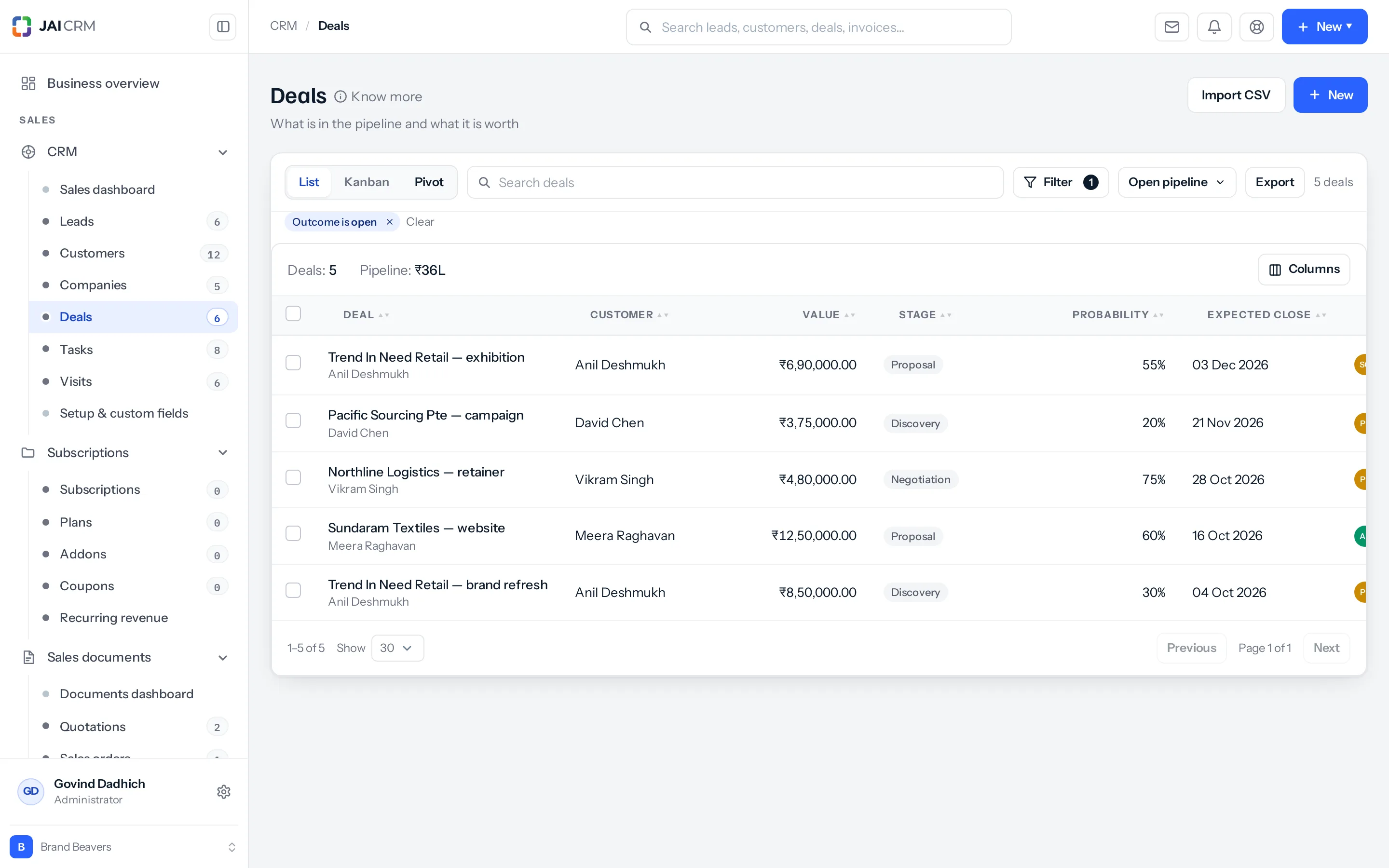
Two things about the board that sound small and are not:
- Where you drop a card is where it stays. Move it within a column and the position holds. A board that rearranges itself is a board people stop trusting, and then stop using.
- Columns stay put when a card leaves. They do not collapse or reflow under your hand.
Winning or losing a deal asks. Drop a card in a won column, or press the won stage on the deal’s own page, and a window asks the value it was won at, starting from the value it carried. The pipeline, the win/loss report and targets count that figure. A lost column asks why it was lost. Moving a deal between two won columns asks nothing.
Stages, and what a stage means
You name your own stages. But a stage is more than a label — each one carries two extra things:
| Setting | What it does |
|---|---|
| Probability | How likely a deal at this stage is to close, as a percentage. Used to weight your pipeline figure. |
| Category | Whether landing here means open, won or lost. |
Category is the important one. It is what lets you rename “Closed won” to “Order received” without your win-rate report quietly going to zero. The report asks the stage what it means, not what it is called.
More than one pipeline
A business selling new cars, used cars and servicing is running three different sales processes. The early stages rhyme; the closing stages do not. Forcing all three through one set of columns tells you nothing about any of them.
So you can have as many pipelines as you have processes, each with its own stages and its own default starting column. Set them up in Settings → Sales pipelines.
What each stage means also shows on the Deal stage list in Settings → Fields & rules → Lists, as Still open, Deal won or Deal lost beside the stage. It is the same setting: change it in either place and the other follows. A stage two pipelines use differently says Differs by pipeline there, and is changed in Sales pipelines.
Change what a stage means and the deals already on it follow: marked Deal won, each one is closed with a close date and an entry in its history; marked Still open again, they reopen. Before a change marks any deal won, a window says how many deals are on the stage and how many of them have no value. Press Go back to fill in their values first, or Save anyway. Changing a deal stage or a lead stage in Fields & rules, Lists asks the same, and for leads says they would be marked won without being converted to customers.
Grouping the board differently
The board does not have to be grouped by stage. Group it by owner to see whose desk is full, by source to see which channel is producing, by pipeline, or by a dropdown field you invented last week.
Whatever you choose becomes your default, per person. It is still there tomorrow, and it does not change what anybody else sees.
Losing a deal properly
Move it to a lost stage and record the reason and, if you know it, the competitor. Both are ordinary fields, and both become reportable. “We lose on price to one particular firm in the south” is a sentence you can only ever say if somebody wrote it down sixty times.
Where to go next
Something missing or wrong here? Tell us. A question that needed asking usually means a page that needed writing.