
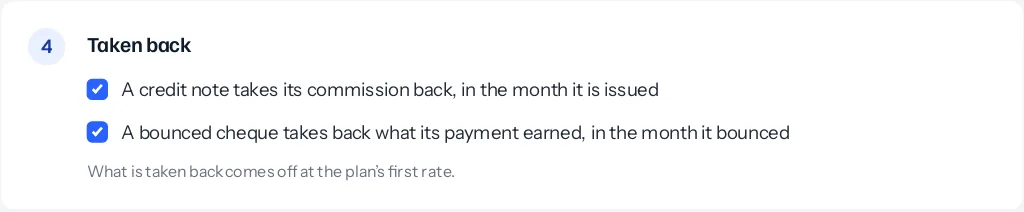
Commission is paid on sales that stay sold. Step 4 of a plan, Taken back, says what undoes a sale. Each is a tick box; leave one unticked to ignore it.
Credit notes
“A credit note takes its commission back, in the month it is issued.” It counts against the salesperson whose invoice it reduces, even when somebody in accounts raised it. On a plan paid on money collected, it takes back only what had been collected beyond what the invoice is now worth: a credit note for the unpaid half of a half-paid invoice takes back nothing, and one for the whole of a paid invoice takes it all. If nothing had been paid, nothing had been earned. TDS a customer keeps back counts as collected.
Bounced cheques
“A bounced cheque takes back what its payment earned, in the month it bounced.” A cheque recorded in September and marked bounced in October takes its amount off October’s count. September, possibly already approved and paid, is not reopened.
Invoices unpaid too long
On a plan paid on what is invoiced, a third box appears: “An invoice still unpaid after 60 days takes its commission back until it is paid.” On the day the days run out, what is still due comes off. When the money arrives later, it counts again in the month it arrives, as “Paid after it was taken back”. The salesperson is paid for the sale once, when it is real.
Write-offs
An invoice written off will never be paid. Where the plan takes back invoices unpaid too long, one written off stays taken back: writing off the balance does not give the commission back.
At what rate
What is taken back comes off at the plan’s first rate. On a plan with steps of 2%, 3% and 4%, a ₹20,000 credit note takes back ₹400. Taking it back at a higher rate would punish a salesperson more for a return than they earned on the sale, and lower steps cover most of anybody’s month.
Why in the month it happens
Approved months are what was agreed and paid. Going back and changing them would mean taking money out of a salary already paid. Taking it back in the current month keeps every approved statement fixed, and the line on the new statement says which invoice it came from.
Changes to a month already approved
Some things change an approved month after the event: a credit note dated back into it, a payment deleted or moved to another date, an invoice given to another salesperson. The next statement worked out puts it right. Each approved month is worked out again on today’s facts, and what each invoice or credit note now counts differently shows as a line marked Put right, naming it and the month, at the plan’s first rate, as every take-back is. Money that reaches an approved month late is paid the same way.
A statement can come out lower than zero if a large return lands in a quiet month. Approved, it is deducted from the next salary run, as long as the salary covers it; otherwise it waits for a later run.
On the statement
Each line taken back shows in red with a minus, says what it was, such as “Credit note against INV-0374”, and opens the credit note or invoice behind it. The statement’s Commission figure says how much was taken back in all.
Something missing or wrong here? Tell us. A question that needed asking usually means a page that needed writing.