
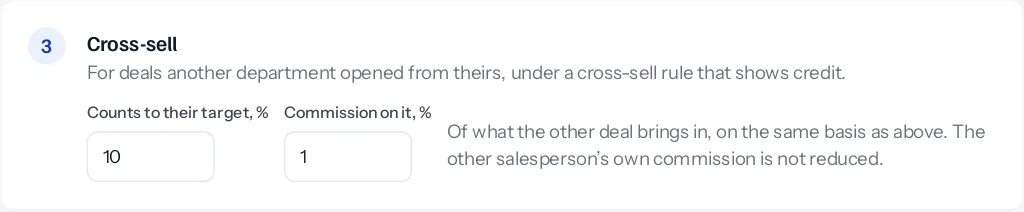
Where the Cross-sell module is on, a plan has a third step, Cross-sell. It rewards a salesperson for the customers they pass on. When their Tiles deal opens a Modular kitchen deal under a cross-sell rule, and the kitchen team brings money in from it, part of that money counts for the tiles salesperson too.
The two figures
- Counts to their target, %: the share of what the other deal brings in that counts towards the first salesperson’s target.
- Commission on it, %: the commission paid to them on the whole of what the other deal brings in.
With 10% and 1%: the kitchen team collects ₹2,00,000 on a deal opened from Rohan’s tiles deal. ₹20,000 counts to Rohan’s target, and Rohan is paid ₹2,000. On his statement the line reads “1% of ₹2,00,000”.
Nobody loses
The kitchen salesperson keeps every rupee of their own count and commission. Cross-sell credit is extra, paid on top, not taken from them. That matters: a team that loses commission when a colleague is credited soon stops accepting handovers.
Which deals
Only deals opened by a cross-sell rule whose step Credit for the first salesperson shows credit. With commission on, that choice reads “Shown in the cross-sell report, and shared through commission plans”. A rule set to None gives no credit in any plan.
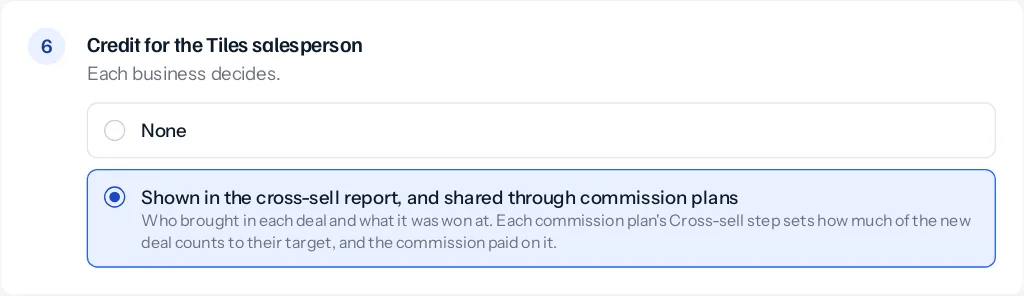
The other deal is counted on the same basis as the plan: money collected against its invoices, its invoices, or its value when won. The credit goes to whoever owned the first deal.
On My target
A cross-sell line shows as “Cross-sell share, 10%” with the share counted and the whole amount, so the salesperson can see exactly what counted and why.
Without the Cross-sell module, the step does not appear and nothing changes.
Leaving it out of one plan
Leave both figures empty, or set them to 0, and that plan gives no cross-sell credit, while other plans keep theirs. That suits a team whose customers are passed on by design, where crediting the first salesperson would pay twice for the same work.
Choosing the figures
Keep the commission share small next to the plan’s own rate, so passing a customer on is worth doing but never worth more than selling. A share counted to the target of 10% to 25% is common: enough to notice on My target, not enough to reach a target on other people’s work.
Something missing or wrong here? Tell us. A question that needed asking usually means a page that needed writing.