
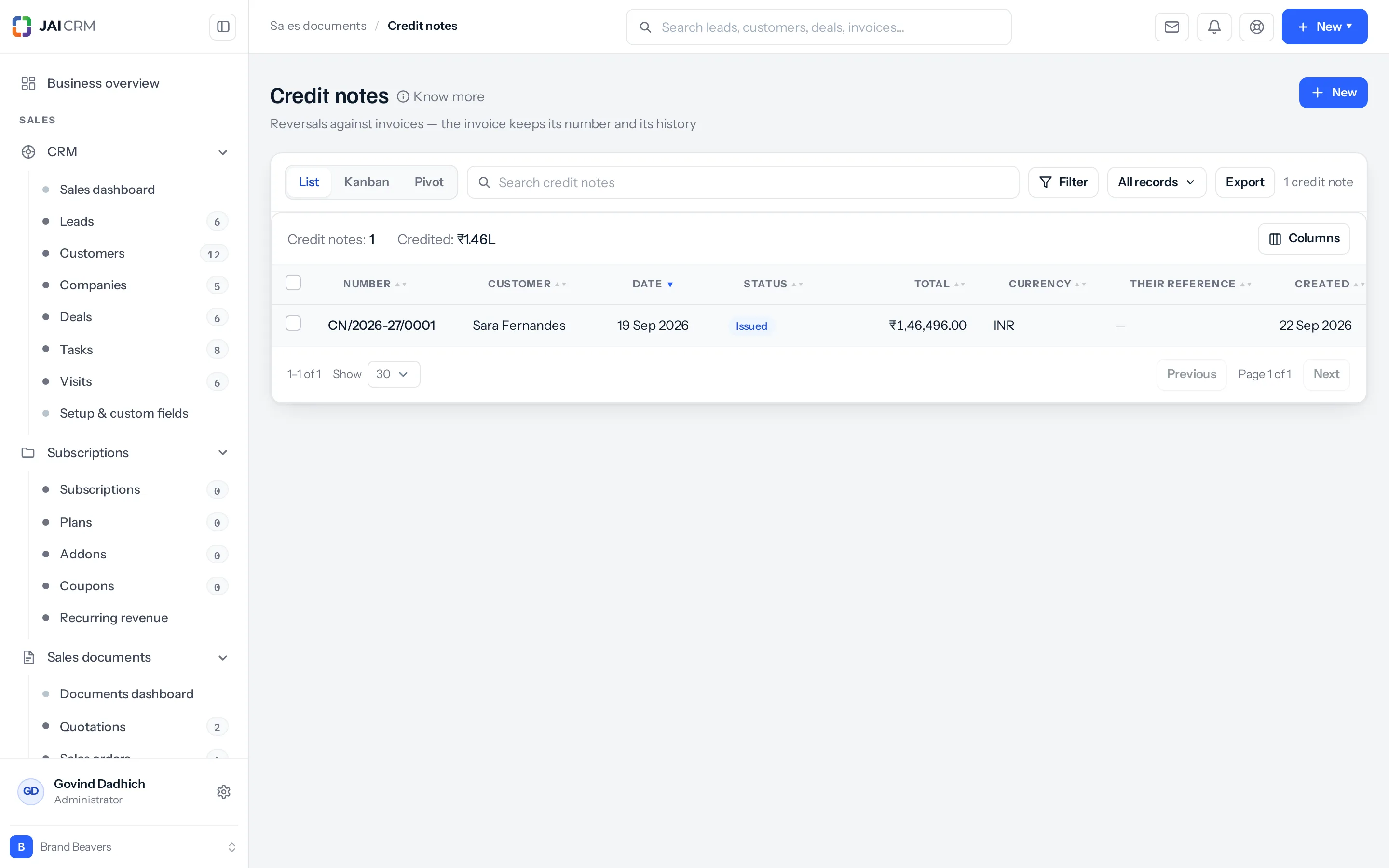
A credit note reverses part or all of an invoice. Goods came back, a rate was wrong, a service was not delivered.
Why not just edit the invoice
Because once it is sent it is final: it has gone out, it has a number, and under GST it has been reported. Changing it would leave the customer holding one document and you holding another with the same number. A credit note is the correct instrument: a second document that says what is being taken back. A draft, which nobody has relied on, is simply edited.
Cancelling a sent invoice is the same thing done in full: Cancel on its menu opens a credit note for its full value, drafted for you to check and issue.
Raising one
- Open the invoice.
- Choose Raise credit note.
- Keep the lines you are crediting and remove the rest. Change quantities for a partial return.
- Give the reason. It prints, and it is what somebody reads in March.
- Save and issue.
A credit note is dated on or after the invoice it reverses; one dated before it is refused. A bill of supply is credited the same way.
It nets, it does not float
The credit note is attached to the invoice it reverses. So the invoice’s outstanding amount goes down by the credited value, and your receivables figure is right without anybody adjusting it.
A credit note kept in a notebook is the commonest cause of a customer short-paying and nobody being able to say whether that credit was ever spent, spent twice, or spent against the wrong invoice.
What is left on it
A credit note is spent on its invoice when it is issued, as far as the invoice still owes. If the invoice was already paid, the rest stays on the note as the customer’s credit. The panel on the right of the note shows what is left to use. Apply to an invoice sets it against another of their invoices, and Refund it records the money going back, from the bank account you choose.
Each one can be taken back with ↺ beside it on the note, which puts the credit back on it. A refund is taken back there rather than from Payments made, so the note is put right too.
The tax comes back too
A credit note carries the same tax treatment as the lines it reverses, so the GST is reversed with the value. That is what makes it usable in your return rather than a note to yourself.
An example
- An invoice for 100 cartons at ₹500, with 18% GST. ₹59,000.
- 12 cartons come back damaged.
- A credit note is raised from that invoice for 12 at ₹500. ₹7,080 including tax.
- The invoice now shows ₹51,920 outstanding. Nobody adjusted anything.
When to raise one instead of editing
The rule is simple: once an invoice has gone to the customer, you do not change it. You raise a credit note against it.
| What happened | What to raise |
|---|---|
| You typed the wrong rate, and it is still a draft | Just fix the draft. |
| The customer returned goods | A credit note for the returned lines. |
| You agreed a discount after invoicing | A credit note for the difference. |
| You charged too little | A debit note for the difference. |
| The invoice was wrong and has been sent | A credit note for the whole of it, then a fresh invoice. |
| The customer will never pay | A credit note is not the answer. That is a write-off, and the two are taxed differently. |
A credit note is a GST document in its own right. It has its own number series, it appears in your returns, and it reduces your output tax. It is not a note and it is not a correction: it is an invoice pointing the other way.
What it does to the numbers
- The original invoice keeps its number, its date and its history. That is the whole reason to use one.
- The customer’s outstanding balance falls by the value of the note.
- Your output tax falls by the tax on the note, in the period the note was raised.
- Both documents stay visible, so the trail reads: this was invoiced, then this much was credited, and here is why.
That last point is what an assessing officer is looking for. A reduced balance with no document behind it is the thing that invites questions; an invoice and a credit note that reference each other answers them before they are asked.
Where to go next
Something missing or wrong here? Tell us. A question that needed asking usually means a page that needed writing.