
Every rule carries one more setting: when it is allowed to act. It sits on the rule itself, under Apply it, so two rules on the same module can behave differently — one claiming new enquiries, another correcting misfiled ones.
| <b>Apply it</b> | What it does | When you would use it |
|---|---|---|
| When a record is created | The rule decides the owner of new records only. Nothing that already exists is touched, ever. | The usual answer, and where every rule starts. Distributing enquiries as they arrive. |
| When a record is edited | The rule leaves new records alone and acts only when an existing one changes. | A record was filed under the wrong thing and gets corrected later. Rare on its own — most people who want this want Both. |
| Both — on create and on edit | Either moment. | A rule you want honoured however the record came to look that way. |
Rules written before this setting existed all read When a record is created, which is exactly what they already did. Nothing changed behaviour on its own on the day it arrived.
Pick anything other than When a record is created and a second dropdown appears beside it, On an edit. That is the next section, and it is the one worth getting right.
What "on edit" means is yours to choose
| <b>On an edit</b> | What it does |
|---|---|
| Every save that matches | The plain reading, and what a new rule starts on. Open a lead whose source the rule covers, press Save, and the rule hands it to whoever it names — even if somebody had moved it by hand an hour earlier. |
| Only a new match | The careful one. The record must not have matched the rule before this save and must match it now. Correcting a phone number on a lead the rule already covered leaves the owner alone. |
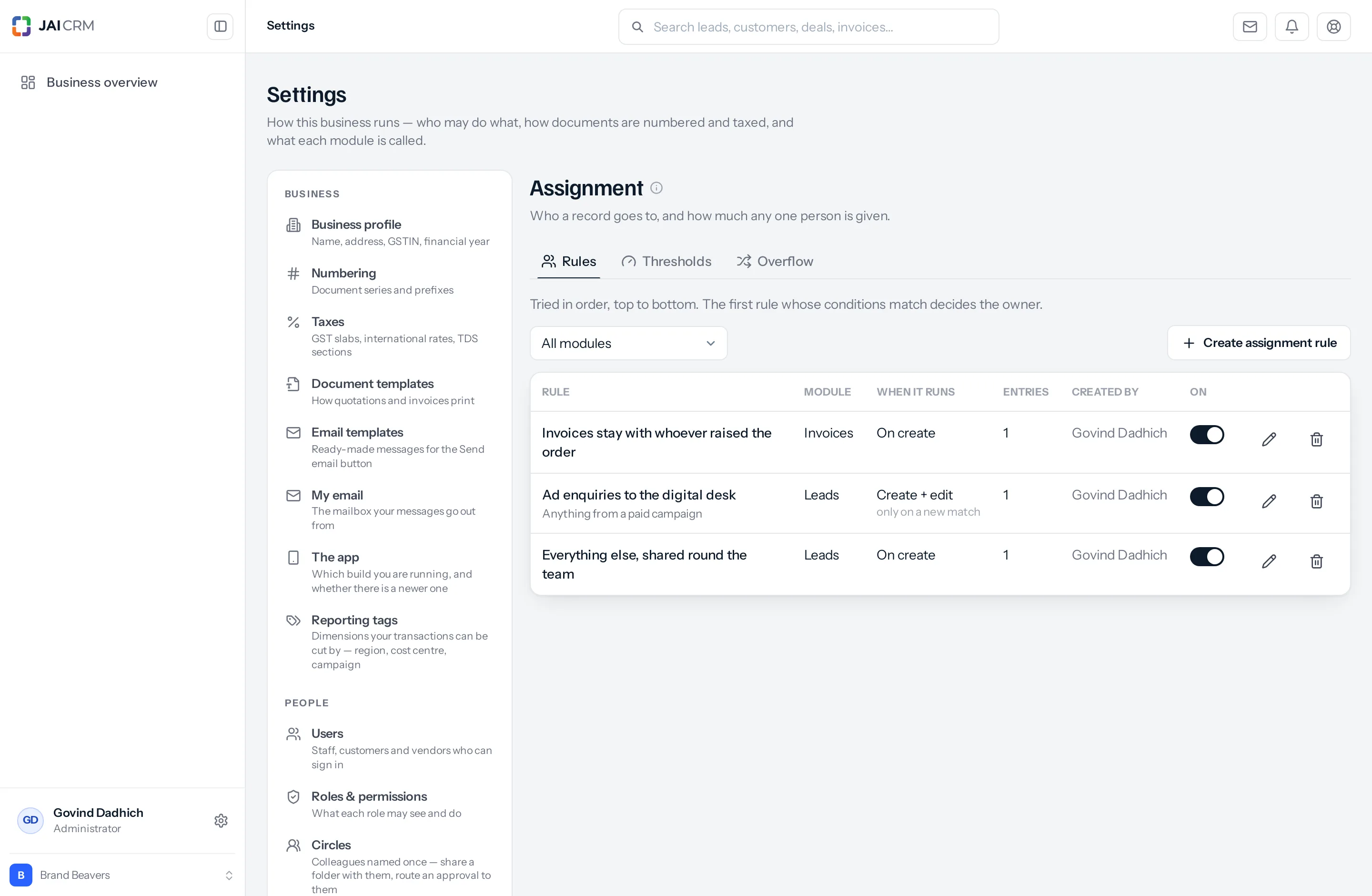
The list on the Rules tab shows both together: a rule set this way reads Create + edit in the When it runs column, with only on a new match in small grey type underneath. If that second line is missing, the rule is on Every save that matches.
Which of the two you want
Ask yourself one question: what should happen when somebody has deliberately moved a record and it is then saved again?
- Every save that matches — the rule is the final word. Right when it expresses a standing arrangement nobody may quietly opt out of: every enquiry from an ad belongs to the ads desk, whoever has touched it since.
- Only a new match — a person’s decision is the final word, and the rule steps in only when something genuinely changed into its territory. Right almost everywhere else.
Watch the rotation on “every save that matches”. Where an entry names several people it hands records out in turn — so each save moves the record on to the next of them, and a lead edited four times in a morning has had four owners. With one person named, or with Only a new match, that does not arise. This is the single reason most rules should be on Only a new match.
A worked example
A rule covering Source contains Google Ads, handing to one person, set to Both:
| You do this | Every save that matches | Only a new match |
|---|---|---|
| Create a lead with source Google Ads | Assigns | Assigns |
| Change the source from Walk-in to Google Ads | Assigns | Assigns |
| Open a lead already sourced Google Ads and save it unchanged | Assigns | Nothing |
| Move it to somebody by hand, then save it again later | Takes it back | Nothing |
| Correct the phone number on a matching lead | Assigns | Nothing |
| Change the source from Google Ads to Walk-in | Nothing | Nothing |
Rows three to five are the whole difference, and they are all the same situation: a record that already matched, being saved again. The bottom row is identical under both, and worth saying plainly — a rule hands records out, and never takes one back because it stopped matching. Nothing becomes ownerless.
A rule with no conditions
An entry set to Every record covers everything, which makes the two settings behave very differently on an edit.
| On an edit | What a catch-all entry does |
|---|---|
| Only a new match | Never fires on an edit at all. It has always matched already, so there is no moment where it newly applies. Such a rule claims everything new and leaves everything existing alone — which is usually exactly right. |
| Every save that matches | Fires on every save in the module. With several people named, that reshuffles who owns what, continuously, for as long as the rule is on. |
The second is allowed because it is occasionally what somebody means. It is very rarely what they want, and it is worth reading that row twice before saving a catch-all rule set to Both and Every save that matches.
Choosing an owner still wins
On an edit, the same principle as on create: if that save is itself moving the owner, the person doing it has decided, and no rule overrules them.
| In that one save | What happens |
|---|---|
| You change the source and leave the owner alone | The rules decide, if the record qualifies. |
| You change the source and hand it to somebody | Your choice stands. |
| You clear the owner | That stands too — clearing it is a decision. |
On an edit this is judged properly, because the record’s current owner is already known. Unlike the New form, picking somebody by name here is always honoured — including picking yourself. That is the one asymmetry between create and edit, and it is in your favour.
Reassigning in bulk is never touched
Selecting records on a list and handing them to somebody is as deliberate as it gets. No rule looks at a bulk reassignment, whatever it is set to, and no threshold applies to it either. If you want fifty leads moved to one person regardless of their cap, that is how.
What goes wrong
| Symptom | Cause | Fix |
|---|---|---|
| Editing a record changes nothing | The rule is on When a record is created. | Set Apply it to Both. |
| A record you moved by hand keeps springing back | A rule is on Every save that matches and the record still matches it. | Set On an edit to Only a new match — or accept it, if the rule is meant to be the final word. |
| Owners shuffle round the team for no reason | A catch-all entry, on Both and Every save that matches, naming several people. | Switch it to Only a new match, which stops it acting on edits entirely. |
| New records are not assigned but edited ones are | The rule is on When a record is edited rather than Both. | Almost always meant to be Both. |
| You changed the source and nothing happened | That save also moved the owner — so your choice stood, as designed. Or the record already matched, on Only a new match. | Read the record’s assignment note; it says which. |
Where to go next
Something missing or wrong here? Tell us. A question that needed asking usually means a page that needed writing.