
Step 3 of a rule decides the new deal. The first deal is never changed: the rule only reads it.
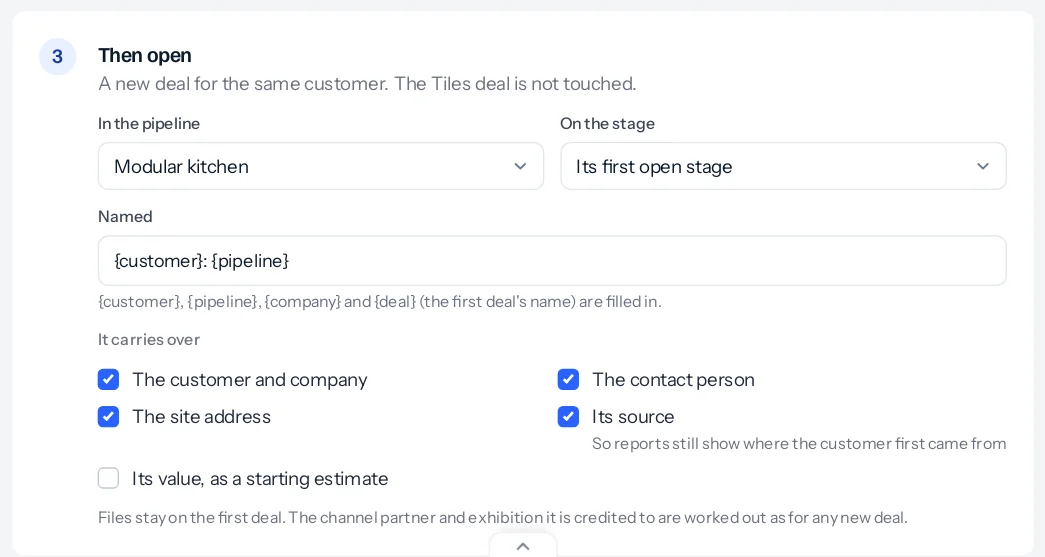
Pipeline, stage and name
- In the pipeline: any pipeline except the one the rule starts from.
- On the stage: the pipeline’s first open stage, or any open stage you choose. A new deal never starts won or lost.
- Named: a pattern. {customer}, {pipeline}, {company} and {deal} are filled in from the customer, the new pipeline, the customer’s company and the first deal’s name. The default gives names like Sharma Residence: Modular kitchen.
What comes across
- The customer and company, always.
- The contact person, if ticked and the first deal has one.
- The site address, if ticked and the first deal has one.
- Its source, if ticked, so reports by source still show where the customer first came from, such as Walk-in.
- Its value, as a starting estimate, unticked to start with. A kitchen is not worth what the tiles were, so most businesses leave it empty for the new owner to fill in.
Files stay on the first deal. The handover note says what was quoted and where the work is, so the new owner rarely needs them; if they do, they ask in the deal’s Charcha conversation.
Credit that works itself out
A deal a rule opens is treated like any new deal for that customer. If the customer was referred by a channel partner and is still inside the partner’s window, the new deal is credited to the partner too. If the customer came from an exhibition, the deal is counted for that exhibition. The probability comes from the starting stage, as it does for a deal made by hand.
The new deal also records where it came from: Cross-sell from names the first deal, and the line under its title says who brought it in and when. See Cross-sell on a deal’s page.
After it opens
The new deal is an ordinary deal from the moment it opens. Its owner can rename it, change its stage, value, contact person or site address, and raise quotations from it like any other. Only Cross-sell from stays as it was, so the deal always knows where it came from.
What came across was copied once, when the deal opened. Changing the first deal’s site address afterwards does not change the new deal’s, and the other way round.
Something missing or wrong here? Tell us. A question that needed asking usually means a page that needed writing.