
Every business passes customers on at a different moment. A tiles showroom may want the kitchen team in once the tiles are chosen, before installation. A kitchen maker may only want wardrobes mentioned once the kitchen is paid for. A lighting firm may want to call ten days before the electrician arrives. Step 1 of a rule covers all three.
Reaches a stage
Choose the pipeline and the stage. The rule starts when a deal in that pipeline is on that stage or any later one that is not lost, or is won. So a deal that skips straight from Quotation sent to Installation still counts as having passed Tiles finalised. The order comes from the pipeline’s stages in Settings, CRM, Pipelines.
Renaming a stage or a pipeline does not break the rule, because it remembers which stage it means, not its name. Removing the pipeline does: the rule’s card then says the pipeline was removed and asks you to choose another.
Is won
The rule starts when a deal in the pipeline is won, at the value it was won at. Whichever way the deal was won counts: the stage on its page, the board, the close dialog, or a won quotation.
Comes near a date on it
Choose a number of days, before or after, and a date on the deal. Expected close is there, and so is every date or date-and-time field you added to deals in Fields and rules, such as an Installation date. Actual close is not offered, because by then the deal is over.
- The deal opens at 9 in the morning on that day. If the day has already passed when the date is filled in, it opens at once.
- If somebody moves the date, the day it opens moves with it.
- If the date is cleared before the day comes, nothing opens.
- A date rule has no separate wait: the days before or after are the wait.
How the rule notices
A deal can reach a stage in many ways: its own page, the board, a bulk change, an import, a won quotation. Rather than depend on any one of them, every rule looks at the deals in its pipeline every five minutes and notes any that have got there since it last looked. So however a deal arrived, it is noticed within five minutes, and its History says so: for example, Reached Tiles finalised. A Modular kitchen deal opens on Fri 16 Oct.
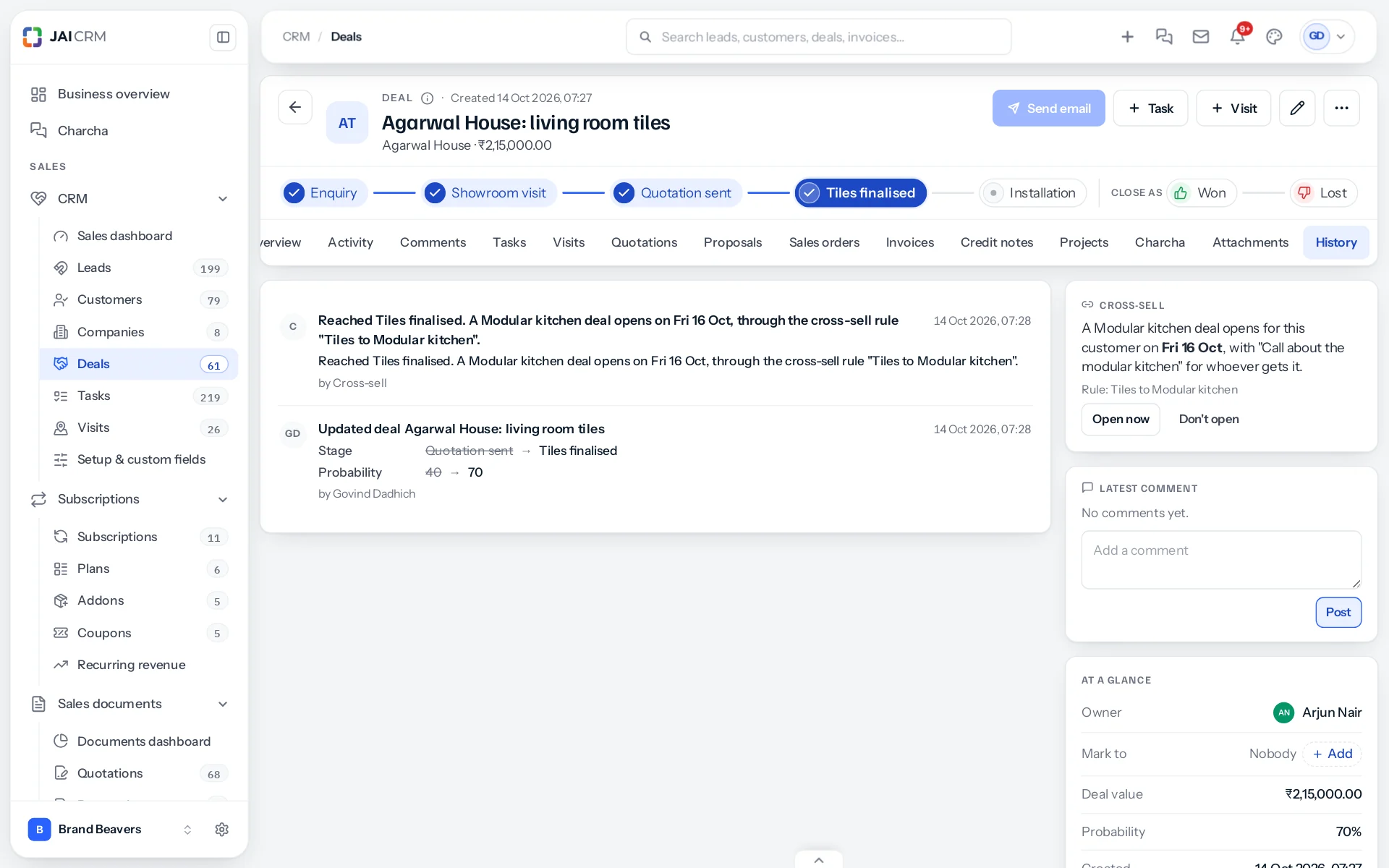
A deal is noted once per rule. Moving it back and forward again does not put it on the waiting list a second time.
Something missing or wrong here? Tell us. A question that needed asking usually means a page that needed writing.